Natural Gas
November 26, 2025
US EIA reports larger-than-expected 11 Bcf draw from gas storage stocks

HIGHLIGHTS
Platts' weekly survey called for 1 Bcf pull
Deficit to 2024 balance deepens
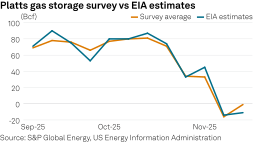
The US Energy Information Administration reported an 11 Bcf withdrawal from natural gas storage for the week ended Nov. 21, marking the market's second net pull of the season.
The EIA's Nov. 26 weekly storage update, published a day earlier due to the Thanksgiving holiday, was bullish to market expectations but smaller than the five-year average draw of 25 Bcf in the corresponding week, EIA data showed.
Platts, part of S&P Global Energy, asked gas market analysts on Nov. 24 for their storage expectations, and the consensus that emerged was a 1 Bcf withdrawal for the week ended Nov. 21.
On the 11 Bcf withdrawal, underground inventories declined to 3.935 Tcf, which was 160 Bcf, or roughly 4%, above the five-year average, EIA data showed.
Relative to 2024, a balance of 3.935 Tcf is 32 Bcf, or about 1%, below the year-ago storage level of 3.967 Tcf for the corresponding week.
In its first session as the prompt month, the January 2026 NYMEX Henry Hub futures contract traded up as much as 16 cents to an intraday high of $4.64/MMBtu before easing back, CME Group data showed. January futures closed the day up 7 cents to $4.55/MMBtu.
Supply and demand
In the week ended Nov. 14, the EIA reported the season's first net withdrawal from storage, of 14 Bcf. The US gas market was relatively more supplied in the week ended Nov. 21, thanks to higher dry gas production and softer demand, S&P Global Energy CERA data showed.
Roughly 500 MMcf/d in additional production week over week placed output at an average of 107.5 Bcf/d during the week.
At the same time, gas demand for domestic consumption declined week over week. Although power burn rose 1.6 Bcf/d to 34 Bcf/d, residential-commercial demand fell 1.8 Bcf/d to 27.4 Bcf/d, and industrial end-users required around 23.8 Bcf/d, down about 400 MMcf/d, CERA data showed.
LNG feedgas demand also softened slightly during the week ended Nov. 21, declining 200 MMcf/d to around 19.3 Bcf/d.
| Working gas in underground storage, US Lower 48 states | |||||||||||||||||||||
| Region | 11/21/2025 (Bcf) | 11/14/2025 (Bcf) | Net change | Year ago (11/21/24) (Bcf) | % change | Five-year avg (2020-2024) | % change from five-year avg | ||||||||||||||
| East | 892 | 905 | -13 | 929 | -4 | 903 | -1.2 | ||||||||||||||
| Midwest | 1,103 | 1,112 | -9 | 1,135 | -2.8 | 1,099 | 0.4 | ||||||||||||||
| Mountain | 292 | 292 | 0 | 292 | 0 | 239 | 22.2 | ||||||||||||||
| Pacific | 319 | 322 | -3 | 310 | 2.9 | 284 | 12.3 | ||||||||||||||
| South Central | 1,329 | 1,316 | 13 | 1,300 | 2.2 | 1,250 | 6.3 | ||||||||||||||
| Salt | 360 | 352 | 8 | 352 | 2.3 | 340 | 5.9 | ||||||||||||||
| Nonsalt | 969 | 963 | 6 | 947 | 2.3 | 910 | 6.5 | ||||||||||||||
| Total | 3,935 | 3,946 | -11 | 3,967 | -0.8 | 3,775 | 4.2 | ||||||||||||||
| Source: US Energy Information Administration | |||||||||||||||||||||
Outlook
For the week in progress that will end Nov. 28, S&P Global Energy CERA's supply-demand model projects a 29 Bcf net withdrawal from storage. A draw that size would be bearish relative to the five-year average of 43 Bcf and would push storage surplus to 2020-2024 to nearly 5%, EIA data showed.
So far, production is trending more than 1 Bcf/d higher Nov. 22 to date, while the market has seen a large drop-off in gas-fired power burn, CERA data showed. Power burn over Nov. 22-26 was modeled at just shy of 32 Bcf/d over the last few days, down some 2 Bcf/d relative to the prior week.
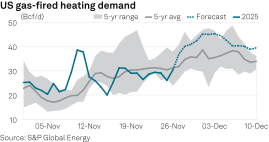
Residential-commercial demand has begun to climb, however, and is expected to exceed normal levels well into December if current forecasts are realized, S&P Global Energy CERA's 14-day demand outlook indicates. Over the next two-week period, Texas and the Midcontinent are expected to experience temperatures as much as 14 degrees Fahrenheit and 17 F, respectively, below typical levels, potentially driving a heavier reliance on inventories to meet demand for heating.
As of Nov. 26, the total US heating demand forecast over the same period is 41.5 Bcf/d, nearly 6 Bcf/d above the five-year average.

Editor: