LNG, Natural Gas
November 24, 2025
TTF gas breaks Eur30/MWh floor amid Ukraine talks, bearish fundamentals
HIGHLIGHTS
Ukraine, US say weekend talks ‘highly productive’
Traders see risk premium easing
Higher LNG imports, mild weather assuage upside pressure
European natural gas prices dipped below Eur30/MWh in early trading Nov. 24 amid growing hopes of a Russia-Ukraine peace deal and with market watchers relatively relaxed about supply-demand fundamentals for this winter.
The Dutch TTF December 2025 contract fell to as low as Eur29.20/MWh in intra-day trading during the morning of Nov. 24, according to ICE data.
Platts, part of S&P Global Energy, last assessed the TTF month-ahead gas price below Eur30/MWh on May 15, 2024, when the index sat at Eur29.61/MWh.
The breaching of the recent price floor comes as market participants monitor the potential for a ceasefire in the Russia-Ukraine war.
Representatives from the US and Ukraine met Nov. 23 in Geneva to discuss a peace proposal put forward by the US last week. In a subsequent joint statement, the two governments said the weekend meeting was "highly productive" and agreed to "continue intensive work on joint proposals in the coming days."
The Nov. 24 fall is "just a reaction to alleged progress in the [Ukraine] talks," a Bulgaria-based trader said. "We sold every instance of peace news this year. Don't see why this time should be different."
A UK-based analyst agreed. "We've seen a weakening geopolitical risk premium creep into the market," the analyst said.
A barrage of Russian attacks on Ukraine's energy system in recent months has hampered the country's gas system, with deputy energy minister Roman Andarak saying earlier this month that Ukraine had lost 40% of its domestic production.
The country needs to import an additional 4.4 Bcm of gas for the current heating season, a presentation from the energy ministry showed.
Fundamentals
More immediate market fundamentals are further driving the price slide, market watchers said, with near-term weather projections offering limited upside for gas demand in Europe.
"Forecasts remain mild and windy for the next two to three weeks," a Netherlands-based trader said. "Only a sustained cold spell would materially tighten the market. Short cold snaps are manageable, as we've repeatedly seen in recent winters."
"The winter risk premium was pretty much the main reason holding up TTF over the past two months," a second UK-based analyst said. "Now is about time to sell as weather still look[s] warm."
Supply-side concerns are also abating in Europe, despite lagging gas storage stocks. EU-wide gas storage sat just above 79% full as of Nov. 22, according to the latest data from Gas Infrastructure Europe. That is nine percentage points lower than the same time last year, when storage was just above 88% full.
Nevertheless, robust LNG shipments are tempering concerns over the storage deficit.
The EU is slated to bring in some 8.2 million mt of LNG across November, according to the latest data from S&P Global Energy CERA. This is roughly 17% higher than the 7 million mt imported over the same period in 2024.
"I don't think low storage is something to be overly concerned about unless Asian demand kicks in" or a severe cold spell drives up demand "significantly," the first UK-based analyst said. "The main supply concern is whether there will be sufficient European [regasification] capacity to cope with an unexpectedly large increase in LNG supplies."
A fifth source, an LNG trader, said the market has reached a "tipping point" and is confident Europe should be well supplied for the rest of winter.
A Portugal-based trader voiced a similar sentiment. "I'm on bearish mode," the trader said.
Asia demand
However, market watchers also see a limit to the downward pressure on European prices if lower levels spur LNG demand in Asia.
"If prices fall too much, now we might see Asian (Chinese) demand resurrecting, which we know can move quite a bit of million cu m/d all at once," another Europe-based analyst said.
Lower downstream demand and elevated domestic gas production have led China to pull back on LNG purchases over the past year. Imports from January to October were down 16.2% year over year at 53.15 million mt (73.3 Bcm), recent customs data showed.
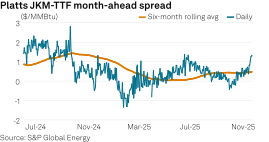
In recent days, the spread between the Platts JKM benchmark for spot LNG cargoes delivered into Northeast Asia and the TTF month-ahead gas price has widened, reaching $1.298/MMBtu on Nov. 21, its highest point since June.

Editor: