Natural Gas
November 13, 2025
Ukraine’s gas sector faces limited impact from energy minister resignation: analysts

By Matt Hoisch
HIGHLIGHTS
Grynchuk resigned Nov. 12 amid corruption probe, denies illegal acts
Market watchers anticipate relative stability from ministry, major companies
Naftogaz inked $148 million EIB grant for gas Nov 13
The resignation of Ukrainian energy minister Svitlana Grynchuk on Nov. 12 following allegations of a far-reaching corruption operation in the country's energy sector should not pose an immediate threat to energy security, market watchers told Platts, although the scandal is expected to fuel headwinds to the country's wider diplomatic efforts.
Grynchuk announced her resignation on Facebook amid growing outrage over an alleged scandal outlined earlier in the week by a Ukrainian anti-corruption agency. Justice minister German Galushchenko, who was Grynchuk's immediate predecessor as energy minister until she took up the post in July, also resigned.
The National Anti-Corruption Bureau of Ukraine (NABU) said Nov. 11 it had unearthed "a large-scale corruption scheme to influence strategic state-owned enterprises," following a 15-month investigation with the country's Specialized Anti-Corruption Prosecutor's Office.
The alleged operation primarily saw contractors for state nuclear company Energatom being "forced to pay kickbacks" to maintain relations with the company, according to NABU. The scheme saw roughly $100 million pass through money laundering operations, it said.
NABU said Nov. 11 detectives had detained five individuals and notified seven others they were suspects, including "a former advisor to the Minister of Energy".
Grynchuk denied undertaking illegal activity in her Nov. 12 Facebook post.
"Within the scope of my professional activities, there were no violations of the law," she wrote. "Such facts cannot exist in principle."
Operational stability
Mykhailo Svyshcho, a Ukraine-based analyst with ExPro Consulting, does not expect Grynchuk's resignation to challenge the country's wider energy system.
"While the Ministry of Energy plays a role in coordinating the sector, the main operational responsibility for the stability of both the power system and the gas sector lies with large state-owned companies such as [transmission system operator] Ukrenergo and [oil and gas company] Naftogaz," he said.
The broader ministry staffing is also stable, he said.
"All deputy ministers and department heads remain in their positions, ensuring continuity and minimizing the risk of disruptions to the ministry's ongoing processes," Svyshcho added.
A second Ukrainian analyst agreed the resignation should not affect gas sector operations.
Grynchuk "had experienced deputies who were in the industry for a long time," he said. "Nothing will change if we see a reshuffle of the ministry."
Others, however, are less sanguine.
"Without clear government leadership, Naftogaz may face difficulties in guaranteeing enough gas imports from the West," said Martin Vladimirov, director of the Energy and Climate Program at the Center for the Study of Democracy, a think tank.
The second analyst disagreed that Naftogaz would struggle operationally in the fallout from the scandal. He argued allied countries would distinguish between the energy ministry and the country's core energy companies.
"Allies trust these companies," he said. "I don't think this scandal will change allies' minds regarding these companies."
A spokesperson for Naftogaz declined to comment.
In a sign of continued trust, the European Investment Bank granted Naftogaz a further Eur127 million ($148 million) for gas purchases, the company said Nov. 13. This comes on top of a Eur300 million loan from the EIB agreed for gas purchases in early October.
The latest grant is provided by the EU with financial support from Norway, it said.
Political fallout
Even as market watchers expect Ukraine's gas sector to carry on relatively unimpeded by Grynchuk's resignation, the scandal creates headwinds for the country's continued diplomatic efforts.
The European Commission praised the effectiveness of Ukraine's law enforcement, while also cautioning that the country's capacity to counter corruption is vital as it works to join the EU.
"This investigation shows that the anti-corruption bodies are in place and functioning in Ukraine," an EC spokesperson told Platts Nov. 13. "The role of independent anti-corruption bodies, which are cornerstones of Ukraine's rule of law as a future Member State, must be safeguarded. The Commission will continue to follow the situation closely."
Some European governments have reaffirmed their support for Ukraine.
"At the moment, we have confidence in the government of Ukraine that it will take care of resolving this issue, as well as in the anti-corruption bodies -- that they will solve this case and bring it to its logical conclusion," Stefan Kornelius, Germany's federal government spokesperson, told media outlet Deutsche Welle on Nov. 12.
However, others who were already critical of aiding Ukraine have used the incident to reinforce their position.
Hungarian foreign minister Peter Szijjarto said the EU should cut off funding.
"Stop sending European people's money to Ukraine," he said late Nov. 12 on Facebook.
Market watchers do not foresee a major collapse in trust among allies, but the corruption allegations only add to the government's challenges as it seeks support to navigate the winter and the wider war with Russia.
"A lot will depend on how the Ukrainian government reacts," the second analyst said.
Gas stocking
Ukraine has focused on bolstering its gas system ahead of the winter amid sustained Russian attacks, most recently this past weekend.
In late October, Grynchuk said the country had stocked "sufficient" natural gas reserves ahead of the heating season but would continue building up further stocks "to ensure stability during the winter."
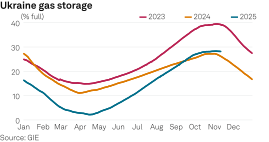
Total Ukrainian gas stocks sat around 12.8 Bcm as of Nov. 11, according to data compiled by S&P Global Energy.
However, some 4-5 Bcm of gas held in Ukrainian storage is cushion gas required for the technical operation of the country's storage sites.
Storage data published by Gas Infrastructure Europe showed working Ukrainian gas stocks at 90.1 TWh (8.5 Bcm) as of Nov. 11, or 28.2% of capacity.
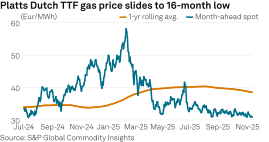
Ukraine's push to accumulate further gas reserves comes as European gas prices sit at a 16-month low.
Platts, part of Energy, assessed the benchmark Dutch TTF month-ahead gas price at Eur30.81/MWh Nov. 12, down 1.04% day over day. The index is at its lowest point since July 2024.

Editor: