09 Nov 2020 | 22:07 UTC — Houston
US ELECTIONS: Good assets are hedge against any adverse US political impacts: Kosmos

Highlights
US Gulf assets are lowest in cost, carbon for Kosmos
Continues tieback opportunities near existing platforms
US Gulf storm impacts in Q3 totaled 2,000 boe/d
The impact of the US election results on federal oil and gas leasing is still unknown, but the best hedge against adverse political effects is good assets, the top executive of Kosmos Energy said Nov. 9.
The jury is still out on any changes the incoming presidential administration of Joe Biden, declared victorious in a narrow and hotly contested election last week, will make regarding permitting on federal lands.
And with a government-sponsored offshore lease sale coming up Nov. 18 for US Gulf of Mexico acreage, some wonder if potential bidders may wait to participate until next March and a subsequent offshore sale when the new administration's agenda may be clearer.
US ELECTIONS: Biden declared winner of presidential race, faces challenges to energy agenda
US ELECTIONS: US RINs rally on Biden's likely enforcement of biofuel mandate
CAPITOL CRUDE: US energy outlook under Biden White House as Senate control still undecided
About a third of Kosmos' roughly 60,000 boe/d of total production comes from the US Gulf, which are its lowest-cost assets, Andy Inglis said during a third-quarter earnings call.
"If the quality of your assets is good, you can continue to compete irrespective of the government in power," Inglis said.
Kosmos did not participate in the March 2020 federal US Gulf lease sale, but was high bidder on four blocks in Lease Sale 253 in August 2019.
The company's Gulf of Mexico assets, which include a handful of operated fields mostly offshore eastern Louisiana, also have carbon content much lower than global averages, and are the lowest in carbon intensity in its portfolio, said Inglis.
US Gulf oil cost 'significantly' lower than elsewhere
"[They are] significantly lower than alternative oil production in the US," he said.
Less than a decade ago, dozens of companies operated in the US Gulf. But since oil prices first dropped to levels below $50/b in early 2015, and shale oil had shorter payback, fewer operators are left in the US Gulf.
The region produced a total of roughly 1.58 million b/d of oil in Q3, according to the US Energy Information Administration.
US Gulf tropical storms and hurricanes in Q3 impacted Kosmos' total production by nearly 2,000 boe/d as the company had 17 days of downtime in the quarter, sizeably more than the six days of total downtime typical for the six-month hurricane season, which ends Nov. 30.
Kosmos' net US Gulf production in Q3 was close to 18,000 boe/d (80% oil), around 10% lower than guidance. That was down 13% from Q2 and down nearly a third from Q3 2019.
All storm-related production that was offline has been restored, Kosmos' Q3 presentation slides said.
The company's Q3 total oil and gas production averaged 56,700 boe/d, down about 6% from three months earlier and down 18% from Q3 2019 as a more constrictive investment climate this year, stemming from low oil prices related to the coronavirus pandemic, tamped down activity.
In other operations, Kosmos' Ghana production averaged 28,100 net b/d of oil, down 2% from Q2 2020 and down 11% from Q3 2019. In Equatorial Guinea, its net production was 11,100 b/d, flat with Q2 2020 and down 3.5% from Q3 2019.
With the impact of the pandemic and the Gulf of Mexico storms, Kosmos' full-year net 2020 production is expected to be 61,000-62,000 boe/d.
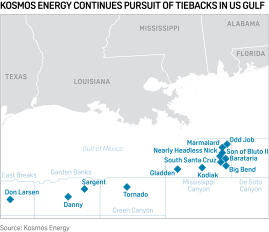
In the meantime, Kosmos continues to pursue near-term tieback opportunities around its existing US Gulf production platforms.
Winterfell well eyed for spudding in late 2020
For example, the company expects to spud an exploration well, Winterfell, later this quarter with results expected early in 2021, Inglis said. It will also begin a completion at a well around the existing Kodiak field in November and bring that online early in 2021.
The company has stakes in 13 fields that has production platforms, and operates five of them: Barataria, Kodiak, Odd Job, Sargent and S. Santa Cruz.
Q3 saw five storms that impacted the US Gulf Coast, including Laura and Delta, which were major hurricanes.
In other developments, Phase I of the Greater Tortue Ahmeyim natural gas project offshore Senegal/Mauritania is expected to be around 50% complete by year-end, with first gas online in Q1 2023, Inglis said. Phase 1 will deliver 2.5 million metric tons/y of LNG for export.
Tortue Phase 2 targets 5 million mt/y, and will leverage existing infrastructure, thus lowering project costs, Inglis added. Phase II, which has a delivered cost into Asia of just over $4/MMBtu, compares "very favorably" with other expansion projects, at least according to an analysis by energy consultants Wood Mackenzie, he said.
"We believe Phase 2 will be the most competitive brownfield LNG expansion project globally," he added. "Wood Mac expects a much tighter LNG market over the coming years, driven by growing global demand and the deferral cancellation of higher-cost LNG projects."