Electric Power, Natural Gas
October 09, 2025
Mexico’s robust power targets hinge on private sector, but clarity is key: execs

By Sheky Espejo
HIGHLIGHTS
Nearly 30 GW in five years seen as ambitious
Grid constraints, remuneration pose challenges
Mexico's new regulatory framework has reopened the door to private investment in the gas and power sectors after six years of paralysis. At the same time, it lays out an ambitious expansion plan for state utility CFE, but industry executives warned that speed, clarity, and viable remuneration mechanisms would be critical to achieve the country's energy goals.
Over the next five years, President Claudia Sheinbaum's administration has pledged to add nearly 30 GW of new generation capacity. Of this, 7 GW corresponds to delayed projects inherited from the previous government, while 6 GW are clean energy projects to be built by the private sector.
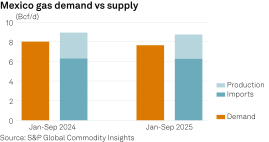
Mexico's installed capacity, mostly thermal, stood near 100 GW in 2025, according to S&P Global Energy. By 2050, that figure is projected to more than double, with gas-fired generation still expected to dominate. Practically all of the gas used in the country for power generation is imported from the US, as the little domestic production is reused by the state oil and gas company Pemex for its upstream operations.
Ambitious
"The government's plan is ambitious," said Abraham Zamora, head of Sempra Infrastructure in Mexico, noting that Mexico added roughly 34 GW of capacity over the last 15 years.
The framework's success hinges on three factors: flexible and clear planning, rapid deployment of rules and guidelines, and ensuring private investors can recover costs with attractive returns, Zamora said on Oct. 7 during the S&P Global Energy Mexico Briefing.
"Building 30 GW by 2030 is ambitious, but it means that the government is really counting on the private industry; otherwise, those plans are unthinkable," said Carla Medina, CEO of gas and power provider Saavi Energia.
Under the updated legal system, the state utility CFE has been given preferential treatment to produce and market electricity, while retaining exclusivity in transmission and distribution. Private participation will be complementary and guided by the government's binding planning process, called planeación vinculante, that determines where investment is allowed.
While the approach prioritizes areas where the state has an interest and excludes everything else, it is positive that the government is putting all technologies on the table, Medina said during the Energy Mexico Briefing.
Clarity
"With the binding planning, the industry will have no doubt on where they can participate and where they can't," Torres said, noting that the government is making progress in the design of the new legal framework.
Katya Somohano, head of Iberdrola Mexico, agreed during the event that there is now more certainty as the government continues to publish details of the new regulation, but noted that there are still many details in the new regulations that need to be known before companies can make investment decisions.
"There are still challenges, although progress is being made," she said.
Mexico's energy sector has enormous potential thanks to the cheap natural gas it has access to, she said, adding that the incorporation of energy storage in the grid is a positive but she cautioned that equipment availability, grid constraints, and remuneration mechanisms remain challenges that must be addressed to make private investments viable.
Arturo Carranza, head of energy projects at consultancy AKZA in Mexico City, explained that the government's next step is to publish a document that establishes the rules and guidelines that credit institutions must follow in their functioning and operation, called Disposiciones de Carácter General, and manuals.
"There is still plenty of work to be done and a lot we need to know," Carranza said.

Editor: