24 Aug 2020 | 21:07 UTC — Houston
US Gulf of Mexico operators shut in more oil, gas as twin storms race toward coast

Highlights
So far, 1.5 million b/d of crude, 1.5 Bcf/d of gas shut-in
Total 281 platforms shut in, 37 operators' reports say
New Orleans-area ports closed: US Coast Guard
Houston — US Gulf of Mexico upstream operators have shut more production, the US' Bureau of Safety and Environmental Enforcement said Aug. 24, as twin storms expected to make landfall virtually back to back raced toward the Gulf Coast.
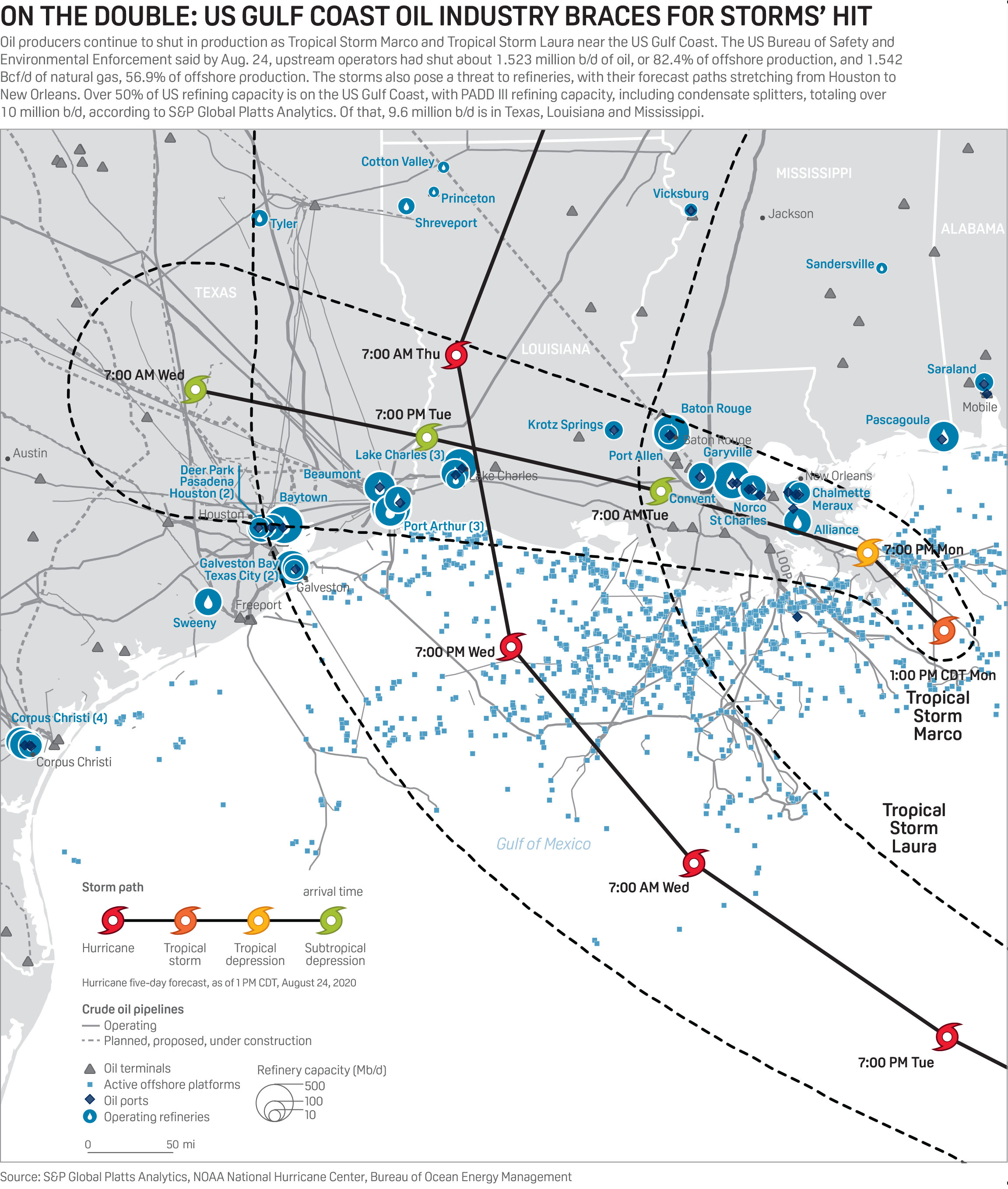
Domestic offshore operators have shut about 1.523 million b/d of oil from US Gulf platforms, or about 82% of the region's crude production, and 1.542 Bcf/d of gas, or nearly 57% of its gas output, BSEE said in its daily update. A day earlier, 57.6% of oil and 44.6% of gas production was shut, the agency said.
In addition, roughly 281 platforms, nearly 44% of the Gulf's total, had been evacuated as of 11:30 am CT Aug. 24 as Tropical Depression Marco and Tropical Storm Laura moved closer to the Gulf Coast. Also, six rigs, or 60% of the total in the region, had been evacuated.
Ten ports in the New Orleans area have been closed, the US Coast Guard said, and the Houston Pilots have halted inbound traffic on the Houston Ship Channel.
Click here for full-size image

HOUSTON, CORPUS CHRISTI PORTS OPEN
Houston-area and Corpus Christi-area ports remained open Aug. 24, but the USCG set port condition Whiskey, requiring vessel owners, operators and managers to review plans to depart or remain at port.
The Louisiana Offshore Oil Port (LOOP) said late Aug. 23 it had suspended operations at its Marine Terminal, although deliveries to its Clovelly Hub remained normal.
Most majors and large public operators have announced shut-in production, including BP, Shell, Chevron, Norway's Equinor and Australia's BHP.
Marco, which as recently as Aug. 23 had been a hurricane, is now projected to make landfall in eastern Louisiana late Aug. 24 as a tropical depression and head west through East Texas, according to the National Hurricane Center.
Laura, which has the more uncertain track and is considered potentially stronger and more dangerous, is forecast to make landfall as a hurricane late Aug. 26 or early Aug. 27 around the Texas-Louisiana border, according to the NHC. The storm is then forecast to head north into Louisiana and Arkansas before making a sharp turn east.
ACTIVE STORM SEASON
The 2020 Atlantic hurricane season, which runs June 1 to November 30, has already produced 11 storms, including three hurricanes, and was forecast to result in 20 storms (nine hurricanes and four major storms).
Activity is expected to be higher than the average and has the potential to significantly disrupt production from the US Gulf of Mexico and impact imports, exports and refining capacity in the area, S&P Global Platts Analytics said.
Year to date, about 67,000 b/d (annual average) of oil production has been disrupted, mainly from Hurricane Cristobal, and there's potential to significantly increase that total this year since the peak of hurricane season in mid-September is yet to come.
The largest impact on production in the past 15 years was 220,000 b/d in 2005, with hurricanes Katrina and Rita.
NYMEX October crude settled Aug. 24 up 28 cents at $42.62/b, as production losses in the Gulf of Mexico were offset by high inventories and low demand stemming from coronavirus pandemic.
However, the production outages boosted spot crude differentials for offshore grades. Heavy Louisiana Sweet crude was assessed by S&P Global Platts at a $2.75/b premium to cash WTI, $1.60/b stronger from Aug. 21, while medium sour crude Mars was assessed at a $2.25/b premium to WTI, up 45 cents.