24 Aug 2020 | 22:09 UTC — Houston
Storms threaten Gulf Coast power system, but load forecasts, prices stay firm
Highlights
Previous storms weaken power demand
Entergy utilities prep to restore service
Houston — As tropical storms Marco and Laura drench the central and western Gulf Coast with high winds and rain this week, tens of thousands of power customers could lose service, which would tend to sap power demand and day-ahead prices, but load forecasts and pricing were not reflecting the storms' potential impact on Aug. 24.
The US Energy Information Administration tracks the power loads for the three main independent system operators – the Electric Reliability Council of Texas, the Midcontinent Independent System Operator and the Southwest Power Pool – that lie in the path of the storms.
Although SPP has no footprint on the Gulf Coast, parts of SPP's Arkansas, Louisiana, Missouri, Oklahoma footprint are in the path of Laura's later stages through Friday.
Click here for full-size image

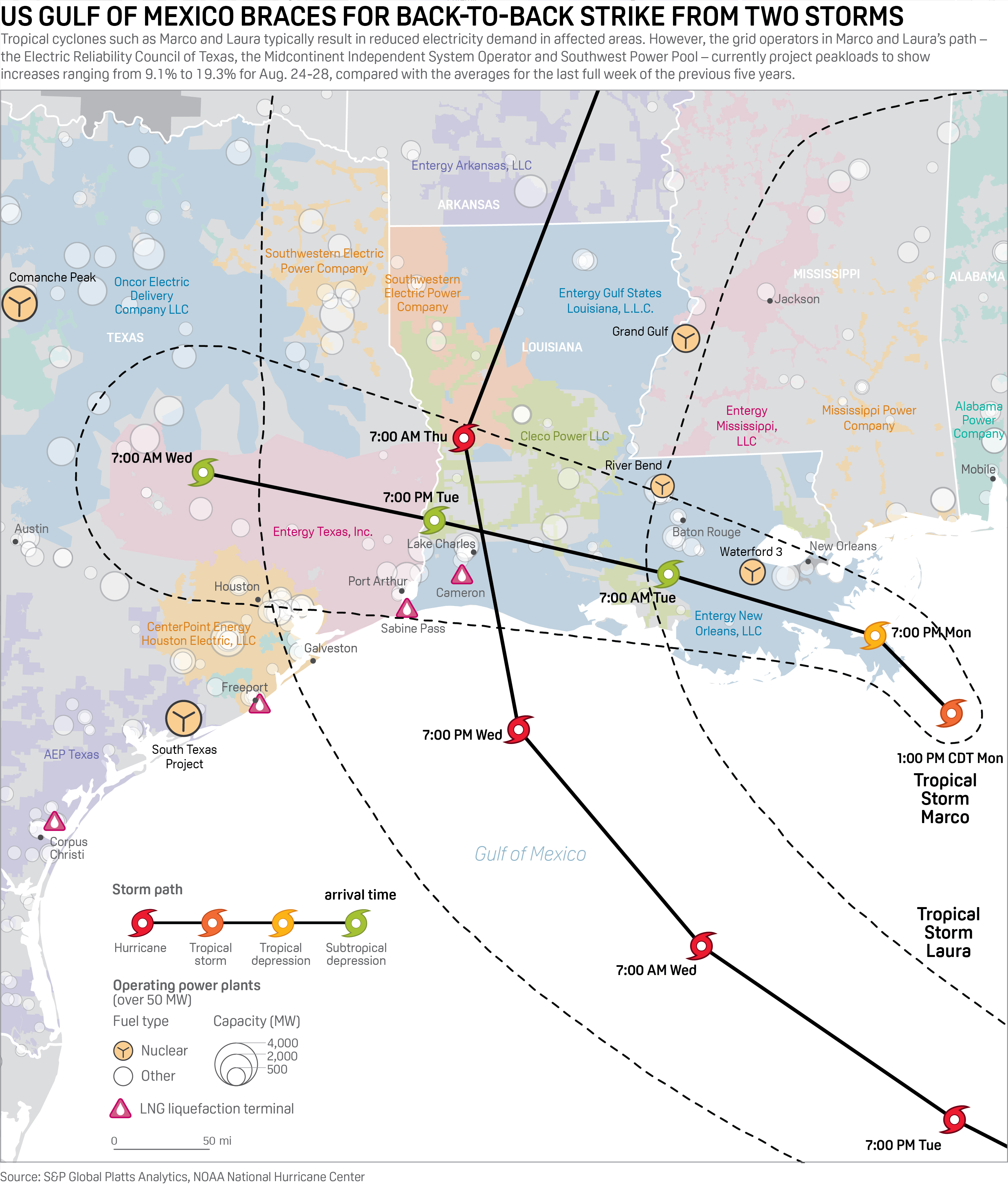
During the last full work week of August in the previous five years, ERCOT's peakload has averaged 63.8 GW, MISO's peakload has averaged 97.5 GW, and SPP's peakload has averaged 40.1. GW. ERCOT and MISO peakloads were skewed somewhat downward by 2017's Hurricane Harvey, which struck near Houston and southwest Louisiana, and caused widespread flooding and power outages.
Marco and Laura's impacts on load could vary widely depending on where the storms strike and wreak the most havoc. As Hurricane Hanna struck the South Texas Gulf Coast, ERCOT's peakloads dropped between 6.2% and 23% in different places compared with the same days of the previous week.
The load impact of the later cyclone Isaias on ISO New England, the New York Independent System Operator and the PJM Interconnection averaged about 20.3% across the three systems.
Load forecasts
However, each of the ISOs affected by Marco and Laura actually project increased peakloads the week of Aug. 24-28.
For example, ERCOT's latest load forecast indicates peakloads would average more than 69.6 GW the work week of Aug. 24-28, up 5.8 GW, or 9.1%, from the comparable work week for the previous five years. MISO's load forecast indicates a 16.9% increase, and SPP's forecast shows a 19.3% increase.
These forecasts appear not to consider the likely impact of reduced industrial power demand, as more than half of US refining capacity is on the US Gulf Coast, and the US Bureau of Safety and Environmental Enforcement said Aug. 24 that upstream operators had shut in about 57.6% of US Gulf oil production and 44.6% of Gulf natural gas production.
Also, Gulf Coast LNG terminals were preparing for the possibility of curtailing operations and issueing shelter-in-place orders to employees, but this may have little impact on the global LNG market, as Gulf Coast facilities have been driven by cargo cancellations throughout the summer.
As for power prices, ERCOT North day-ahead on-peak trading on Aug. 24 on the Intercontinental Exchange was trading at 44.69/MWh for delivery Aug. 25 and $45.83/MWh for the balance of the week, up from the $25.41/MWh for delivery Aug. 24.
And the SPP South Hub balance-of-month on-peak package was bid at $28/MWh and offered at $33/MWh on ICE, compared with a bid of $24/MWh and offer of $44/MWh for delivery Aug. 24.
MISO's Louisiana and Texas hubs had no trading activity on ICE Aug. 24.
The temporary reduction in natural gas output from the Gulf of Mexico may have prompted speculation for stronger power prices in the short term.
Storm restoration preparations
Entergy, the main investor-owned utility serving the MISO area threatened by the storms, has assembled a team of about 3,400 people, including its own workers, contractorts and support personnel to restore power and natural gas services, the company said in an Aug. 23 news release.
"Due to additional measures that must be taken because of the COVID-19 pandemic as well as the potential for impact from back-to-back storms, customers should prepare for extended restoration times, especially if there are widespread outages," Entergy said. "Our crews are prepared to restore service to as many customers as possible during the short window between the storms, but some customers may remain out through both events."
Entergy's subsidiaries have moved equipment from low-lying areas to higher ground and established flood protections elsewhere that could see high water, Entergy said. High water vehicles and drones have also been secured.
"Hurricane Marco and Tropical Storm Laura, combined with the pandemic, create a potential triple threat to Louisiana," said John Hawkins, vice president of Entergy distribution operations for Louisiana. "This has been an unprecedented year for everyone, but I'm confident we have the resources and manpower necessary to successfully respond to what is another unique set of challenges"