Agriculture, Energy Transition, LNG, Natural Gas, Electric Power, Biofuel, Renewables, Nuclear
August 21, 2025
INTERVIEW: No plan to incentivize US LNG imports after EU pledge, Finland DG says

By Matt Hoisch
HIGHLIGHTS
$750 billion EU-US energy commitment is ‘really confusing’: Director General
Supports EU push to ban Russian gas, LNG
Finland’s total LNG import capacity, gas storage unlikely to increase
The government of Finland is not incentivizing importers to boost US LNG purchases following the EU's commitment to buy $750 billion in US energy over the next three years, according to the Director General of Finland's Energy Department.
"It's actually really confusing because the European Union doesn't have the instruments to make that happen," Riku Huttunen told Platts, part of S&P Global Energy, in a recent interview. "The European Union can say where you can't buy -- for example, from Russia. But it can't say to you that you should buy from the US."
Huttunen also said he's not in discussions with Brussels about how to incentivize more imports from the US down the line. "To me, it would be a senseless discussion."
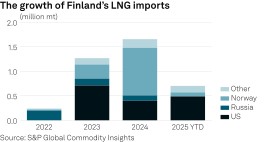
Even without an added push from the government, the US is Finland's primary source of LNG.
Since the start of 2025, it has supplied about 490,000 mt of the country's roughly 700,000 mt in imports, according to Energy data.
Finland, which aims to be carbon neutral by 2035, is not as reliant on natural gas as other European countries. Just 3.9% of Finnish energy came from gas in 2023, according to the International Energy Agency , far behind the 31.2% offered by biofuels and waste and the 27.6% supplied from nuclear energy.
Still, Huttunen stressed gas remains important for industrial users and for security during peak energy demand times, such as the coldest winter periods.
Russian gas
Like much of Europe, Finland's gas system has radically transformed over the past several years.
In 2021, about 75% of its natural gas came via pipeline from Russia through the Imatra interconnection point, with the remainder supplied from Baltic states through the Balticconnector pipeline linking Finland with Estonia, according to Finland's Energy Authority. Following Russia's full-scale invasion of Ukraine in 2022, the country suspended Russian pipeline gas and pivoted to ramp up LNG imports.
Huttunen is not planning for a return of Russian gas in the near term. "There is no discussion in Finland about this," he said. "The industries are not asking for a Russian connection whatsoever."
He said he supports a proposal from the European Commission to phase out all Russian gas and LNG imports into the EU by 2028.
Finland is also working on its own legislation to ban future imports of Russian gas. But, given the existing suspension of Russian flows and the EC's proposal, Huttunen said the government is "not in such a hurry" to push through a domestic ban.
Still, the Director General left room for the possibility of an eventual return of Russian gas in the longer term. "In theory, if we would see a big change in Russia, in their politics, policies -- in theory we might import Russian gas in the future, but it's very difficult to see at the moment," he said.
European LNG prices are softer year over year. Platts assessed the DES Northwest Europe LNG marker at $10.558/MMBtu Aug. 20. This is nearly 15% lower than the same time in 2024, when the marker was assessed at $12.40/MMBtu.
Energy security
Finland's overall LNG import capacity will "most likely" not increase, Huttunen said. However, he added, the capacity of some individual terminals could shift in the coming years.
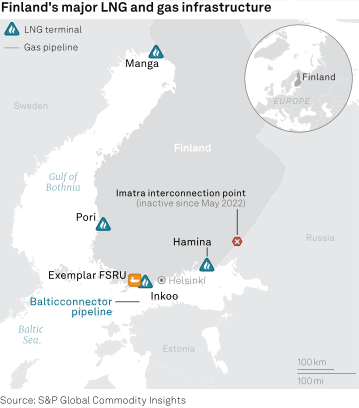
Finland imports the bulk of its LNG through the 5 Bcm/year Exemplar floating storage and regasification unit stationed at the southern port of Inkoo. It also has the smaller Hamina, Pori, and Manga LNG terminals.
In addition to regasification, the Exemplar provides most of Finland's domestic gas storage. That too is unlikely to increase, according to Huttunen. "There's no discussion about building any remarkable storage capacity in Finland," he said.
The country also utilizes underground storage in Latvia via the Balticconnector. The subsea pipeline, however, has faced security challenges. In October 2023, a ship trailing its anchor damaged the pipeline, spurring a six-month halt in transit.
Huttunen said Finland's gas system is better prepared should another incident take the pipeline offline.
"We had a big, real-life stress test -- if you like -- of our system and operations, and now we are wiser," he said.
Still, Huttunen also said Finland needs to maintain an "adequate level of security of supply." What that looks like, however, varies, from assessing LNG terminal capacity to bolstering fuel flexibility.
"It's not one silver bullet to solve this issue," he said. "There are many."
