LNG, Natural Gas
July 08, 2025
Looming South Central gas storage draws unlikely to slow US surplus growth

By J Robinson
HIGHLIGHTS
South Central storage draws likely July to August
Analysts see US gas storage surplus growing
As summer heat builds across the US South Central region, end-users are relying more heavily on regional storage to meet demand. In the weeks ahead, though, net withdrawals from inventory there may not be enough to meaningfully narrow the US storage surplus.
On July 3, the US Energy Information Administration reported this summer's first double-digit withdrawal from salt cavern storage, totaling 10 Bcf. The withdrawal was accompanied by the smallest injection to non-salt storage since early April – just 18 Bcf. Although South Central stocks still grew by a net 8 Bcf in the week to June 27, it was a clear sign that hotter summer weather and stronger gas demand have increased the region's need for stored supply.
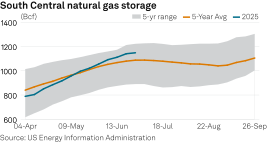
Historically, the US South Central region begins making net withdrawals from inventory around early to mid-July. Over the past five years, South Central stocks have on average crested just below 1.1 Tcf from late June to early July. Historically, inventory levels there fall steadily through the end of August, dropping by some 40-50 Bcf. According to data from the EIA, regional inventories have hit a five-year average low at 1.04 Tcf in the final week of August, before steadily rebounding through the remainder of the injection season.
Although South Central stocks are now estimated at 1.148 Tcf, or about 60 Bcf above average, as of the week ended June 27, history suggests that inventories will likely retreat over the roughly eight-week period from early July to late August.
Weather
According to the US National Weather Service, temperatures in Texas and other South Central region states will likely trend above average in July. According to the agency's One Month Outlook, south-central Texas faces a 50%-60% chance for above-average temperatures in July. All of South Texas faces a 40%-50% chance for hotter weather, and the entire South Central region is at a 33-40% risk for above normal temperatures. Short-term outlooks published by the Weather Service show a similar risk for hot weather across much of the region.
So far this month, power burn data from the US Southeast is bearing out the agency's forecast. In July, gas-fired power demand has averaged about 11.6 Bcf/d – up from just 11.4 Bcf/d in June. Over the next two weeks, power demand across the Southeast is expected to continue climbing to an average of over 12.5 Bcf/d, according to a 14-day forecast from S&P Global Energy.
In Texas, power burn has been roughly flat from June to July at around 6.6 Bcf/d. According to the Energy forecast, demand would only climb about 50 MMcf/d over the next two weeks, but could surpass 6.8 Bcf/d by mid- to late July.
Market outlook
Although stronger gas demand across the South Central region will likely prompt storage withdrawals over the weeks ahead, it may not be enough to meaningfully narrow the US gas storage surplus.
According to the Energy natural gas supply-demand model, the next three storage reports from the EIA are expected to show injections that outpace the five-year average. The injections, ranging from the low-40s Bcf, to upper-50s Bcf would add a combined total of 149 Bcf to US inventory, compared with the five-year average injections totaling just 124 Bcf.
"Natural gas storage surpluses may surpass 200 Bcf above five-year norms into mid-July," Eli Rubin, senior energy analyst with EBW Analytics, wrote in a July 8 market note to subscribers.
According to Rubin, the South Central gas market has faced relatively weak fundamentals recently, thanks to "extended LNG maintenance, mild local weather, and strong ERCOT wind," he wrote.

Editor: