Natural Gas
June 25, 2025
EU gas storage rules to be made more flexible under provisional agreement

HIGHLIGHTS
Deal keeps 90% target, but with deviations allowed
Target can be met any time between Oct.1 and Dec. 1
Aims to reduce pressure on summer filling, lower prices
EU gas storage rules are to be made more flexible under a provisional agreement reached late June 24 between the European Parliament and Council on a revised gas storage regulation.
The draft legislation aims to address speculation on the gas market and bring down prices by introducing greater flexibility in rules on gas storage refilling, the Parliament said.
"This revision will provide for more flexibility and less bureaucracy," Parliament rapporteur Borys Budka said.
The EU adopted its gas storage regulation (EU/2022/1032) in June 2022, and the rules -- which include a 90% fullness target by Nov. 1 -- had been set to remain in effect until the end of 2025.
However, the European Commission in March proposed extending the regulation to the end of 2027, adding that it would also allow member states greater flexibility when deciding on measures to refill storage facilities.
Members of the European Parliament and the Polish Presidency of the Council reached an informal agreement on June 24 to extend the rules until the end of 2027.
"In the current geopolitical context, this agreement shows that the EU remains determined to shield its citizens and businesses from any risk of supply disruption and price spikes," EU energy commissioner Dan Jorgensen said.
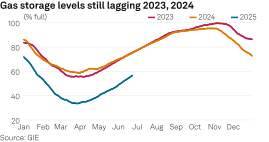
EU gas storage sites are currently filled to 56.6% of capacity, with some 642 TWh of gas in stock, according to the latest data from Gas Infrastructure Europe.
But storage levels are well down on the same time last year, when sites were filled to 75.5% of capacity.
Flexible targets
The Parliament said MEPs and the Council had introduced several amendments to the text designed "to ease tensions in the gas market." It said speculation surrounding the existing mandatory 90% fill rate target by Nov. 1 each year was driving the cost of refilling during the summer.
The new agreement will allow member states to achieve the 90% filling target at any point from Oct. 1 to Dec. 1, taking into account the start of each member state's storage withdrawal period. Once the 90% target is met, it will not be required to maintain that level until Dec. 1.
Member states would also be able to deviate by up to 10 percentage points from the filling target "in case of difficult market conditions such as indications of speculation hindering cost-effective storage filling," the Parliament said.
The EC can further increase the deviation by delegated act for one filling season if these market conditions persist, while interim gas storage refilling trajectories are also to be made indicative rather than mandatory.
MEP Andrea Wechsler said the deal meant the EU would continue to ensure secure gas supply while gradually returning to market-based principles in the gas market.
In a statement posted to the website of the German CDU/CSU representation of the European People's Party, Wechsler said member states would be granted a "high degree" of flexibility to protect consumers from high gas prices.
"Member states can independently deviate up to 10% from the 90% storage filling target in difficult conditions. A further 5% is possible in the event of market problems," she said.
"Furthermore, the rigid interim targets have been eliminated. In the future, simply submitting the filling plans to the Commission will be sufficient."
Previously, a floor of 75% fullness in the event of continued difficult conditions had been put forward.
The Parliament plenary vote is scheduled for July. "Crucially, the regulation could enter into force as early as 2025, thus having a direct impact on gas prices in Europe," Wechsler said.
The Parliament added that under the agreement, the competent authority monitoring gas refilling should include information on the share of Russian gas being stored in that member state.
Once the text is formally adopted by both the Parliament and Council, it will then enter into force on the day following its publication in the EU's Official Journal.
Market stability
The EC welcomed the provisional agreement, saying the extended regulation would "significantly" contribute to maintaining the EU's security of energy supply and gas market stability by "incentivizing preparations for the upcoming winter seasons in a coordinated manner."
The EC said it would work closely with the member states to ensure an "optimal" gas storage refilling and the achievement of the targets.
It said storage filling could also be supported through the use of the EU's gas demand aggregation and joint purchasing tools, and that it would continue monitoring the security of gas supply across the EU and market developments, including via the Gas Coordination Group with the member states.
It said it would also review the EU's energy security framework more broadly "to enhance the resilience of the EU's energy system at any time and ensure price stability."
European gas prices hit a recent peak of almost Eur60/MWh in mid-February, partly due to low storage stocks.
Prices have softened since, with Platts, part of S&P Global Energy, assessing the benchmark Dutch TTF month-ahead price on June 24 at Eur35.46/MWh.
Teresa Ribera, the commission's executive vice-president for clean, just and competitive transition, said the agreement strengthened the EU's preparedness for future winters and provided the flexibility supporting refilling at competitive prices.
"We will continue to work collaboratively with member states to ensure a secure and affordable energy supply to Europeans," Ribera said.
The Council, whose president is currently Poland, said the revised agreement would reduce the EU's exposure to "volatile" prices linked to geopolitical instability after Russia's war against Ukraine.
"Today's agreement represents a strategic victory for our energy sovereignty and European resilience to price manipulations on the gas market," Polish industry minister Marzena Czarnecka said.
"By ensuring sufficient gas storage ahead of winter, we are not only protecting our citizens and businesses from price shocks and supply disruptions, but also sending a clear message that we will not be held hostage by external energy pressures."

Editor: