LNG, Natural Gas
June 11, 2025
Spanish LNG re-exports set to slip in June as domestic demand picks up
HIGHLIGHTS
11 cargoes re-exported in April-May
Higher temperatures, demand limit June reloads
Spanish TVB July Eur1.595/MWh below TTF
While LNG re-exports out of Spain increased on the year at the start of the summer due to attractive gas prices in Spain, traders expect this trend to weaken in June on increased local demand.
According to data from S&P Global Energy, 11 LNG cargoes were re-exported from Spain over April and May, up from three in the same period last year, though below the 14 cargoes seen in 2023.
Spain remained the hub most used for re-exports in April, with seven cargoes leaving the country that month. Four cargoes were reloaded from the country in May, matching the numbers seen out of Finland's Inkoo. Re-exports were mainly directed to Italy and Gibraltar, which received five cargoes each over the two months.
The Spanish PVB month-ahead contract averaged Eur1.25/MWh above Med LNG prices but Eur3.80/MWh below the Italian PSV over May, according to Energy data.
However, with a drop in hydro stocks and increased demand for gas, especially in the power sector, Spain's PVB day-ahead discount to the TTF benchmark narrowed to almost 30 euro cents/MWh, reducing the scope for re-exports in June, according to market participants.
"In May, we saw more re-exports because Spain was the cheapest market, but it is not the case anymore with PVB being almost at parity to TTF". A Spain-based gas trader said. "Spain was very soft with no hot spell in May, but now the temperatures are set to be higher, and we are seeing lower hydro stocks. So, I think that we will see less reexports out of Spain in June."
The discount between Med LNG prices and the Spanish TVB -- the price of LNG stored in Spain's regasification plants -- has narrowed over the month. In May, sources reportedly optimized bookings on the Spanish TVB due to its more attractive prices compared to LNG; however, this discount appears to have diminished since then.
Indeed, Platts assessed, for the first time, Spain's TVB H2 June price at Eur34.025/MWh June 9 and the second time on June 10 at Eur33.145/MWh, or a premium of almost 27.5 euro cent/MWh to the equivalent Med LNG contract and Eur1.595/MWh below the July Dutch TTF.
The July contract of the TVB was valued at Eur33.37/MWh on June 10, a Eur1.37/MWh and 99.5 euro cent/MWh discount to the Dutch TTF and Spanish PVB, respectively.
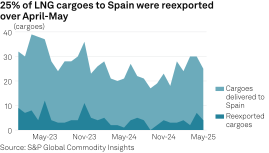
Overall, LNG imports to Spain totaled 2.95 million mt in April and May, which is 31% above the levels seen a year earlier, data from Energy showed. In June so far, the country received 601,000 mt of LNG, down 9% from the first 10 days of last month, but up 86% on the year.
Despite the higher imports, storage fill remains below the levels seen last year, with Spain's inventories being 73.2% full as of June 9 compared with 90.4% a year earlier, data from Gas Infrastructure Europe showed.
European regulations
This reflects a broader trend in the EU, where, despite a rise in LNG imports, sources have been arguing that injection rates should increase to meet mandated storage targets.
However, it remains to be seen whether the EU's storage targets will be formally relaxed, with the Parliament and Council still in discussions on the Commission's proposals to extend the regulation. For now, the target of reaching 90% by Nov. 1 remains in place.
Spain is a regular re-exporter of LNG. But Russian LNG transshipments to non-EU ports are now banned.
The EU ban on the transshipment of Russian LNG, which took effect on March 26, aims to limit Russian LNG exports but could also potentially increase the volume of Russian LNG in the EU at the expense of Asian deliveries.
The ban -- part of the EU's 14th sanctions package and designed to stifle Russia's LNG sector -- prohibits the reloading of Russian cargoes at EU ports for export to third countries.
To date, the Belgian port of Zeebrugge and the French port of Montoir have facilitated the transshipment of Russian LNG from the 17.4 million mt/year Yamal LNG facility.
The EU stopped short of an outright ban on Russian LNG imports at the EU level, meaning Russian cargoes may still offload LNG at EU ports, but the gas must be either consumed or transshipped within the bloc.

Editor: