Electric Power, Natural Gas
June 03, 2025
Northeast heat wave promises higher US gas demand, prices

By J Robinson
HIGHLIGHTS
Northeast high temps forecast in upper-80s F
US power burn to reach 37.5 Bcf/d, June 6-8
Rising temperatures across the Northeast this week will lift US Lower 48 gas-fired power demand to its highest since February, potentially helping to firm up cash-market weakness at the Henry Hub.
In cities stretching from Washington DC to Boston, a blast of summer-like weather from June 4-6 will lift high temperatures into the upper-80s Fahrenheit, according to forecasts from AccuWeather.
As temperatures rise, a spike in regional cooling demand is expected to push Northeast gas-fired power demand to an average 10.1 Bcf/d through June 8 – up from an average 7.9 Bcf/d over the past week. At its highest, regional power burn is expected to top 10.6 Bcf/d from June 5-6, according to a 14-day demand forecast published by S&P Global Energy.
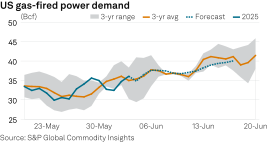
Along with smaller increases in power demand across Texas, the Southeast and the West, US-level power burn should average over 36.8 Bcf/d through the upcoming weekend, hitting its highest since late February. Over the short term, demand is expected to crest around 37.5 Bcf/d from June 6-8. Looking ahead, though, US power burn could reach 40 Bcf/d by mid-June, according to the forecast.
Prices
In recent trading, spot market gas prices have come under pressure from relatively weak shoulder-season demand in the US residential-commercial and power sectors. Springtime maintenance and other outages at US LNG export terminals have also weighed on overall demand in recent weeks.
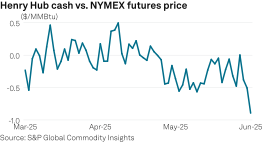
At the US Henry Hub, cash prices dipped to a four-week low in late May, trading below $3/MMBtu. On June 3, the benchmark location traded as low as $2.78 before rebounding modestly to an assessed price of $2.83, according to data from Platts, part of S&P Global Energy.
In the futures market, summer gas prices have remained comfortably above $3 as traders continue to expect tighter market conditions by the third quarter. In recent trading, the cash-to-futures price discount has widened to around 80-90 cents. At market settlement June 3, the newly prompt July futures contract ended trading around $3.73, according to data from CME Group.
"The market is attempting to round the corner from a very loose spring injection season to a bullish structural summer outlook," Eli Rubin, senior energy analyst with EBW Analytics, wrote in a June 3 market note to subscribers. "A weak Henry Hub physical market, [though], still below $3.00, may act as a short-term brake on warranted medium-term bullish enthusiasm," he said.
If the short-term spike in gas-fired power demand isn't enough to boost Henry Hub spot gas prices back above $3, an end to maintenance at US LNG terminals might be sufficient.
At Cameron LNG, a turnaround that began May 1 could be coming to an end soon. Although the operator did not offer an estimated timeframe for its scheduled maintenance, similar turnarounds in recent years have lasted about three to four weeks. On May 30, Cheniere Energy confirmed a major planned maintenance at Sabine Pass LNG. The turnaround at Trains 3 and 4 is expected to last over three weeks, Cheniere said during a May 8 earnings call.

Editor: