23 Apr 2020 | 19:19 UTC — Houston
US oil, gas rig count falls 76 on week to 491 after record-low crude price

Highlights
Oil rigs made up most of plunge, down 73 to 371
Natural gas-oriented rigs down just three to 120
Rig count has lost 41% of volume in last four weeks
Houston —
The US oil and gas rig count fell 76 week on week to 491, rig data provider Enverus said Thursday, a few days after oil prices plunged below zero and continuing the rapid recent decline in drilling activity.
In the last six weeks, the domestic count has dropped by 347 rigs, or 41%.
The downed rigs came overwhelmingly from the oil-weighted side, falling 73 to 371 week on week, while operators relinquished just three natural gas-oriented rigs, leaving 120.
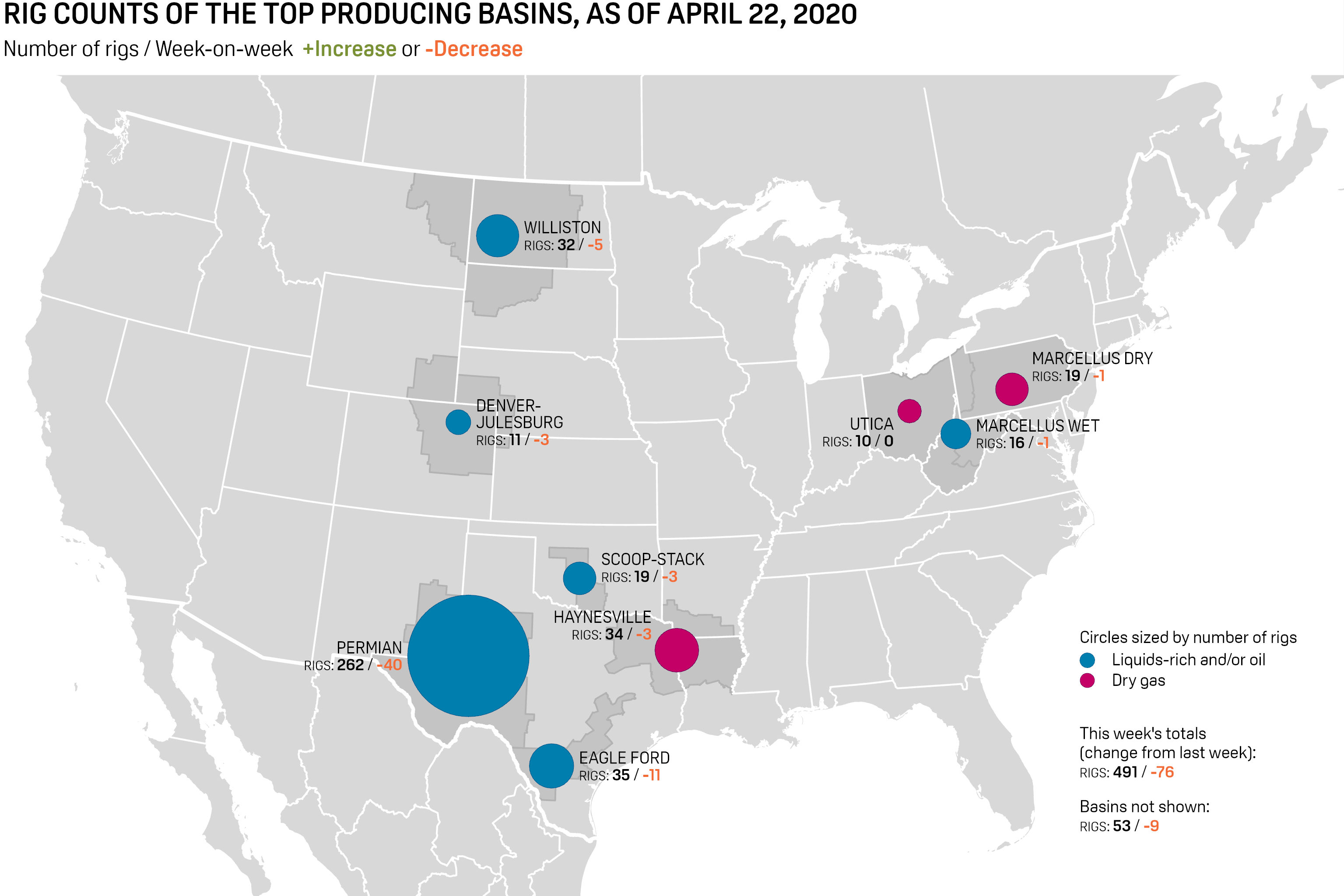
Of the total 76-rig decline this past week, the Permian Basin of West Texas/New Mexico accounted for 40, leaving 262.
Eleven rigs left the Eagle Ford Shale of South Texas, for a total 35, less than half the number of rigs in the basin just five weeks ago.
Rigs working in domestic fields have plummeted in recent weeks as the global coronavirus pandemic continues to sap oil demand. On Monday, a mounting crude surplus pushed the price of WTI crude futures below zero for the first time to settle at minus $37.63/b.
Oil is currently trading in the mid- to high teens/barrel, at levels last seen in 1999.
For the week ended April 22, the WTI price averaged $4.46/b, down $16.83, while WTI Midland averaged $13.68/b, down $4.93. The Bakken Composite was less volatile, averaging $17.75/b, up 62 cents.
Click here for full-size image

LOSSES PER WEEK HAVE DOUBLED
"The US land rig count has fallen by double digits each of past five weeks, and the rate of decline in the nosedive is accelerating," said Bob Williams, Enverus' director of content.
"Losses per week have doubled just in the past month," Williams added. "If major producing states like Texas and Oklahoma implement true prorationing measures--so far they have stopped short--then we'll likely blow past 300 [rigs] to a new record low."
In a Wednesday investor note, Tudor Pickering Holt said around 150-200 more horizontal rigs are still likely to be shed in the coming months, based on its discussions with both public and private operators.
The Enverus horizontal rig count on Thursday was 453, down 62 on the week, compared with 733 at the beginning of March.
Given the rapid pace of downed activity that has already occurred in the past several weeks, TPH now expects second-quarter 2020 activity finishing down more than 40% from Q1. Such a loss "would mark the sharpest sequential decline that we've seen over the past couple of decades, and also imply that a number of operators are now early-terminating rig contracts, versus merely letting spot rigs go," the bank said.
Q2 FORESEEN AS 'ABSOLUTELY BRUTAL'
Next week begins several weeks of Q1 earnings calls for the E&P sector, which observers say will serve more as a look ahead to how upstream managers view the rest of 2020 than a look-back at the last three months.
The focus will be how operators grapple this year with shredded crude prices that began early in March after Russia and OPEC failed to agree on production cuts and have deteriorated in the weeks since.
"We expect the next few weeks to be more about getting through the next few months than looking back on Q1 results," TPH said, adding it expected Q2 to be an "absolutely brutal" quarter.
Most E&P companies have already cut their capex for this year, sometimes twice. For many US-based operators, 2020 capex cuts are now 50% of original projections.
On Monday, RBC Global Energy Research said to date the group of producers it tracks has slashed 2020 investment by more than $70 billion, or about 30%, since early March.
Besides capex cuts, Q1 calls are expected to focus on producers' production impacts for the rest of the year and any plans for voluntary shut in output. TPH expects May-June production cuts by US independent operators of 3 million b/d.
On Wednesday, Colin Fenton, CEO of TPH Commodities, said in a video he has calculated 700,000 b/d of US liquids production already shut in, including 165,000 b/d each from the Permian and the Bakken Shale in North Dakota/Montana and 125,000 b/d from the Eagle Ford.
Coupled with the operator announcements in recent days, "we can say with confidence that 1 million b/d are already slated to be out of this market in the middle part of this year," Fenton said.
Several E&P companies have already announced voluntarily output curtailments, including ConocoPhillips, Continental Resources, PDC Energy and Cimarex Energy.
"Overall, we expect oily E&Ps to reduce production anywhere from 5% to 25% in Q2 2020 due to continued weak prices," KeyBanc Capital Markets analyst Leo Mariani said in a Monday investor note.
Also, "we expect ... a second round of capex cuts from companies that have not already done so, although we expect gas-focused E&Ps to generally maintain 2020 guidance," Mariani said.
| Oil cutbacks slash into US rig count | ||||||||
| Oil-focused basins | Gas-focused basins | |||||||
| Date | Permian | SCOOP-STACK | Eagle Ford | Williston | Denver-Julesburg | Marcellus | Haynesville | Utica |
| 3/4/2020 | 429 | 41 | 79 | 52 | 28 | 38 | 41 | 10 |
| 3/11/2020 | 428 | 39 | 75 | 52 | 27 | 38 | 42 | 10 |
| 3/18/2020 | 416 | 37 | 72 | 53 | 26 | 38 | 41 | 10 |
| 3/25/2020 | 396 | 36 | 68 | 51 | 21 | 38 | 40 | 10 |
| 4/1/2020 | 374 | 34 | 63 | 47 | 21 | 38 | 37 | 10 |
| 4/8/2020 | 334 | 26 | 58 | 41 | 19 | 36 | 38 | 10 |
| 4/15/2020 | 302 | 22 | 46 | 37 | 14 | 37 | 37 | 10 |
| 4/22/2020 | 262 | 19 | 35 | 32 | 11 | 35 | 34 | 10 |
| Seven-week change | -167 | -22 | -44 | -20 | -17 | -3 | -7 | 0 |
| -38.90% | -53.70% | -55.70% | -38.50% | -60.70% | -7.90% | -17.10% | 0.00% | |