26 Mar 2020 | 15:40 UTC — Denver
US working natural gas in underground storage decreases 29 Bcf: EIA
Highlights
Storage reaches 80% above last year
Coronavirus fails to quell US demand so far
Denver — US working gas stocks dipped 29 Bcf last week as one more withdrawal likely remains before the flip to injections. As of yet, the coronavirus outbreak has done little to quell demand despite stay-at-home measures implemented across much of the country.
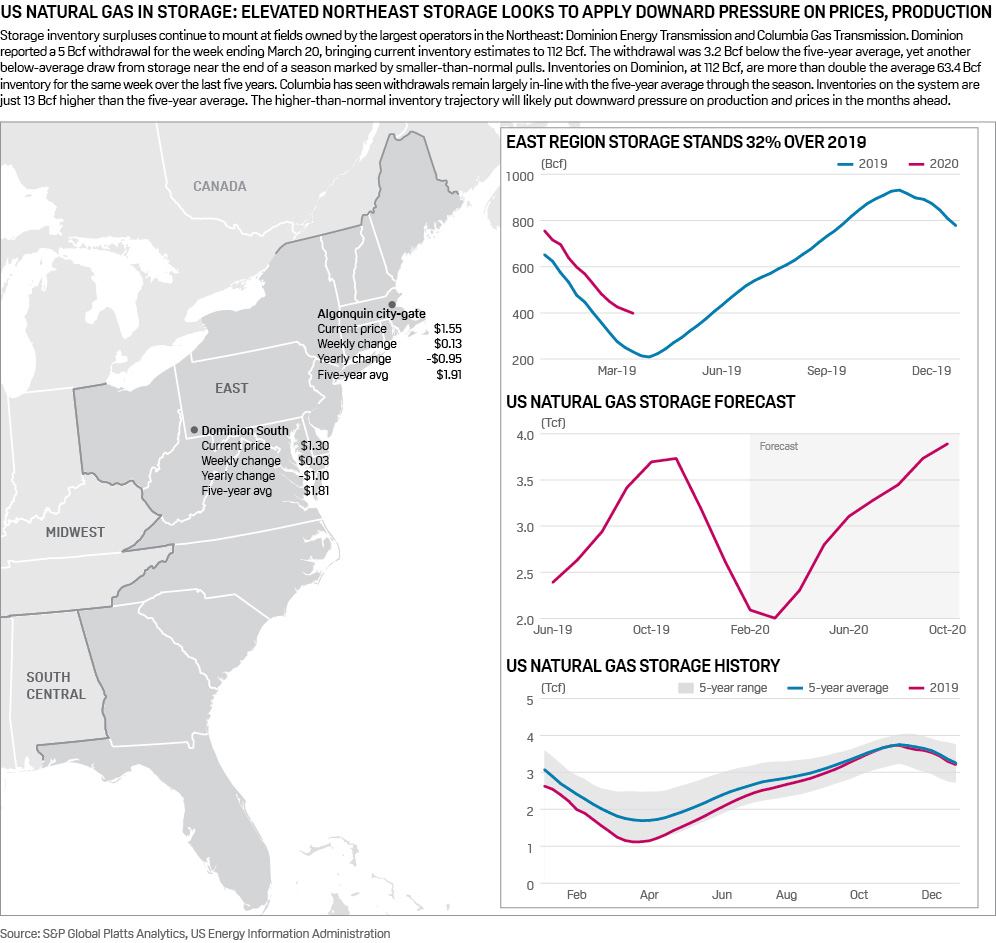
Storage inventories fell to 2.005 Tcf for the week ended March 20, the US Energy Information Administration reported Thursday morning. The pull was slightly above an S&P Global Platts' survey of analysts calling for a 27 Bcf withdrawal, but it was below the 39 Bcf pull reported during the corresponding week in 2019 as well as the five-year average draw of 40 Bcf, according to EIA data.
Storage volumes now stand 888 Bcf, or 80%, more than the year-ago level of 1.117 Tcf and 292 Bcf, or 17%, more than the five-year average of 1.713 Tcf.
Despite increasingly aggressive measures by US states and the federal government to slow the spread of the coronavirus, demand for the week ended March 20 remained relatively unfazed, according to S&P Global Platts Analytics. Power burn in the US Gulf Coast, and residential/commercial demand in the Midwest and Mountain regions, both increased week on week while cooler weather in the central and western US drove up demand.
Texas helped elevate total US production by 0.7 Bcf/d, which is the largest weekly increase since last October. The recent production momentum is unlikely to persist as the collapse in crude oil prices will reduce associated gas coming out of the Permian.
The NYMEX Henry Hub April contract slid 3.4 cents to $1.625/MMBtu in trading following the release of the weekly storage report.
The market has come down significantly in the past few weeks, with most of the price declines weighted on the front of the forward curve. April Henry Hub has dropped more than 20 cents from two weeks earlier, while the October contract is priced at $2.08/MMBtu, down 8 cents over the same period.
Platts Analytics' supply and demand model currently expects a 24 Bcf draw for the week ending March 27, which will likely be the last net withdrawal of the season.
US balances are slightly tighter this week despite the massive economic and societal slowdown as much of the country stays home. Production is down 0.5 Bcf/d this week to average 92.2 Bcf/d. A 0.4 Bcf/d increase in net Canadian imports offset most of the decline. Demand increased due to a surge in LNG feedgas deliveries, which rose 1.3 Bcf/d from the week prior.
Click here for full-size image