LNG, Natural Gas
March 18, 2026
EU ban on Russian gas, LNG spot imports begins
By Matt Hoisch and Neil Hunter
HIGHLIGHTS
Further restrictions to phase in across 2026-2027
EU has pushed back on pressure to boost Russian flows
Russia has said it’s redirecting some Europe-bound LNG to Asia
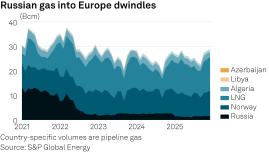
The European Union's ban on spot imports of Russian natural gas and LNG entered into force March 18, commencing the first in a series of stepwise halts under the landmark legislation approved in January to sever the EU from its once-central gas supplier.
Restrictions on Russian flows will ratchet up further across the next two years. Imports under short-term contracts will end in the coming months and those under long-term contracts over 2027.
Russian LNG imports under short-term contracts concluded before June 17, 2025 will be banned from April 25, 2026.
Pipeline imports of Russian gas brought in under short-term contracts concluded before June 17, 2025, will be banned from June 17, 2026.
LNG imports under long-term contracts concluded before June 17, 2025 will be outlawed from Jan. 1, 2027.
Pipeline gas imports under long-term contracts concluded before June 17, 2025 will be banned from Sept. 30, 2027, if member states are on track to meet gas storage filling targets, and as late as Nov. 1, 2027 if they are not on track.
Long-term contracts are defined as being more than one year and short-term contracts as less than a year.
Pricing pressure
The spot halt comes as the Iran war spurs the greatest disruption to global energy markets since Russia's 2022 invasion of Ukraine.
European leaders have faced pressure amid recent price spikes to boost Russian fuel flows. However, Brussels has held firm. European Commission President Ursula von der Leyen said March 11 that raising Russian imports in response to rising prices would be "a strategic blunder."
The International Energy Agency's executive director, Fatih Birol, similarly said March 6 that it would be "economically and, in my view, politically wrong" for the EU to seek further gas supplies from Russia to soften the current price pressure.
Platts, part of S&P Global Energy, assessed the month-ahead Dutch TTF gas price at Eur51.315/MWh on March 17. While the index has subsided from recent peaks, it remains some 63% higher than before the latest Middle East war began.
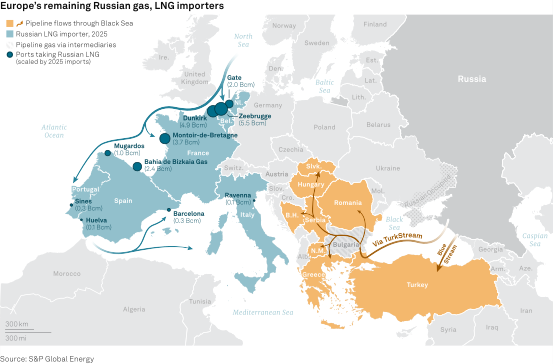
The ban on spot imports also had an immediate impact on spot pricing and physical gas flows in the Balkan region, which still receives Russian pipeline supply via Turkey.
Prior to the ban's enforcement, the Bulgarian VTP and Romanian PVT day-ahead contracts recorded strong daily increases, while edging closer to their TTF counterpart once again following the recent price shock.
Platts valued the Bulgarian VTP spot at Eur49/MWh at 1630 GMT March 17, rising by Eur5.745/MWh day over day, and distancing itself from the within-day valuation of Eur46.505/MWh. Platts assessed the Dutch TTF day-ahead contract at Eur51.08/MWh at this time.
Meanwhile, the Romanian PVT was valued at Leu 245.81/MWh (Eur48.255/MWh) by market close on March 17, up Leu 15.815/MWh day over day, and at a Leu 21.885/MWh premium to the within-day product.
Moreover, Entsog data indicated that physical shipment of gas through the Strandzha and Strandzha 2 interconnections from Turkey to Bulgaria fell by 46.294 GWh/d to 544.328 GWh/d between March 15-17.
What remains of Russian pipeline gas exports to Europe flows through these interconnections.
Russian redirection
Russia said its LNG exporters would redirect some previously Europe-bound cargoes to Asia after President Vladimir Putin mused earlier this month about ending supplies of Russian natural gas to Europe "right now."
Putin later said that Russia is increasing oil and gas supplies to "reliable partners" and highlighted Slovakia and Hungary as among buyers he considers reliable, according to a March 9 transcript posted on the Kremlin website.
The two landlocked EU member states remain heavily reliant on Russian flows via the TurkStream pipeline for a large share of their gas needs.
Last week, Russia's Gazprom said multiple attacks targeted gas compressor stations in Russia key to supplying gas via the TurkStream and Blue Stream pipelines. Gazprom said the strikes were repelled.
Russia and Hungary have accused Ukraine of the recent attacks. Ukraine's defense ministry has not replied to a request for comment.

Editor: