Metals & Mining Theme, Non-Ferrous
December 31, 2025
Congo's export quotas squeeze cobalt supply as Indonesia's ramps up
HIGHLIGHTS
Congo's export quotas to tighten cobalt supply in 2026
Indonesia's cobalt output to increase, easing pressures
Recycling, low-cobalt tech to boost cobalt availability
The Democratic Republic of Congo is at risk of eroding its cobalt dominance in 2026 as rising prices drive up production from competitors, increase recycling, and incentivize the use of cobalt-free batteries in energy storage and electric vehicles.
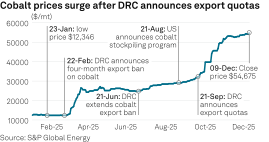
Congo produced 74.5% of global cobalt supply in 2024, according to S&P Global Market Intelligence, but the country shocked the market Sept. 21 when it replaced an export ban on cobalt hydroxide, which had been in effect since Feb. 21, with stringent export quotas. The new system limits annual exports to 96,600 metric tons for 2026 and 2027, which is equivalent to 48.2% of the country's 2024 production, according to Market Intelligence data.
Industry participants said that quotas were well below market expectations and could quickly tip the cobalt market into a structural deficit, leading to sustained higher prices and risking demand destruction in the battery sector.
"I think we can confidently expect the cobalt market to be very tight next year. [Congo's] export quota for 2026 is set at less than half of the country's 2024 production, effectively constraining global availability," Joel Crane, commercial manager at Cobalt Blue Holdings, an Australia-based mining and processing company, told Platts, part of S&P Global Energy.
"On top of that, many customers are starting the new year with virtually no shipments from [Congo] since mid-2025," Crane added.
The Platts-assessed cobalt hydroxide CIF China price surged 69.9% to $54,674.58/mt on Dec. 9 from $32,187.45/mt on Sept. 21, when Congo announced the export quotas.
S&P Global CERA analysts upgraded their March-quarter 2026 European cobalt metal price to $24.23/lb, or $53,418.01/mt, up 8.3% quarter over quarter, but expect prices to fall from the June quarter onward as exports normalize under the quota system, according to their November report.
Supply squeeze
As the cobalt market grapples with tightening supply due to Congo's export controls, a trend of continuous destocking has emerged across all industry segments. Producers were holding back sales in anticipation of rising prices, further tightening the supply landscape, according to market sources.
In the short term, this could lead to rising cobalt prices, complicating the operational strategies of downstream enterprises reliant on this critical mineral.
"Uncertainties over the timing and volume of export flows to end-use markets in China have continued to support elevated cobalt prices," S&P Global Energy CERA analysts said in their November report.
China's imports of Congo's cobalt hydroxide plunged 86.9% to just 6,346 mt in October from 48,608 mt in May, according to the General Administration of China Customs.
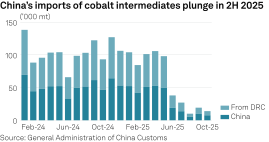
To date, Congo has yet to clear most cobalt shipments, with actual deliveries yet to begin in earnest.
Long-term solutions
The medium- to long-term outlook offers a glimmer of hope for replacement cobalt supply. Indonesia's contribution to the global cobalt raw material supply is projected to increase in 2026 and 2027, which could help ease market pressures, sources said.
Indonesia has approximately 658,000 mt/year of high-pressure acid leach nickel capacity under construction, with phased commissioning scheduled from 2025 through 2027, Antaike, a Chinese state-owned research agency, said at an industry event in November.
If the projects are commissioned as scheduled, Indonesia's cobalt output could potentially increase to 66,812 mt in 2027 from an expected 38,324 mt in 2025, and additional facilities expected to come online could further boost that figure.
Mined cobalt production from Indonesia is forecast to rise 39.1% to 53,318 mt in 2026 and expand by a further 25.3% in 2027, according to CERA analysts.
However, with refined nickel prices at a low of $14,073.74/mt as of Dec. 16, incentives to ramp up production could be limited.
Consequently, the expansion of Indonesia's cobalt production capacity will likely fall short of expectations, said Alice Yu, associate director and co-lead of critical minerals markets at CERA.
Recycling potential
The anticipated increase in secondary material recycling, bolstered by China's recent allowance of black mass imports, is also expected to enhance the availability of cobalt raw materials.
Recycling can improve local availability of cobalt and reduce dependence on other regions. Cobalt recovery rates from recyclable materials can exceed 95%, depending on the recycling method, according to a 2024 report by S&P Global Mobility.
Persistently high cobalt prices will also restrain the development of technologies that utilize the metal and compel downstream enterprises to accelerate the adoption of cobalt-free or low-cobalt technological alternatives, China-based sources said.
Automaker Tesla has been reducing the cobalt content of its electric vehicle batteries since 2020, and lithium-iron-phosphate batteries, which are used in many EVs, have no cobalt.
In 2025, the battery industry accounted for 70% of global cobalt consumption, with communications and consumer electronics representing 37% and power batteries 33%, according to Antaike. Cobalt usage in EVs fell short of expectations as nickel-cobalt-manganese battery installations were increasingly displaced by lithium-iron-phosphate batteries.

Editor: