Metals & Mining, Energy Transition, Electric Power, Non-Ferrous, Ferrous, Renewables
October 21, 2026
LME Week: Aluminum sector sees power costs key to riding electrification trends

Editor:
HIGHLIGHTS
Power costs critical for aluminum expansion
Global output drops 1% amid GCC disruptions
Recycling capacity surge makes scrap strategic
As industry leaders gather in London for one of the world's largest metals events, S&P Global Energy Platts presents the LME Week thought leadership series, examining the forces redefining global metals markets and shaping the outlook for 2027 and beyond. This feature examines how producers are responding to rising aluminum demand through capacity expansions and recycling investments amid an increasingly fragmented global market.
The global aluminum market enters 2027 with stronger fundamentals. Producers are confident in long-term demand, driven by grid expansion and e-mobility, among other electrification and energy transition trends. However, industry players in this highly fragmented market remain sensitive to volatility and uncertainty in energy costs, trade regulations and the geopolitical landscape.
Hydro Extrusions, a unit of Norwegian energy and aluminum company Norsk Hydro, is "seeing strong long-term trends driven by electrification, renewable energy, copper substitution and circularity," its executive vice president, Paul Warton, told Platts, part of S&P Global Energy. "The underlying role of aluminum continues to strengthen, as grid expansion, mobility, buildings and infrastructure all require lightweight, durable and recyclable materials."
McKinsey & Company expects global aluminum demand to expand at a compound annual growth rate of 2% from 2025 to 2035, underpinned by the build-out of data centers, which the consultancy estimated Oct. 13 require 16 mt of aluminum per megawatt and could account for 1.1% of total global aluminum demand by 2030.
Greece's Metlen Energy & Metals told Platts it is responding to the uplift in demand by investing in alumina capacity and aluminum recycling.
The opportunity is significant, but producers are also bracing for continued volatility in energy costs, carbon regulation, geopolitical tensions and, not least, tariffs.
Global output slips
A steep upward revision of US Section 232 tariffs had triggered 6% [to over 8%] spikes in aluminum prices in 2025, breaking a decade of unified global pricing, McKinsey said.
That tariff shock spilled over into 2026, where it was amplified by the conflict in the Middle East. Ensued intermittent closures of the Strait of Hormuz and operation suspensions and cuts at regional smelters slashed the Gulf Cooperation Council's output by over 1.4 million metric tons. Consequently, global primary production fell 1% to 54.8 million mt between January and September.
The supply disruption drove London Metal Exchange prices to a peak of $3,753/mt in September, up 25% from the start of the year.
Compensatory trade shifts have been significant, though. In the first eight months of 2026, China's unwrought aluminum exports jumped 57% year over year to over half a million tons, while Indonesia doubled its exports to 700,000 mt, according to S&P Global Market Intelligence's Global Trade Analytics Suite. And Russia ramped up its primary production by 7.7% in January-August, Rosstat said in September.
The offsets have pulled the LME benchmark back to $3,080/mt in October, close to the values last seen in February.
Financial services company StoneX expects LME prices to hold above the $3,000/mt line through the 2026 year-end, before coming under pressure of increasing supply in 2027.
"In our view, the support is genuinely fundamental rather than sentiment-driven ... The market is running a deficit ... and ... visible inventories sit at extremes," Natalie Scott-Gray, Stone-X's senior metals analyst, said in an Oct. 16 note. She added that LME aluminum stocks —at 238,125 mt as of Oct. 14— are at their lowest since 1990, and global stock coverage has fallen to 42 days of consumption, a level not seen since before the 2008 financial crisis.
Depleted inventories are keeping regional premiums elevated despite benchmarks receding to their pre-Iran war levels, with mid-October Rotterdam and US Midwest premiums of $560-$600/mt and $2,390/mt, respectively, sitting $200/mt and $100/mt above their February levels, according to Platts assessments.
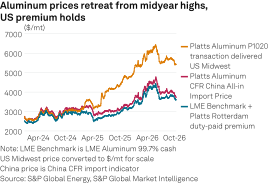
Although domestic premiums have soared since the US Section 232 tariff on aluminum imports first increased to 25% in March 2025 and doubled to 50% in June the same year, North America's primary aluminum output in the first nine months of 2026 was stagnant at 2.9 million mt, International Aluminium Institute data showed.
In 2025, the US produced 664,000 mt of primary and over 2.6 million mt of secondary aluminum, according to the US Geological Survey. Meanwhile, the country continues to import 84% of its primary aluminum needs, SAFE's Center for Strategic Industrial Materials (C-SIM) said Oct. 7.
Brussels-based industry association European Aluminium told Platts that the EU produced 1.2 million mt of primary and 4.4 million mt of secondary aluminum in 2025. The bloc's imports of primary metal amounted to 3.2 million mt the same year, according to GTAS, meeting over 70% of the demand.
Capacity rollouts
However, under a high-supply pipeline scenario, North America could reach 28% self-sufficiency in refined aluminum, while Europe is projected to hit 26%, according to McKinsey.
A very wide gap between the West and China's aluminum prices has already prompted 2.5 million mt of primary aluminum smelter restarts and expansions worldwide, Platts estimates.
Over 600,000 mt of capacity was reactivated in Europe (Slovakia, Spain and Iceland), alongside 285,000 mt/year in additions in North America, with Century Aluminum and Rio Tinto completing their expansions in South Carolina and Quebec, and Magnitude 7 Metals restarting its Missouri smelter.
However, sustaining capacity in Europe will require competitive and predictable energy, Hydro's Warton said.
SAFE's C-SIM warned Oct. 7 that, without long-term access to affordable power, US primary aluminum capacity could continue to decline. Given that smelting aluminum consumes 13-16 megawatt-hours of electricity per metric ton — accounting for 40% of production costs — a new smelter would require decades of electricity priced near $40/MWh, while the US' industrial rates exceed $80/MWh, the think tank said.
Elsewhere, rapid growth is taking place in Vietnam, Angola and, most notably, Indonesia, which is adding 1.48 million mt of capacity in 2026 alone.
In their Oct. 14 outlook, S&P Global Energy CERA analysts see global primary aluminum supply being 1 million mt short of demand this year, but expect the deficit to dwindle to 179,000 mt in 2027, unless stronger-than-expected supply growth pushes the market into a surplus.
StoneX, which estimates this year's refined aluminum demand rising 1.6% to 75.36 million mt, exceeding production by 703,000 mt, forecasts the market to flip into a hefty 1.15 million mt oversupply next year, given new capacity and all the ex-China restarts, including in the GCC, where the UAE's Emirates Global Aluminium expects to return to full production in Q1 2027.
Recycling accelerates
In China, primary capacity remains capped at 45 million mt/year, but the country aims to ramp up its secondary aluminum production to 19 million-20 million mt/year by 2030, from today's 15 million mt/year, as part of its push toward 25 million mt/year of non-ferrous metals recovered through recycling.
Outside China, secondary aluminum capacity has increased this year by at least 325,000 mt, comprised of Speira's new furnace in Germany, RevoCast's casting complex in Canada, and EGA's Al Taweelah plant in the UAE.
Beyond 2026, aluminum recycling in the US could expand by 600,000 mt/year after Novelis and Aluminum Dynamics launch their new facilities, while expansions by Metlen, Hydro and EGA should boost scrap-smelting in Europe.
The number of new projects and restarts, alongside Alcoa's $5.5-billion acquisition of South32's aluminum assets, signals the industry's view of long-term prospects as solid.
McKinsey said that as new and planned capacities boost demand for feedstock, aluminum scrap is set to become increasingly contested.
China, as the largest importer of aluminum scrap on par with India, has been applying 91% and higher purity thresholds for scrap imports for a few years to incentivize processing domestically, but the market has yet to adapt to a looming bottleneck – a non-OECD export ban on metal waste that the EU will implement in May 2027 and that is set to affect three-quarters of its 1.27 million mt aluminum scrap exports.
