Metals & Mining Theme, Refined Products, Non-Ferrous
October 02, 2025
Alcoa's Australian refinery closure signals decline in alumina industry

HIGHLIGHTS
Australia's alumina production declines, threatening top ex-China producer status
Rising costs, competition erode Australia's alumina competitiveness globally
The permanent closure of Alcoa Corp.'s West Australian Kwinana refinery signals a continued decline for Australia's alumina industry.
Alcoa announced Sept. 29 it would close Kwinana for good due to age, scale, operating costs, market conditions and bauxite grade challenges, following the asset's full curtailment in June 2024.
Alcoa's Australian operations represent one of the world's largest integrated bauxite mining, alumina refining and aluminum smelting systems, according to the company.
Kwinana was commissioned in 1963 and was the first of Alcoa's three Western Australian alumina refineries. It has an annual nameplate production capacity of 2.2 million metric tons and produces both non-metallurgical and smelter-grade alumina.
The refinery received bauxite ore from Alcoa's Huntly mine in Western Australia.
"Production was gradually wound down at Kwinana from the time the curtailment announcement was made in January 2024, reducing by about 60% from fiscal 2023 to fiscal 2024, with no production in fiscal 2025," an Alcoa spokesperson told Platts Oct. 1.
While Alcoa would not provide specific production numbers from Kwinana, the spokesperson confirmed that "nameplate capacity remains unchanged at Alcoa's other Australian operations."
"The two operating refineries and two bauxite mines in Western Australia and the aluminum smelter in Victoria are not impacted by this decision," the spokesperson said.
Western Australia Cabinet minister Sabine Winton told a Sept. 30 press conference in Perth that the government is "bitterly disappointed" with Alcoa's decision on Kwinana.
However, Winton said there are "no concerns in terms of Alcoa's broader arrangements or activities in Western Australia."
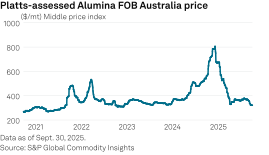
The closure decision comes as the Platts assessed Alumina FOB Australia price has plummeted to $321/ metric ton on Sept. 30 from $562/mt a year prior, and well down from the multi-year high of $805/mt in December 2024.
Australian production declining
Australia's alumina production has declined over the last three years despite being the leading producer outside China, while Indonesia presents "significant growth potential" that threatens Australia's standing, said S&P Global Energy analyst April Kaye Soriano in an email interview on Sept. 29.
Australia's alumina exports declined from 18.6 million mt in fiscal 2021 to 15.9 million mt in fiscal 2024, according to the federal government's most recent Resources and Energy Quarterly published June 30.
According to the quarterly, world alumina production has risen from 141.7 million mt to 144.2 million mt over that time.
Australia's alumina production is expected to rebound to 18 million mt in fiscal 2027, with new projects set to boost its bauxite output to 104 million mt by then, according to the quarterly. However, its export earnings from aluminum, alumina and bauxite are expected to fall to A$19 billion in fiscal 2027 as alumina prices decline.
Aside from Kwinana, Alcoa has two other Australian alumina operations at Pinjarra and Wagerup, while South32 Ltd's Worsley refinery and Rio Tinto Group's Queensland Alumina Ltd and Yarwun operations comprise Australia's other alumina refineries.
Pressure from Indonesia
Australia's alumina export earnings have declined from A$9 billion in fiscal 2022 to A$8.5 billion in fiscal 2024, according to the report.
"Australia's position remains strong, but major consumer China's substantial investments in Indonesian alumina refineries — projected to account for approximately 60% of Indonesia's supply by 2030 — are shifting sourcing preferences toward Indonesia," Soriano said.
"The anticipated increase in supply from Indonesia will exert considerable pressure not only on Australian producers but also on the global market. This trend is a crucial factor in our projections of a rising surplus in the near to medium term, which will likely weigh on prices."
In addition to the increased competition, Australia is also grappling with several significant challenges, including rising capital, labor, and energy costs, Soriano said.
These are further complicated by lengthy regulatory approval processes, so Australia must "improve its regulatory framework and optimize operational efficiencies," Soriano said.
"Declining productivity, significant increases in energy prices and one of the highest cumulative tax burdens among [Organisation for Economic Co-operation and Development] countries are all reducing Australia's competitiveness as a resources jurisdiction," Anita Logiudice, director of policy and advocacy at the Chamber of Minerals and Energy Western Australia, told Platts in a Sept. 30 email.
"Improving Australia's investment fundamentals requires faster, more predictable project assessment timeframes, a reliable supply of affordable and low-emission energy, access to well-located, turnkey industrial land and stable policy and regulatory settings that provide the confidence needed to invest for the long-term."
Bauxite challenges
Alcoa's bauxite challenges in Australia are not unique either.
"The decline in bauxite grade quality is a common issue among long-time top producers, including China, which is facing similar challenges as reserves are depleted at an alarming rate, leaving behind lower-grade resources," Soriano said.
"This situation leads to production inefficiencies and higher operational costs, making it increasingly difficult for industries to maintain profitability amid varying ore quality."
This is in contrast to Indonesia, which, being "relatively young" in the market, "may not yet be facing the same level of grade decline, but it will need to manage this issue as its production matures."

Editor: