Maritime & Shipping, LNG, Crude Oil, Agriculture, Rice
September 05, 2025
Trump cuts Japan auto tariffs to 15% while unlocking $550 billion in investments
By Takeo Kumagai and Samyak Pandey
HIGHLIGHTS
Reduces tariff on automobiles, other goods to 15%
Japan to invest $550 billion across US sectors
Increases US farm, fuel and food purchases
Trump cuts Japan auto tariffs to 15% while unlocking $550 billion in investments
US President Donald Trump has signed an executive order reducing an additional 25% tariff on automobiles and other goods to 15% under the US-Japan agreement, White House officials said, paving the way to implement Tokyo's $550 billion investment pledge across US energy, infrastructure and industrial sectors.
The move, which came Sept. 4, follows a July 22 framework agreement between the US and Japan, which lays the foundation for cutting the US' "reciprocal tariffs" on Japan from 25% to 15%.
Under the agreement, the US will apply a baseline 15% tariff on nearly all Japanese imports entering the US, alongside separate sector-specific treatment for automobiles and automobile parts; aerospace products; generic pharmaceuticals; and natural resources that are not naturally available or produced in the US, according to the executive order.
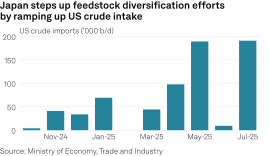
The new tariff framework, combined with expanded US exports and investment-driven production, will help reduce the trade deficit with Japan and restore greater balance to the overall US trade position, the executive order said.
Japan will also provide American manufacturing, aerospace, agriculture, food, energy, automobile and industrial goods producers with breakthrough openings in market access across key sectors, it said.
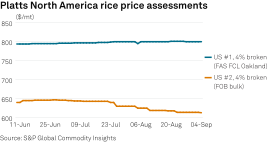
Specifically, the Japanese government is working toward an expedited implementation of a 75% increase in US rice procurements within the Minimum Access rice scheme and purchases of US agricultural goods, including corn, soybeans, fertilizer, bioethanol (including for sustainable aviation fuel) and other US products, totaling $8 billion annually.
In biofuels, Japan is exploring additional imports of ethanol -- including for sustainable aviation fuel via ETBE -- but since ETBE and ethanol for ETBE production already face a zero tariff, any future increase would primarily depend on Tokyo's decisions around higher domestic blending mandates and potential adjustments to required carbon intensity thresholds.
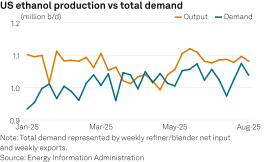
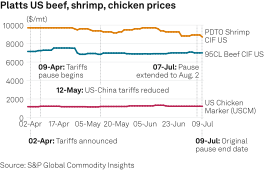
The July 22 framework also outlined expanded access for US beef and pork into the Japanese market, with Tokyo agreeing to work toward reducing tariff-rate quota barriers that have limited imports in recent years. For corn, rising domestic shortfalls have made Japan more reliant on US supplies, particularly for both food and feed use. The agreement also highlighted Japanese interest in scaling imports of US-origin bioethanol, provided that new blending or sustainability rules create additional demand.
It added that the Japanese government is also working to accept US-manufactured and US-safety-certified passenger vehicles for sale in Japan without additional testing. Separately, Japan will purchase US-made commercial aircraft and US defense equipment.
Tokyo has agreed to invest $550 billion in US sectors, including energy infrastructure and production, LNG, advanced fuels, grid modernization, critical minerals mining, processing and refining, and commercial and defense shipbuilding, including new yards and modernization of existing facilities. It will also target pharmaceutical, medical production and semiconductors.
"These investments -- which will be selected by the United States government -- will generate hundreds of thousands of United States jobs, expand domestic manufacturing, and secure American prosperity for generations," the executive order added.
"Regarding reciprocal tariffs, it has been decided that, retroactively from Aug. 7, items with existing tariff rates of 15% or more will not be subject to additional tariffs, while items with rates below 15% will be charged a tariff of 15%, including the existing rates," Japanese Prime Minister Shigeru Ishiba told reporters in Tokyo Sept. 5.
"For automobiles and automobile parts, the tariff will be reduced from 25% to 15%, including existing tariffs," Ishiba said. "Additionally, for semiconductors and pharmaceuticals, even if sector-specific tariffs are imposed in the future, our country will not be at a disadvantage compared to the EU, and no tariffs will be imposed on aircraft and aircraft parts."
The US' 25% tariff on automobiles separately took effect April 3.
The US was Japan's largest export market in 2024, with exports valued at Yen 21.295 trillion ($145.19 billion), according to data from the Ministry of Finance. Motor vehicles accounted for Yen 6.026 trillion, or 28.3%, marking the largest share of the country's total exports, the Ministry of Finance data showed.
Platts, part of S&P Global Energy, assessed New York Harbor any-September barges at $2.15/gal Sept. 4 at an unchanged 12-cent premium over September Chicago paper.
Platts assessed New York Harbor any-October barges at $2.1150/gal on Sept. 4, at an unchanged 13.50-cent premium over October Chicago paper.
Platts assessed the price of 90CL beef CIF US Sept. 4 at $7,077/mt, or $3.21/lb, for a 30- to 60-day shipment period, unchanged from the previous assessment amid a thin volume market.
