Metals & Mining Theme, Non-Ferrous
September 03, 2025
European Commission submits Mercosur trade deal to parliament, eyes minerals access

By Euan Sadden
HIGHLIGHTS
Agreement covers market of over 700 million people globally
Deal eliminates export taxes on critical minerals supply
Enhanced access to South American raw materials supply chains
The European Commission has put forward its proposals for a major trade agreement with South American bloc Mercosur to the European Parliament and Member States, opening the possibility of enhanced trade in critical minerals.
In a statement released Sept. 3, the commission said that, once approved, the trade agreement with the Mercosur countries -- Argentina, Brazil, Paraguay and Uruguay -- would create the world's biggest free trade zone, covering a market of over 700 million people.
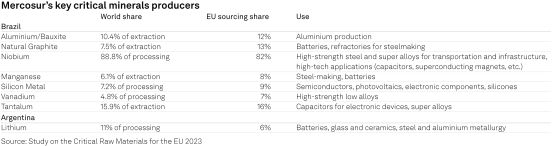
More specifically, the commission said the EU-Mercosur agreement will enhance EU competitiveness by strengthening access to critical minerals such as lithium, graphite, manganese and tantalum, with Mercosur countries accounting for a significant proportion of global supply.
According to a European Commission report published in 2023, Brazil currently accounts for around 13% of EU natural graphite supply and approximately 12% of aluminum/bauxite supply. Similarly, Argentina accounts for a 6% share of EU lithium supply.
"The agreement will make it easier for EU companies to invest in key supply chains, including for critical raw materials and related goods, all with a high level of environmental and labour protection," it said. "This can play a pivotal role in advancing the green and digital economic transformations of both regions, while ensuring predictable and stable supply chains."
According to a commission factsheet, the deal will enhance security and predictability of critical mineral supply chains by eliminating minimum pricing requirements and export taxes, while removing non-automatic licensing requirements that have created uncertainty for Europe-based importers.
The removal of these trade barriers could significantly reduce costs for European companies seeking to secure long-term supply agreements for materials like lithium from Argentina and graphite from Brazil. Under the proposed agreement, EU companies will also face no barriers to investing directly in Mercosur's critical mineral industries.
Given the complexity of the deal and potential concerns from some European agricultural sectors about increased competition from South American producers, the agreement is expected to take up to a year to secure approval from the European Parliament and individual EU member states.
The EU-Mercosur trade negotiations have been ongoing for over two decades, with talks repeatedly stalled over agricultural trade concerns and environmental protection standards. The agreement was initially reached in principle in 2019 but faced opposition from several EU member states, particularly France, over concerns about Amazon deforestation and competition with European farmers.
Platts, part of S&P Global Energy, assessed Lithium Triangle (LiT) FOB at $9,400/mt on Sept. 2, unchanged day over day.
The LiT assessment reflects industrial and battery-grade quality of lithium carbonate, with a minimum quality of 99.0%.
Platts assessed spodumene concentrate with 5.5-6.0% lithium oxide content at $830/mt FOB Brazil on Sept. 2, down $20 day over day.
