Metals & Mining Theme, Ferrous, Non-Ferrous
August 22, 2025
TRADE REVIEW: Tight molybdenum concentrate supply reverses market bearishness in H1 2025

By Teo Ngoma
HIGHLIGHTS
Molybdenum oxide prices up 12% from May 14-June 3 despite economic challenges
Traded volumes increase to 13,735 mt in H1 2025, with Busan leading at 46%
US tariffs create supply uncertainty, but spot prices remain stable in H1 2025
The molybdenum oxide powder market faces rapid economic and trade shifts due to US tariffs and retaliatory measures from China, the EU, and Canada. Despite strong headwinds, market volatility stayed low in early 2025 until supply tightened in May.
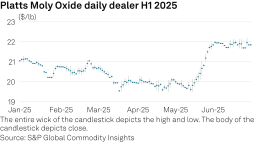
During the first quarter of 2025, the Platts Moly Oxide Daily Dealer benchmark dipped 5.2% from Jan. 2 to March 31, and continued to soften throughout April. However, prices jumped sharply between May 14 to June 3 by 12% to $21.975/lb Mo, the highest price level in H1.
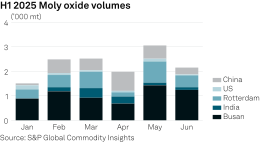
Traded volumes reported to Platts between Jan. 2 to June 30 reached 13,735 mt, up from the same period in 2024 at 10,197 mt. Busan remained the principal hub for moly oxide powder trades in H1 2025, accounting for 46% of all reported trades, followed by Europe with 22%. China was the third busiest location, accounting for 20% of all reported trades in H1 2025. Indian sales represented 8% of all reported spot sales, after experiencing heightened activity compared to 2024 due to the removal of import duties on molybdenum product to boost the local market in July 2024. The US market represented 4% of all Platts-reported deals in H1 2025. Overall, the increase in traded spot volumes was the result of lower volumes booked on long-term procurement contracts and lower inventories, pushing participants, especially traders, to the spot market to fulfil their monthly deliveries, sources said.
Despite a bearish economic outlook, geopolitical conflicts and trade tensions between the US and China, the moly oxide powder spot market showed resilience throughout H1 2025.
A floor price was reached at $19.55/lb Mo on March 18 and the spot assessment remained rangebound between $19.60-$20.10/lb Mo throughout April and first half of May.
Price hike amid tighter feedstock supply
Throughout the first months of 2025, market participants said molybdenite concentrates were widely available in Asia, underscoring a price drop to around Yuan 3,400/mt ($474/mt) from Yuan 3,600/mt at the beginning of January. Tightness on concentrate supply started from mid-May, pushing prices for oxide powder up as mines in China were holding off offering material to Chinese consumers, according to sources. As concentrate inventories dried up in Asia, most Asian consumers switched their buying interest to oxide powder, pushing prices upward. H1 2025 peak was reached on June 3 at $21.975/lb Mo. By June 30, moly oxide spot prices were assessed at $21.85/lb Mo, showing no sign of softening amid strong demand from Asia and limited material availability. On June 4, the price level for molybdenite concentrates was heard at Yuan 3,850-3,865/mt.
However, operational reports from major mining Western companies showed an overall increase in production from the major players such as Freeport McMoRan, Antofagasta or Southern Copper, reporting respective 7.1%, 34.5% and 9.4% rises in molybdenum production in H1 2025 compared to H2 2024.
Overall sales of molybdenum increased in H1 2025 from H2 2024 as Southern Copper and Antofagasta reported 8.7% and 37.7% rises in volume sold, respectively, while Freeport's sales volumes increased by 13.5%.
Other major Chinese producing companies, as well as Anglo American, did not disclose their molybdenum production for H1 2025 at the time of writing the article.
Indian spot market activity
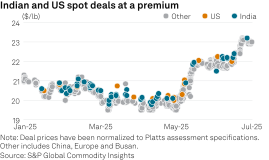
Deals prices in India and the US were significantly higher than in other regions like Busan or Rotterdam due to local market specificities. India, similarly to the US, is a premium market with prices at least 20 cents/lb Mo above Busan or Tianjin prices. The Indian market was reported to be more active this semester compared to a year ago, following a drop in the number of licenses granted by the Bureau of Indian Standard to foreign ferromolybdenum producers. Indian FeMo producers increased imports of spot moly oxide powder to account for the gap in supply. In addition, the conflict between Iran and Israel may have affected shipments between Iran and India, squeezing supply and pushing prices up.
"People are looking for prompt availability, which is not available," a converter said on June 23.
By the time of writing the article, the monsoon season and the end of hostilities between the two parties resolved the supply squeeze in the region.
US Tariffs uncertainty
In the US, tariffs implemented by the administration of President Donald Trump on imported goods created uncertainty for market participants with important market share in the US.
At the time of the article, the US administration imposed a blanket tariff of 10% on all goods imported into the country, in the absence of country-specific trade agreements, like the one negotiated with the European Union, Japan or South Korea in July and implemented on Aug. 7. Molybdenum, as of August, was not part of Annex II of the Executive order, exposing Chilean or Peruvian molybdenum to a 10% ad-valorem tariff rate.
However, in the US spot market, which only represents a fraction of the actual consumption of molybdenum, spot prices largely remained unaffected during H1, as most of the deals concluded were for material customs cleared before blanket tariffs were applied. Concerns remain, however, in the medium to long run, on how supply of molybdenum products, including ferromolybdenum, would be impacted in the US, and how prices would evolve.
What's to come
Equilibrium of supply/demand on the global molybdenum market will potentially remain precarious, exposed to market disruptions like trade policy shifts, mine shutdowns or geopolitical tensions. Sustained demand levels in China from molybdenum and ferromolybdenum producers will put Asia at the focal point of the global market, while the European spot market was not expected to recover in H2, according to market participants. Finally, as trade negotiations will continue between the US and its trading partners, sellers of molybdenum and ferromolybdenum on the US spot market continue to follow market developments, but said they were still assessing the impact of import duties on their selling margin or their selling prices.
