Coal, Metals & Mining Theme, Metallurgical Coal, Ferrous
August 15, 2025
TRADE REVIEW: Asian met coal market eyes recovery as Indian restocking, Chinese rebound shape Q3
HIGHLIGHTS
End-users pivot away from Australian supply; Chinese reselling pressure Q2 prices
Q3 demand hinges on India’s post-monsoon restocking, China’s fragile recovery
Australian supply recovery weighs on price rebound
This report is part of the S&P Global Energy Metals Trade Review series, where we dig through datasets and digest some of the key trends in iron ore, metallurgical coal, copper, alumina, cobalt, lithium, nickel and steel and scrap. We also explore what the next few months could bring, from supply and demand shifts to new arbitrages and quality spread fluctuations.
The Asian seaborne metallurgical coal market is looking forward to a recovery in the third quarter, supported by India's post-monsoon restocking and a potential rebound in China's domestic markets, despite mounting supply pressure from anticipated Australian mining resumptions following previous wet weather and safety concerns.
The market closed the second quarter of 2025 under pressure from Chinese reselling, limited end-user appetite and recovery of Australian supply, but entered the third quarter with sellers tentatively searching for a floor.
Premium hard coking coal (PHCC) prices fell steadily through Q2 after a brief rebound at the start of the quarter, with Platts' premium low-vol hard coking coal (PLV HCC) assessment nearing a three-year low of $173.5/mt toward the end of Q2.
The quarter began with temporary price rallies triggered by Australian supply disruptions, including mine suspensions at Australian mid-vol mines such as Moranbah North, Appin and Oaky Creek, heavy rainfall, and congestion at Dalrymple Bay and Hay Point terminals. However, these gains quickly faded as bearish steel fundamentals in China and India took hold.
The PLV HCC CFR China price steadily declined over Q2, dropping from $175/mt at the end of Q1 to $158/mt at the end of Q2, highlighting the persistent weakness of Chinese buying appetite.
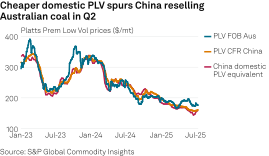
Wide price gap triggers Chinese reselling
The widened spread between Australian FOB prices and CFR China indices, alongside falling Chinese domestic prices, prompted Chinese end-users to resell their long-term contracted cargoes of Australian premium coal and even Canadian premium coal.
The spread between Platts PLV HCC FOB Australia and CFR China stood at minus $6/mt at the beginning of Q2 and reached a one-and-a-half-year high of $34/mt on May 28, before narrowing to $16/mt at the quarter's end.
Within Q2, Chinese traders and steelmakers were offering Oaky North cargoes loading over July and August.
Waning Chinese domestic prices in the quarter led to even Canadian cargoes -- linked to the Platts PLV CFR China floating prices -- being resold to an Asian buyer.
This wave of reselling placed further downward pressure on FOB Australian prices and narrowed the Australia-China price gap.
Following Q1, China continued to take a backseat as Asia's largest spot buyer, while its active coking coal futures contracts in Q2 saw prices reach a nine-year low in June.
Chinese domestic prices continued to be far more competitively priced against imports, with the average Q2 discount to CFR China prices at $11.6/mt, according to data from Platts, part of S&P Global Energy.
"A notable trend in coking coal markets is China's shifting status to being a coking coal exporter...The surge in export volumes indicates oversupply conditions in the domestic market", analysts at Energy said June 28.
Asian end-users shift blends to reduce costs
Amid weak coke and steel margins, end-users across Asia diversified their blends in Q2 to manage costs and reduce reliance on expensive Australian materials. Indian buyers increasingly turned to competitively priced US, Mozambique, and Canadian coal, while Southeast Asian mills also shifted interest toward Canadian or US origins, further eroding Australian market share.
"Australian premium coal is too costly to us under the current market conditions. We have to pivot away. Canadian premium coal works well in our ovens," a Southeast Asian end-user source said, noting their recent term contract for Canadian PLV was linked to the Platts CFR China index.
However, Indian buyers supported Australian spot PHCC demand, and trading activities were largely limited to break-bulk purchases in Q2 -- primarily premium mid-vol Goonyella. End-users reliant on Australian premium mid-vol coal as a key blending component were observed paying higher premiums over the quarter amid a comparatively tight supply of PMV coal after the accidents.
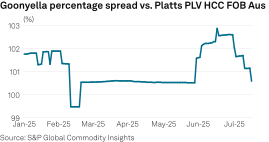
Otherwise, buyers leveraged competitive alternatives to maintain flexibility amid deteriorating steel market conditions.
In H1 2025, India's metallurgical imports from Australia dropped to 19.1 million mt from 20.2 million mt a year earlier, whereas its US imports rose to 5.5 million mt from 4.9 million mt in H1 2024, and inflows from Mozambique increased to 2.4 million mt from 2.1 million mt, according to data from S&P Global Commodities at Sea.
Q3 market trajectory
With forward cargoes from Australia facing stiff competition and end-users avoiding unnecessary exposure to high-priced material, Q3 opened with the market watching whether Indian restocking and Chinese sentiment shifts can halt the downtrend.
India's extension of quantitative restrictions on met coke imports for the rest of the year is likely to support coking coal demand.
Meanwhile, its post-monsoon restocking needs could also lift coking coal spot demand, though buyers remained cautious about the impact of quota allocation.
"Although quotas for popular coke origins like Indonesia remained unchanged from the first half of the year, there is an expectation that any unused quotas from other origins may be reallocated for them," an Indonesian supplier said.
"If more competitively priced Indonesian coke remains available, Indian cokeries may remain cautious on restocking coal," the source added.
"We have increased our price forecast for PLV HCC FOB to $178/mt in Q3, up from our previous estimate of $172/mt, driven by stronger demand expectations from India. We expect prices in the second half of 2025 will average $181/mt FOB, giving a full-year average of $183/mt, compared with $178/mt and $181/mt, respectively, in our June report," analysts at Energy said July 31.
China remains the biggest uncertainty. Late-June rebounds in coking coal futures and steel prices sparked tentative optimism, but questions persist about the durability of this recovery in Q3.
As domestic confidence strengthens, the reselling of Canadian coal has begun to recede. Rebounds in Dalian futures in early July spurred a pick-up in demand for second-tier hard coking coal, tightening availability as cargo holders redirected supply to DCE to secure margins.
"The recent rebound reflects both fundamentals and sentiment, but sustainability hinges on downstream steel demand and any concrete policy support," a Chinese trader said.
Whereas uncertainties persist on the demand side, there were visible signs of Australian premium coal supply recovery. Production of Australian premium mid-vol Illawarra from the Appin mine resumed on April 23, and spot cargoes were traded in July. Oaky Creek mine operations were also heard to have resumed at the end of June, according to market participants.
Logistics have also improved, with Hay Point waiting times reduced from a month to just one day, reflecting smoother operations, market sources said July 5.
"The shorter waiting times at Hay Point show mines are operating normally again," an international trader said July 8.
This recovery will test the market's ability to absorb volumes without price erosion, especially as China and India remain cautious.
