Metals & Mining Theme, Energy Transition, Non-Ferrous, Renewables
August 13, 2025
Lithium demand for battery storage, EVs undervalued amid price recovery: execs

HIGHLIGHTS
US EV growth slow; major opportunities elsewhere
Energy storage emerging as key driver of lithium demand
The market is undervaluing the potential growth in lithium demand driven by the electric vehicle and battery storage sectors, especially as prices show signs of recovery, according to Australian executives at a major industry conference.
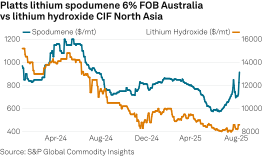
The Platts-assessed spodumene FOB Australia price was $975/mt on Aug. 12, well down from its November 2022 high of $8,200/mt. The Platts-assessed lithium hydroxide CIF North Asia price was $8,850/mt on Aug. 12, down from $11,700/mt on Aug. 13, 2024.
"We are seeing pain through the whole supply chain," including lithium raw material and chemicals producers, Dale Henderson, managing director and CEO of Pilbara Minerals Ltd., told the Diggers and Dealers Mining Forum in Kalgoorlie, Australia, on Aug. 5.
Part of this pain has been attributed to sluggish EV growth. In July, the US rescinded tax credits for EV purchases as part of US President Donald Trump's One Big Beautiful Bill Act, a move that will "likely stymie the development of the US EV sector," S&P Global Energy metals and mining research team wrote in an Aug. 8 note.
However, Australian executives urged investors at the forum to look outside the US for significant growth opportunities in EVs and battery storage, both of which require lithium.
"Everyone seems to get fixated on North America. Yes, it is subdued. Yes, government policy in that [US] jurisdiction is creating headwinds; but frankly, it does not represent the overall market," Tony Ottaviano, managing director and CEO of Australia's newest lithium producer, Liontown Resources Ltd., told the forum.
Ottaviano said countries with greater populations than the US, such as Brazil and Mexico, have helped drive a 22% year-over-year increase in global battery EV sales in the first half of 2025, according to his presentation.
Ken Brinsden, the Australian CEO, president and managing director of Canada-headquartered lithium developer Patriot Battery Metals Inc., told the forum on Aug. 4 that "we [as an industry] are definitely being too cautious on demand."
"I know people talk about ... North American EV sales as though it is some sort of horror story and Trump is creating havoc ... and it is all bad news, but it does not matter. North America is not the main game. It was never the main game from a lithium raw material demand point of view. It is all about the rest of the world. And the rest of the world is going gangbusters."
"The industry is going to move back to a more natural state of demand outstripping supply much faster than the Western analysts are currently giving it credit for."
Henderson, who succeeded Brinsden as CEO of Pilbara Minerals, said global EV sales have "surprised to the upside" despite the fact that "heading into this calendar year, some forecasters were predicting headwinds, particularly from the US."
"The demand drivers shaping this industry remain unchanged -- it's about the energy shift, technology shift, and government stimulus," Henderson said. He cited the International Energy Agency's forecast that $3.3 trillion will be spent this year on energy, of which two-thirds is on clean technologies.
Lithium demand for energy storage
Lithium demand from energy storage systems is emerging as a "structural pillar catching up to EVs, and [is] not yet widely reflected in forecasts," according to Ottaviano's presentation.
"What we are predicting is as the future pans out, by 2029 ... one in every four lithium units will direct themselves into energy storage. We believe the market continues to underestimate the demand coming from this sector," Ottaviano said.
Global stationary storage growth in the June quarter showed over 120% annualized growth, with an about 200% increase in June from a year earlier, Brinsden told delegates.
"So there is a reasonable chance that in stationary energy storage, we are actually still accelerating. This market is going to be much bigger than the EV market -- much bigger -- because global energy networks need to be stabilized and we need to smooth the available power," Brinsden said.
"We think analysts are underestimating battery energy storage systems like they underestimated solar power growth."
Not a straight line for energy transition
Henderson said that while "EV adoption continues to take flight at different rates depending on different markets ... the energy transition and technology adoption we are witnessing was never going to be a straight line."
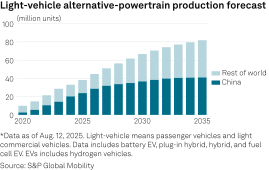
China has increasingly dominated global EV production. The country accounted for 2.57 million of the 9.93 million units produced globally in 2020, and 15.39 million of the 33.04 million units produced in 2024. By 2035, China is expected to make 30.95 million of the world's total of 81.88 million units, according to S&P Global Mobility.
"Global EV sales continue on an upward trend, up 29% [year over year] in May, led mainly by gains in China," Suzanna Massingue, low-carbon transportation analyst at Energy, said in an Aug. 12 email.
"From January to May, sales in China accounted for more than 70% of global sales, showcasing the country's dominance. When excluding China, [year-over-year] growth in May was closer to 11%, with slower sales in the US (at 5% [year-over-year] growth) and recovery in the European market (up 19% [year over year])."
