Metals & Mining Theme, Non-Ferrous
July 16, 2025
TRADE REVIEW: Asian lithium market to face challenges in Q3 with persistent oversupply, stalled demand
By Marco Loke and Litian Wang
HIGHLIGHTS
Lithium trading slows on global trade tensions, oversupply issues
Seaborne spot liquidity muted amid weak downstream appetite
Spodumene prices drop as refiners cut output on negative margins
This report is part of the S&P Global Energy Metals Trade Review series, where we dig through datasets and digest some of the key trends in iron ore, metallurgical coal, copper , alumina, cobalt, lithium, nickel and steel and scrap. We also explore what the next few months could bring, from supply and demand shifts to new arbitrages and quality spread fluctuations.
The Asia lithium market faces continued downward pressure in the third quarter as persistent oversupply and elevated inventory levels across the entire value chain weigh on prices, with no substantial production cuts from upstream miners or midstream refiners despite declining prices, compounded by the typical off-season for EV sales in July and August.
Lithium carbonate prices decline in Q2
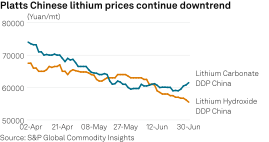
Chinese lithium carbonate prices experienced a downward trend in Q2, hitting a four-and-a-half-year low of Yuan 59,000/mt ($8,228) on June 20, driven by increasing market pessimism and oversupply expectation.
Trading activity slowed in Q2 amid uncertainty from ongoing US tariff-related trade tensions and weakened market confidence resulting from persistent lithium oversupply.
A consumer noted that downstream inventories are excessively high - at about 40,000 mt in June versus 30,000 mt in March - leading to buyers' reluctance to place large orders. "Everyone is maintaining a need-only buying strategy to keep inventory levels lean," said a trader.
According to China's Automotive Power Battery Industry Innovation Alliance, China's power battery sales in China in May grew just 1.0% month-over-month — far below March's 30.7% and February's 6.4% - and contributed little to alleviating the rising inventory levels of lithium chemicals in Asia.
Meanwhile, market sources shared that the monthly lithium chemicals production is trending upward. Some low-cost salt lake producers are ramping up output to further dilute fixed costs and gain market share.
Several producers suspended operations in April and May due to negative margins, citing maintenance or technical upgrades. While some returned to the market in June after successfully reducing processing costs, others resumed production despite losses to preserve market share.
Platts, part of S&P Global Energy, assessed lithium carbonate on a DDP China basis at Yuan 64,200/mt on July 9, down 13.24% from April 1.
Looking ahead, market participants remained cautious. Some expect prices to bottom out around Yuan 55,000/mt before rebounding, as high-cost producers exit.
"Unless ineffective production capacity is phased out, inventories will keep building," said a producer. "Focusing on economically viable and sustainable operations will rebalance between supply and demand in the lithium industry," the producer added.
Weak demand weighs on lithium hydroxide prices
A trader noted that cathode manufacturers are sourcing only battery-grade lithium carbonate in the spot market. This is due to weak order volumes for nickel-manganese-cobalt (NMC) battery cathodes, which usually require lithium hydroxide, with most demand covered by term contracts. Additionally, lithium carbonate also offers a longer shelf life than its hydroxide counterpart.
Platts assessed lithium hydroxide at Yuan 56,000/mt DDP China on July 9, representing a 17.04% decrease from April 1, leaving a Yuan 8,200/mt price gap between hydroxide and carbonate.
Seaborn lithium chemicals track Chinese market trends
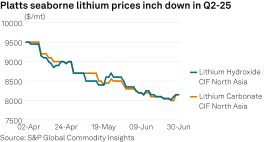
Platts assessed battery-grade lithium carbonate and lithium hydroxide at $8,300/mt CIF North Asia as of July 9, down 12.63% from $9,500/mt on April 1.
Spot liquidity for lithium in the seaborne markets of South Korea and Japan remained limited throughout Q2, as term contracts cover roughly 90% of their lithium demand.
A Chinese lithium producer noted that South Korean consumers have been reducing their term contract volumes. Similarly, Japanese traders reported subdued spot activity due to persistent sluggish demand.
Market sources noted that declining plug-in electric vehicle (PEV) sales in key western export markets are pressuring seaborne lithium prices.
"[US] automakers, dealers and consumers are slowing their efforts to promote and adopt PEVs as they digest potential changes to incentives," said Alice Yu, principal analyst at S&P Global Energy metals and mining research team.
International market participants are also closely watching the potential expiration of the Inflation Reduction Act (IRA) and the expected unveiling of the One Big Beautiful Bill (OBBB), both of which could significantly reshape the clean energy incentive landscape.
Spodumene falls further in Q2 amid margin pressure
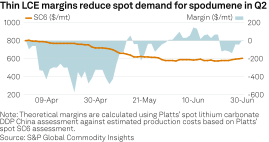
Spodumene spot trades remained subdued in April and May as lithium carbonate margins turned increasingly negative. During this period, several Chinese lithium refiners reportedly suspended or cut production, further curbing spodumene demand. This accelerated the decline in spodumene prices, helping refiners to narrow losses amid ongoing cost pressure.
In June, as Australian miners approached the end of their fiscal year on June 30, spot bidding activity picked up. Albemarle concluded a 250 mt battery-grade lithium carbonate at Yuan 59,910/mt and 300 mt at Yuan 60,010/mt EXW China and another 300 mt at Yuan 60,010/mt EXW China on June 18. Meanwhile, SQM awarded 10,000 mt of Australia-origin spodumene at $635/mt CIF China on June 26.
These bidding events modestly boosted market sentiment, supporting spodumene prices heading into Q3. Some refiners who had previously suspended their operations also resumed production, contributing to the slight price recovery in June.
However, market participants remain cautious amid ongoing oversupply and are closely watching for potential miner production cuts.
Platts assessed spodumene concentrate with 6% lithium oxide content down 18.13% from April 1 to $655/mt FOB Australia on July 9, while spodumene concentrate with 5.5% lithium oxide content was assessed at $620/mt CIF China.
Platts assessed spodumene concentrate with a 0.1% differential to 6% lithium oxide content at $10.92/mt FOB Australia on July 9. The value per 0.1% lithium oxide is considered linear for spodumene concentrate containing lithium oxide in the 5.5%-6% range.

Editor: