Metals & Mining Theme, Ferrous
July 11, 2025
Egyptian steel rebar imports intensify pressure on Brazil's oversupplied market

HIGHLIGHTS
Foreign producers plan more volume for Latin America
Mercosur-Egypt agreement zero-tariff benefits deals
This is the first in a two-part series examining the price and demand landscape in Brazil's domestic rebar market. To read the second part of this series click here.
The Brazilian domestic steel rebar market is experiencing heightened competition, with new entrants like Sinobras, Aço Verde do Brasil and Simec adopting more aggressive strategies in the Southeast, while traditional leaders ArcelorMittal and Gerdau are also engaged in a fierce battle for market share. Adding to this dynamic, a lesser-known name has intensified price competition in the long steel sector: Egypt.
Supported by the bilateral agreement between Mercosur and Egypt within zero-tariff benefits, shipments of Egyptian rebar to the country have grown significantly in the last three years, going from second place among the main supplying countries with 2,000 mt in 2022 -- behind Turkey with 125,934 mt, to first position in 2024, with 149,235 mt sold.
January through June, 98,410 mt of Egyptian rebar had already arrived in Brazil, also leading among supplier countries, followed by Russia (3,677 mt) and Germany (447 mt), according to the latest data from the Brazilian Ministry of Development, Industry, Commerce and Services, or MDIC. The imported rebar entered Brazil via the ports of Itajaí, São Francisco do Sul and Fortaleza.
As a category C product for the entire Mercosur, as provided for in the free trade agreement, rebar had exemptions removed in eight equal stages, the first being on Dec. 6, 2017, and the following seven stages at 12-month intervals. Dec. 6, 2024, was a date with the total drop in tariff exemptions foreseen for rebar in Brazil, which coincides with the increase in imports, the Arab-Brazilian Chamber of Commerce, or ABCC, pointed out.
The secretary-general of the ABCC, Mohamad Mourad, explained that Egypt has been establishing itself as an increasingly relevant player in the export of finished steel as it is able to place products in different markets, through its logistics hubs, under very competitive conditions.
"What we will see from now on is a movement of contributions [of Egyptian steel] in the Brazilian steel market, which will possibly gain space as the product becomes accessible to its buyers and proves its technical qualities," he told Platts via email. "It is therefore expected that the product will also gain space in other Mercosur countries, as is already happening in Brazil."
Exports of steel products from Egypt to the entire world grew 103% between 2022 and 2023, from $458.49 million to $933.60 million, with the main customers being the US, Romania and Turkey, Mourad added.
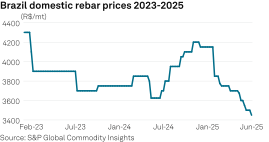
Since the beginning of 2025, Platts has assessed Brazilian domestic rebar average prices falling from Real 4,150/mt Jan. 10 to Real 3,450/t July 4, a drop of Real 700/mt or 16.8%.
Platts is part of S&P Global Energy.
Turkey leaves the scene
In the opposite direction, the Turkish rebar market, which paved the way for importing the product into Brazil, has been losing ground in the region despite its sales history and technical certification already absorbed by the Brazilian market. In 2024,Turkey sent 12,561 mt to Brazil, compared to another 12,262 mt the previous year and, those already mentioned, 125,934 mt in 2022.
Among the reasons for a decline in shipments of Turkish rebar to Brazil, a Turkey-based trader pointed to the free trade agreement between Egypt and Brazil.
"No import tariff is paid on Egyptian steel," he said.
Another market source in the Turkish market also said that Brazil makes a lot of purchases of rebar with smaller gauges, close to 8 mm and that is why it stopped doing business in the country.
A source at the Marmara mill said Brazil was no longer a target market, attributing a loss of market share mainly to uncompetitive prices.
Turkish rebar producers also face domestic challenges related to construction demand and quota limitations on sales to Europe.
The initial balance for the European Q3 import quota for Turkish rebar tariff-free, which was set at 96,390 mt, had 34% of the total volume awaiting allocation on its first day.
Year to date, Platts assessed Turkish exported rebar price has gone from January's $565/mt FOB to $535/mt FOB on July 2, a decline of $30/mt or 5.31%.

Editor: