Metals & Mining Theme, Non-Ferrous
June 01, 2025
Indonesia makes headway against illegal tin mining, promising market relief

HIGHLIGHTS
Crackdown on illegal tin mining has limited production
Industry experts expect a recovery as the state concludes its investigations
Indonesia's progress converting illegal tin mining assets into legal and producing operations could help ease a global supply crunch for the battery metal, according to industry experts.
The growing popularity of electric vehicles has increased demand for tin, an anode material that boosts the performance of lithium-ion batteries. Indonesia is the world's second-largest producer of refined tin behind China, but illegal mining has been a major problem in the industry. An illegal scheme allegedly involving collusion with state-owned Timah Tbk led to massive financial losses for the government as well as environmental damage.
In April, Indonesian authorities confiscated five smelters allegedly involved in illegal mining, according to local media reports. The smelters will now be managed by the state. The Attorney General's Office said the seizure was not meant to halt tin exploration and that operations are expected to resume soon under new management.
The crackdown on illegal mining restricted Indonesia's production in 2024, exacerbating tightness in global supply. The anticipated restart of the smelters would help add supplies to a tight market, experts told Platts, part of S&P Global Energy.
"We are currently seeing output from Indonesia recovering ... and we expect this recovery to continue in 2025 and beyond," Freddie Mitchell, market intelligence analyst at the International Tin Association, said in an email.
Production hurdles
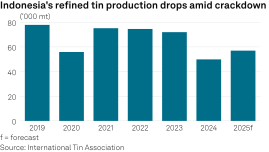
The confiscated smelters represent half of the country's refining capacity, according to the ITA. As a result of the seizures, Indonesia's refined tin production dropped 30.7% in 2024 to 49,900 mt, the country's lowest output in over 20 years, ITA data shows.
The country's annual refined tin production reached at least 72,000 mt in 2019 and 2021–2023 before authorities increased scrutiny on the industry. Lockdowns due to the COVID-19 pandemic halted the global industry and Indonesia only produced 55,900 mt in 2020.
The ITA expects Indonesia's refined tin production to rise to 57,000 mt in 2025 as the government concludes its probe.
Deeply ingrained
Prior to the crackdown, Indonesia struggled to contain illegal tin mining, a practice that has been entrenched in the local economy for decades. Timah controls more than 90% of the licensed tin mining areas in the country, but the company's output only represented 30% to 40% of Indonesia's tin exports for years, according to Inav Haria Chandra, an equity research analyst at PT OCBC Sekuritas Indonesia.
The unaccounted output is likely processed by private smelters that source ore from middlemen, who buy material from smaller miners digging around Timah's licensed area, Inav said.
"Small miners prefer selling to middlemen because it's easy money — no paperwork, instant cash, and no strict quality checks," Inav said in an email. "Private smelters often paid better too, since they avoided environmental and reclamation costs that Timah has to bear. For small miners, this was a faster, more profitable way to earn a living."
Changes are coming for Indonesia's tin industry. Authorities have arrested alleged middlemen, including certain prominent businesspeople. The government has also expanded its SIMBARA tracking platform to include tin, aiming to trace the mineral's origin from mine to export.
"This is the strongest action we've seen in years, and it's already starting to clean up the industry," Inav said.
But it is still too early to say if Indonesia can completely eliminate illegal tin mining.
"The recent crackdown efforts by the government are a positive step," Thomas Radityo, an equity research analyst at Indonesia-based Ciptadana Capital, said in an email. "However, for these efforts to have a lasting impact, consistent and effective enforcement will be crucial, which has historically been a challenge."
Challenges everywhere
Despite an expected supply recovery in Indonesia, regulatory hurdles are limiting producers' ability to ramp up output. The government's new RKAB system for approving domestic mining production and sales quotas has increased the oversight of miners, but it also slowed the approvals process. Indonesian miners are also reconsidering new investments due to higher costs linked to a recent increase in mineral royalties.
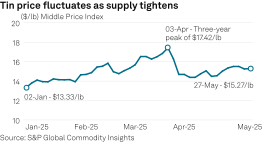
The developments in Indonesia are expected to increase volatility in the tin market. The Platts-assessed price of tin was $15.27/lb in-warehouse US on May 27, rising 14.6% from $13.33/lb at the start of 2025. The price reached a three-year peak of $17.42/lb on April 3 amid unrest in the eastern Democratic Republic of Congo that led to interruptions at Alphamin Resources's Bisie mine.
Amid the volatility, the ITA expects the global refined tin market to record a supply deficit of 7,600 mt in 2025.
"Although supply from Indonesia is recovering, there remain disruptions elsewhere," ITA's Mitchell said.

Editor: