Metals & Mining Theme, Non-Ferrous
May 20, 2025
Lithium Triangle region remains strategic amid uncertainties and trade disputes

By Anne Barbosa
HIGHLIGHTS
Recent market dynamics may impact tax revenue, employment in the region
Argentina, Chile see opportunities to industrialize, find new partners
Immediate reduction in exports is not expected at this moment
Despite the recent tariff agreement between China and the United States, the ongoing trade dispute continues to create global uncertainties and may affect tax revenue and employment in the Lithium Triangle of Argentina, Chile and Bolivia. However, it also presents opportunities, specialists told Platts, part of S&P Global Energy.
Manuel Viera Flores, president of the Chilean Mining Chamber, said in a recent interview that although some minerals are currently tariff-free, "We must be cautious about what may come and be prepared for it, as any tax increase is negative for the development of various economic activities."
He mentioned that demand for lithium, which is essential for electric vehicle battery production, may decline due to the current weak price trend and availability of substitutes like sodium and nickel. "There are more than 60 lithium projects in the world that will increase supply and tariff measures have a significant impact, as there will be lower tax revenue," he said.
Flores also affirmed that these measures could affect Chile and significantly impact employment. "Therefore, it is important to increase the number of countries to which we can sell our minerals."
Despite the challenging price environment, the Lithium Triangle region remains key in the global race for lithium supply. Imports from Chile and Argentina - the two largest suppliers of lithium salts to China - accounted for 95.8% of China's total imports.
Supply levels, economic implications
"Argentina and Chile are extremely critical countries for the United States in this sector and demand remains relatively steady for mineral goods, so an immediate reduction in exports is not expected at this time," Felipe Ramos, political risk analyst and international consultant, told Platts.
"The price variation in this sector is due to other reasons, but in the short term, there is much more fear of instability than a disruption in the current supply levels of these goods from these countries," Ramos said.
The trade dispute contradicts the energy transition movement and can change price dynamics, said Daniel Dreizzer, managing director at Aleph Energy.
"Important parts that make up electric vehicles, such as lithium batteries, have many imported components and this can increase the cost across the entire supply chain," Dreizzer said.
"Argentina already has its own serious problems and something international like this puts the recovery and macroeconomic stabilization at greater risk, in addition to making it more difficult to attract investments," he said.
Dreizzer added that the back-and-forth tariff movements indicate the dispute can change easily. "It is not something structural - just as it came, it can go away. It's not like the pandemic, so it can be corrected quickly if that's the case."
Chile exported 91,610 mt of lithium during January-April, up 2.7% year over year, customs data showed. While exports to Japan, South Korea and the US all rose, exports to China, the traditional main buyer, fell 2.4% to 63,301 mt.
For that reason, Flores affirmed that beyond lithium, "Chile has a high dependence on copper and mineral districts, so any tariff imposed to enter a market brings dire consequences for the country because the economy is based on a raw material export process, which makes it vulnerable."
Flores also sees industrialization as an opportunity. "Our perception at the Chilean Mining Chamber is that the country is in a favorable moment to industrialize raw materials, a topic that I believe authorities should control," he concluded.
Meanwhile, Bolivia, also part of the group, is investing to formally start lithium production, focusing on closing contracts and partnerships to increase production and reduce costs, a source linked to the country told Platts.
Neighboring Brazil's emerging opportunity
Beyond the Lithium Triangle nations, Ramos highlighted Brazil's role in the critical minerals race. Already among the top global lithium producers, the country also sees opportunities in other fields.
"Brazil has about 23% of the international rare earth reserves, but with very little production," Ramos said. "These recent discoveries are of great interest to the United States, because the US finds itself in an extremely vulnerable position regarding the ongoing process of creating difficulties, especially with China."
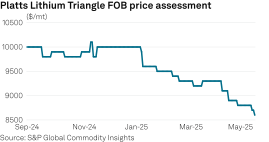
Platts, part of S&P Global Energy, assessed FOB Lithium Triangle prices at $8,600/mt on May 20, stable from the previous day and down 14% since its launch in September 2024.

Editor: