Metals & Mining
May 13, 2026
FACTBOX: Trump-Xi summit to tackle China's rare earth dominance

By Euan Sadden
Editor:
HIGHLIGHTS
Summit scheduled for May 14-15
China controls 91% of global rare earth refining capacity
Export curbs forced auto plant shutdowns in US, Europe
US access to critical minerals and rare earth elements is expected to be a central issue on the agenda when US President Donald Trump and Chinese President Xi Jinping meet in Beijing on May 14-15, a topic of growing strategic importance amid escalating trade tensions and recent export restrictions imposed by China.
"The center of gravity moved away from tariffs — long seen by Trump as the decisive lever — and toward something more structural: China's control over critical minerals, rare earths, and the magnet supply chains that underpin modern military capability and advanced manufacturing," Heidi E. Crebo-Rediker, a senior fellow in the Center for Geoeconomic Studies at the Council on Foreign Relations, said in a paper published May 10.
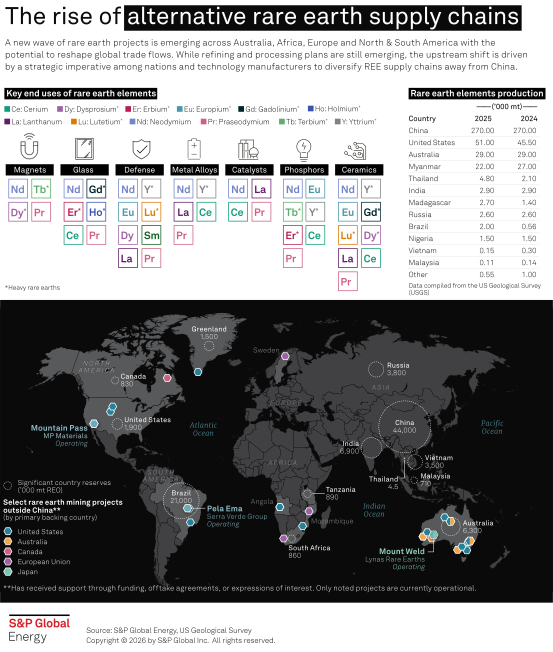
The US continues to rely on China for the majority of its rare earth supply. According to the International Energy Agency, China accounted for 61% of global mined supply and 91% of global refining and processing capacity for key rare earths in 2024.
China also maintains a dominant position in the processing of other critical minerals, including lithium, copper, cobalt, and graphite.
"The United States heads to the summit facing an uncomfortable reality: Its rapid expenditure of advanced weapons systems in the Middle East and Ukraine will compound deep vulnerabilities in supply chains tied to rare earth elements and permanent magnets — inputs overwhelmingly dominated by China," Crebo-Rediker said, adding that replenishing missile systems, precision-guided munitions, interceptors, and advanced electronics now depends on even greater access to materials processed or produced almost entirely within China's critical minerals ecosystem.
Rare earth elements
- Rare earth elements are a group of 17 metallic elements essential to the manufacture of catalysts, magnets, and batteries. Their applications span a wide range of industries, including petroleum refining, electronics, automotive manufacturing, and wind energy.
- These elements are also critical to modern military technologies such as lasers, radar, sonar, night-vision systems, stealth technology, and missile guidance and control systems.
- Magnets represent the largest market for rare earth metals. Neodymium, praseodymium, samarium, and dysprosium are primarily used to produce high-performance, lightweight Neodymium Iron Boron (NdFeB) and Samarium Cobalt (SmCo) permanent magnets. NdFeB magnets, in particular, are crucial for the rotor assemblies in electric vehicle motors.
Trade flows
Export Restrictions
- China has leveraged its dominance in rare earths as a geopolitical tool, employing export restrictions and licensing controls to signal its ability to disrupt global supply chains. In response to Trump's tariffs, China introduced export controls on several heavy rare earth elements — dysprosium, gadolinium, lutetium, scandium, terbium, and yttrium — and their related metals and magnets on April 4, 2025. These controls require foreign exporters to obtain a dual-use export license from the Ministry of Commerce before shipping these materials abroad.
- On June 11, 2025, Trump announced that the US and China had reached a "deal," suggesting an easing of trade tensions.
- On October 9, 2025, China announced significant new export controls on five additional rare earth elements — samarium, gadolinium, lutetium, europium, and ytterbium — and their related products, equipment, and technologies. Originally slated for November 7, 2025, these regulations were eventually suspended until Nov. 10, 2026.
The new rules broadened the definition of controlled items to include not only Chinese-origin rare earths and their compounds, but also foreign-made products containing Chinese materials or manufactured using Chinese technology.
Supply Impact
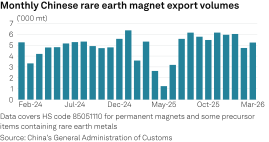
- The initial export restrictions in April 2025 led to a sharp decline in exports of rare earths and permanent magnets. According to the IEA, the extended permit approval process and resulting export drop in April and May forced the shutdown of several automotive production lines across the US and Europe.
- The European Commission described the situation as alarming, particularly for carmakers and appliance producers, and urged Beijing to ease licensing procedures
- Although export volumes recovered in June and July as US-China trade tensions cooled, Western industry associations, such as the European Association of Automotive Suppliers, continued to report inconsistent and unpredictable export licensing approvals through the second half of 2025.
- Should the suspended restrictions be fully implemented, the IEA, in a report released in April 2026, estimates that countries outside China could face an annual economic impact of $6.5 trillion, with the US and Europe most exposed. The automotive sector is particularly vulnerable, facing potential direct losses of over $3 trillion outside China, followed by the electronics and other transport sectors, including aviation, trucking, and rail, the IEA said in its report.
Prices
- China's export restrictions have also driven significant price volatility for rare earth elements, especially those used in magnets.
- The sharp drop in exports following the April 2025 controls triggered an initial price spike as buyers sought to secure supply. According to the IEA, European prices were up to six times those in China, hindering the cost competitiveness of rare-earth-based products manufactured outside China.
- In addition, rising demand from electric vehicles, robotics, drones, and defense applications continues to put upward pressure on key magnet raw materials, even as governments and manufacturers pursue diversification, recycling, and strategic stockpiling to reduce reliance on Chinese supply.
- Within rare earth markets, price sentiment remained bullish in April as defense, automotive, and other industries sought to replenish depleted inventories. Platts assessed samarium oxide CIF North America at $300/kg in April, marking a 140% month-over-month increase. Dysprosium oxide also saw a sharp rise, climbing $800/kg, or 67%, to $2,000/kg.
- In contrast, the Platts neodymium-praseodymium oxide CIF North America price was assessed at $120/kg in April, down $5/kg from March. Terbium oxide declined by $200/kg month over month, settling at $4,700/kg.