Metals & Mining, Ferrous
May 12, 2026
Asian steel mills step up CBAM compliance as carbon costs reshape EU trade flows
Editor:
HIGHLIGHTS
Asian mills accelerate CBAM compliance efforts
EU sets first carbon price at Eur75.36/mtCO2e
Import quotas constrain exports more than CBAM
Asian steelmakers are accelerating efforts to comply with the EU's Carbon Border Adjustment Mechanism as the announcement of a clear carbon price under the regime and tightening import restrictions begin to reshape export economics, trade flows and pricing structures.
Market participants said mills are prioritizing emissions reporting, third-party verification, and cost optimization to remain competitive in the EU, where carbon is increasingly factored into purchasing decisions alongside raw materials and freight.
CBAM developments
One of the most notable developments came on April 7, when the European Commission published its first CBAM certificate price of Eur75.36/metric tons of CO2 equivalent ($88.44/mtCO2e ) for the first quarter of 2026, establishing a key benchmark for carbon costs on imports.
Under the current timeline, importers will be required to purchase CBAM certificates from February 2027 to cover emissions embedded in 2026 imports, aligning their costs with those paid by domestic producers under the EU Emissions Trading System.
Li Fang, a CBAM researcher at HiQLCD, a Chinese life cycle assessment data platform, said the regulation remains widely misunderstood due to its complexity and evolving implementation details, leading to confusion in data sharing.
Uncertainty surrounding verification is also a major issue, especially as some European importers are already requesting officially accredited emissions reports from manufacturers, even though the European Commission has not yet released its list of recognized accreditation agencies, he added.
Meanwhile, Jing Liu, founder and lead consultant at China-based Jingzhe Environment and Climate, a CBAM research and consulting firm, said the key challenge with CBAM is no longer understanding the framework but whether the institutions responsible for verification are equipped to implement it credibly.
Carbon-accounting and emissions data providers such as HiQLCD , US-based Sphera and London-based CarbonChain are emerging to mitigate this challenge, stepping in to help companies improve emissions transparency and strengthen carbon reporting capabilities.
Quotas a more immediate concern than CBAM
While CBAM remains a major theme for steelmakers in 2026, regional suppliers said that trade policy developments are having a more immediate impact on market dynamics.
On April 13, the EU reached a preliminary agreement to tighten steel safeguard measures, including cutting import quotas and imposing tariffs on excess volumes, to shield the domestic industry from global oversupply and trade diversion.
Market participants said these safeguard quotas are a more immediate constraint on Asian exports than CBAM-related costs.
Latest European Commission data showed that India's hot-rolled coil quota under category 1A was exhausted within days of the new quota period starting April 1, with its allocation of around 225,305 metric tons quickly oversubscribed.
Indian steelmakers said demand from Europe was strong in the last quarter of 2025 and the first quarter of 2026, supported by frontloading ahead of the quota change.
"All our shipments to the EU will be out by the end of April, with cargoes to arrive before July when the new quota system takes place. Now demand in the EU slows down too," an Indonesian mill source said, adding that CBAM-related costs were fully borne by buyers and no carbon risk premium was factored into offer prices.
Novel accounting methods
A Singapore-based trader said some Asian mills are adopting alternative carbon accounting methodologies, leading to emissions figures that are significantly below standard default values.
Some were calculating emissions based on export volumes rather than total steel output, while others were using "mass balance accounting," a method Climate Group's SteelZero said could enable greenwashing if applied without sufficient rigor, allowing emissions reductions to be allocated to selected products without a direct link.
"It remains uncertain whether these methodologies will be accepted, and any decision could set an important precedent," the trader said.
In a position paper released last September, SteelZero warned that, if applied without sufficient rigor, mass-balance accounting could enable greenwashing by allowing companies to allocate emissions reductions across their portfolio to selected products without a direct link.
Significant cost gaps emerging
With growing emphasis on CBAM compliance, Asian mills are prioritizing emissions transparency as verified carbon data is increasingly affecting mills' cost competitiveness in the EU market.
Suppliers without accredited emissions data risk being assigned default values under CBAM, a punitive measure that substantially increases carbon costs.
According to Prabodha Acharya, chief sustainability officer at JSW Group, carbon costs are becoming a core pricing factor alongside raw materials and production costs. He added that JSW Steel has been submitting emissions data quarterly to EU customers and is seeking third-party certification. Its HRC emissions intensity is 1.8-2 tonnes of CO₂ per metric ton of steel, below the 4.7 tCO₂/mt default for Indian mills.
"Although the tax is formally paid by importers, its impact is being felt across the value chain," he said.
Market participants said buyers are increasingly favoring suppliers with lower verified emissions, and that carbon clauses and emissions benchmarks are becoming more common in contracts.
"Pricing is expected to diverge based on emissions intensity. It's a question of who can lower emissions, verify them and still offer competitively into the EU," an eastern China-based trader said.
With CBAM costs in place, many European buyers have turned to the domestic EU market for supply, as domestic prices have risen, supporting import markets.
"With import quota cuts, steel production in the EU is likely to ramp up to compensate. Prices are likely to rise further, but, of course, are subject to other market conditions," said a Hong Kong-based distributor.
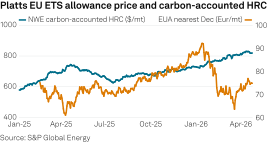
Platts, part of S&P Global Energy, assessed the EU Emission Allowance Nearest-December at Eur 77.24/mt ($90.84/mt) May 11, while Northwest Europe carbon-accounted HRC was assessed at $812.27/mt May 11, up $82.40/mt since the start of the year.
