Metals & Mining Theme, Non-Ferrous
May 07, 2025
US aluminum market nears possible trade flow shift as stocks dry up

HIGHLIGHTS
US aluminum stockpiles likely to deplete by July: market sources
Tightening supply may boost US Midwest Premium, attract overseas imports
Industry remains hopeful for US tariff concessions on Canadian aluminum
US aluminum inventories may soon run dry, potentially sparking price increases and shifting trade flows as the sector grapples with US tariffs, according to market participants and industry experts.
The aluminum industry expected the US's March 12 implementation of 25% tariffs on all aluminum imports to boost the Platts US Midwest Premium to 45-50 cents/lb. This price would attract aluminum imports from across the globe.
However, prices have stayed below this threshold due to pre-tariff stockpiling.
Market participants told Platts, part of S&P Global Energy, inventories will likely run dry by July, setting the stage for possible shortages and price hikes while aluminum starts to make its way from distant producers.
"While the Midwest premium increased with the introduction of tariffs, it has not reached the $880-$990/mt [44 to 49.5 cents/lb] level, which analysts predict support shipments from any region to the US," William Oplinger, CEO of US aluminum giant Alcoa, said in a recent earnings call.
"In our view, the Midwest premium has not fully responded due to the uncertain market sentiment as well as inventory build in the US ahead of the tariffs. The depletion of these inventories should trigger some upward response," Oplinger added.
The Platts spot 99.7% P1020 US Aluminum Transaction Premium was assessed at 38.25 cents/lb plus LME cash, delivered Midwest, net-30-day payment terms, on May 2.
This assessment, also known as the Midwest Premium, has risen 63.8% since the start of the year. It reached an all-time high of 41.75 cents/lb on Feb. 28 before decreasing slightly to current levels.
The Midwest Premium would have to reach at least 45 cents/lb to begin attracting overseas aluminum imports into the US, mostly from the Middle East, according to an April 30 report by S&P Global Energy analysts.
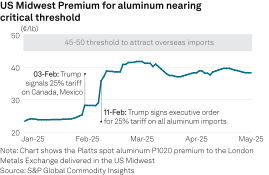
US aluminum stocks expected to run out
While the US consumption of pre-tariff aluminum stockpiles and weak spot market activity have kept prices below 45 cents/lb, market participants anticipate inventories to deplete by mid-summer.
"Inventory in the warehouses is declining, and metal is getting tighter. I see metal drying up in July," an aluminum producer said.
With current prices unable to attract imports, warehouses have not been able to replace the tonnage they sell.
An Owensboro, Kentucky, warehouse official told Platts that inventories dropped to 140,000 mt at the beginning of May from 200,000 mt in January.
"Stocks are still dropping, and we're not seeing any significant inbound," another warehouse official said.
A depletion of inventories could cause significant disruptions for the US industry, as overseas imports can take up to two months to arrive on American shores once ordered, an aluminum trader said.
"There is legitimate concern for June/July," the trader said. "I think it could happen where we run out of metal. It will be bad for the economy and the industry."
Others are not convinced about this scenario unfolding, suggesting that higher aluminum prices may start to affect end-users.
"Based on the current situation, we would expect the impact of high import tariffs and elevated US premiums to hurt domestic demand and reduce import requirements for aluminum and aluminum products," S&P Global Energy aluminum analysts wrote in their April report.
"Latest data on US manufacturing activity pointed to contractionary territory in March," the report added.
Karen Norton, principal aluminum analyst for S&P Global Energy and one of the report's authors, said her team does not see the Midwest Premium as undervalued.
"We have generally been more bearish on the premium than many quarters, so we would not necessarily take that view [of an undervalued Midwest Premium]. It does appear that demand is stronger than expected at the moment, but perhaps there is an element of pre-emptive buying," Norton said.
Industry hopeful for tariff exemption on Canada
Norton said the premium reaching 45 cents/lb threshold and sustaining at this level is a matter of "if rather than when."
"Certainly 45 cents has been cited as the level needed to attract metal from the Middle East in volume, but at the same time, nor are we necessarily ruling out the possibility of a more favorable agreement with Canada that could lead to a lower benchmark premium," Norton said.
Canada is a critical source of aluminum supply for the US, accounting for about 70% of US primary aluminum imports, according to Energy data.
The surge in the Midwest Premium has primarily been driven by the 25% tariff on Canadian aluminum. Canadian aluminum had received tariff exemptions in US President Donald Trump's first administration. The US aluminum sector has emphasized the importance of reinstating these exemptions.
"We've had ongoing conversations with the Trump Administration about the nature of the [aluminum] tariffs. We remain very optimistic that President Trump will find solutions that he found in his first term for the needs of our industry," Charles Johnson, president and CEO of the Aluminum Association, told reporters at an April 24 press roundtable.
The Aluminum Association is a US-based trade group representing US aluminum and aluminum product producers.
Canada elected Mark Carney as its prime minister on April 28. Carney has made it clear that his government will prioritize US tariffs and trade relations.

Editor: