Fertilizers, Chemicals
April 21, 2026
No quick sulfuric acid fix for Chilean copper sector: analysts

By Kip Keen
Editor:
HIGHLIGHTS
Chile faces sulfuric acid supply crunch
China accounts for 37% of Chile's sulfuric acid imports
Chilean prices surge 100%
Chile's mining industry would not have an easy time replacing sulfuric acid from China should reported export restrictions go ahead in May, analysts told Platts.
Chile is among the countries most exposed to changes in Chinese exports, analysts said. If restrictions are long-lived and Chile cannot source alternatives, copper production could be disrupted later this year.
Sulfuric acid prices increased in 2026, driven by the war in the Middle East and by blockades in the Strait of Hormuz. Almost half of the global seaborne sulfur used to make sulfuric acid comes from the Middle East, where it is extracted from oil and gas.
Chile produced 23.8% or 5.5 million metric tons of global mined copper in 2024, according to S&P Global Market Intelligence. Analysts estimate that about a fifth of the world's copper is extracted using sulfuric acid-based methods. How much of Chile's copper output China's export restrictions put at risk is hard to gauge, analysts said. But some disruption could be tough to avoid in part due to the logistics of organizing new supply chains for a dangerous chemical.
"Transport costs and safety constraints make this a regional market, so replacing Chinese volumes is not just a pricing issue but a physical availability one," Patricia Barreto, an analyst at S&P Global Energy CERA, said.
Big sulfuric acid source
China accounted for 37.1% or 1.5 million mt of Chile's imports of sulfuric acid products under HS code 2807 in 2025, according to S&P Global Market Intelligence's Global Trade Analytics Suite data.
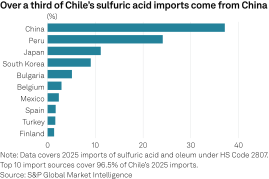
The next key source was neighboring Peru at 24.1%, or 1 million mt, followed by Japan at 11.1%, or 0.4 million mt.
Other countries, like Canada, produce some sulfuric acid, but shipping the stuff is not straightforward, said Marco Martins, an analyst at critical minerals consultancy Project Blue.
"That wouldn't materialize soon because of logistics and processing bottlenecks to put this [sulfuric acid] online into some form of export-ready material," Martins said.
The most obvious source of additional supply is Peru, but the country has limited extra capacity, analysts said.
Pain level
Miners have inventories of sulfuric acid and its use can also be adjusted at sites where the input is crucial to leaching copper, a process that can take months, analysts said.
"The leaching lead times for Chilean copper are quite long," Martins said. "I'm talking about several months. So that sort of creates a lag that can be helpful in terms of finding solutions to see how the market could settle."
Chilean buyers covered much of their sulfuric acid needs for the first half of 2026, but left a lot of the second half of the year uncovered, according to Fiona Boyd at Acuity Commodities. This means they will have to get back in the market soon to source sulfuric acid.
Even if Chilean buyers can find what they need, sulfuric acid could cost much more than it did just months or even weeks ago.
The Platts-assessed weekly spot price for sulfuric acid CFR Mejillones, Chile, was up 100% to $380/mt on April 15 as compared to Feb. 25, before the Middle East war began. The latest price was up 26.7% since April 8. Platts is part of S&P Global Energy.
The high price, while hurting miners on costs, could help spur and divert more supply to mining from the agricultural sector. The primary use of sulfuric acid is in producing fertilizers.
"An interesting point raised at [the CESCO Week copper event in April] was that some crops can go a year without fertilizer application, which suggests that, at current copper margins, some acid could be diverted from fertilizers to mining if prices are right," Barreto said, referring to a recent copper industry conference in Santiago, Chile.
Miners have started to report first-quarter earnings and will no doubt face questions about sulfuric acid supply and costs on earnings calls.
Big miners with operations in Chile did not respond to Platts emailed requests for comment.
