Fertilizers, Chemicals, Metals & Mining
April 15, 2026
China's sulfuric acid restrictions set to squeeze miners

By Kip Keen
Editor:
HIGHLIGHTS
Chile, Indonesia face supply squeeze
Copper, nickel output cuts could come
China's reported plan to further restrict sulfuric acid exports starting in May is set to squeeze miners on costs and supplies of the crucial input, especially in import-dependent countries like Chile and Indonesia, analysts said.
The Iran war disrupted the seaborne market for sulfur, which is needed to make the acid, which is then used to make fertilizers and also extract metals like copper, nickel and uranium. The Middle East is a key source of sulfur, extracted in oil and gas processing.
Market disruption could lead to wider output cuts in the metals mining sector, where higher sulfuric acid prices threaten to curb marginal production, and the combined effects of the Iran war and reported Chinese restrictions could hit availability, analysts said.
"A long-lasting ban could impact copper cathode production in Chile," said Yuya Pan, an S&P Global Energy CERA analyst, told Platts.
Other analysts pointed to uranium miners in Kazakhstan and nickel producers in Indonesia as sensitive to higher prices and sulfuric acid imports.
Big exporter
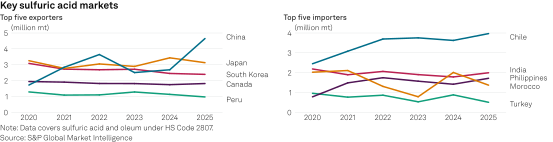
In 2025, China was the top global exporter of sulfuric acid, exporting 4.6 million metric tons of sulfuric acid and related products under HS Code 2807, according to S&P Global Market Intelligence's Global Trade Analytics Suite data. The top importer of sulfuric acid in 2025 was Chile at 4 million mt.
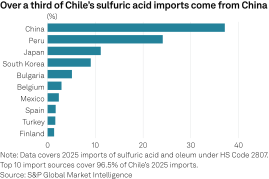
Chile and Indonesia are particularly dependent on China for imports of sulfuric acid. Chile imported 37.1% and Indonesia 61.6% of foreign sulfuric acid supplies from China in 2025, according to the data. Meanwhile, over three-quarters of Indonesia's sulfur comes from China.
"What is usually a low-profile industrial chemical is now acting as a binding constraint across both agriculture and metals processing," CERA analysts said in an April 13 report.
High prices for sulfur and sulfuric acid, fueled by the Iran war, have already affected some production of nickel-containing mixed hydroxide precipitate and cobalt in the Democratic Republic of Congo, according to media reports. Analysts expect deeper supply disruptions should China's restrictions prove broad and last for more than a few months, as the country is the world's top exporter of sulfuric acid.
"No, the rest of the world cannot fill the void," said David Davidson, a Paradigm Capital analyst.
Bottleneck
When, or if, sulfuric acid becomes a significant bottleneck for miners hinges on complex trade flows, as well as margins.
The CERA analysts pointed to thin margins in the nickel business as undermining economics and possibly curbing production at higher sulfuric acid prices.
"This creates a more pronounced risk of supply disruption, especially for battery-grade material," the analysts said in the April 13 report.
Sulfur and sulfuric acid prices have surged in many regions amid the Iran war.
Platts, part of S&P Global Energy, assessed the weekly spot price for sulfuric acid CFR Mejillones, Chile, at $300/mt April 8, up 57.9% from Feb. 25.
Chilean copper production is in the crosshairs given its reliance on sulfuric acid imports for heap-leach operations, analysts said.
For now, Chile appears well supplied for sulfuric acid, but the country could feel a squeeze in the second half of the year, Fiona Boyd, a sulfur and sulfuric acid specialist and consultant at Acuity Commodities, told Platts.
"There's uncovered demand in Chile for the second half," Boyd said.
In part, the impact on Chilean producers from Chinese restrictions will depend on whether miners have longer-term sulfuric acid supply contracts or if they have been buying on spot markets instead, along with inventory levels they can dig into, Patricia Gamboa, the Chilean Copper Commission's director of research and policy planning, said at the CRU World Copper Conference in Santiago, Chile.
"It could indeed affect production levels, but not immediately," Gamboa said April 15, adding Chilean miners have been diversifying sulfuric acid procurement from countries including Japan.
Chile's minerstypically cover their needs in annual contracts, but last year covered less sulfuric acid supply than usual, given less urgency at the time, Boyd said.
"They need to step in, probably in May," she said.
Boyd added there has been market speculation the Chilean government might seek talks over sulfuric acid supplies with China. China imports much of its copper from Chile, including copper concentrate, which feeds smelters, that in turn produce sulfuric acid as a byproduct.
Doubling sulfuric acid prices would add at least 50-cents/pound to copper mining costs at solvent extraction and electrowinning operations (SX-EW) in Chile, Davidson said, adding that high copper prices make the cost increase manageable.
SX-EW is responsible for about 20% of global copper supplies, according to Robert Friedland, copper-miner Ivanhoe Mines' executive co-chairman, who has warned about the impact of sulfuric acid and sulfur disruption to miners in social media posts.
"Some copper producers are operating with less than 30 days of foreseeable sulfuric acid supply," Friedland said in an April 12 social media post. He has previously warned of production cuts stemming from the Iran war's impact on the sulfur trade.
Meanwhile, uranium mining also uses sulfuric acid and some analysts see potential for supply disruption in the sector.
Higher costs could delay expansion plans at in-situ recovery uranium operations "and force some high-cost mines to postpone their production expansion plans," Yuanta analysts said in an April 15 report.
Sulfuric acid is typically used in both conventional uranium mills and in-situ recovery operations.
