Metals & Mining, Non-Ferrous
April 14, 2026
North American aluminum sector nearing 'supply crisis' after Middle East disruptions

Editor:
HIGHLIGHTS
Consumers to feel shortage impacts in summer 2026
Midwest Premium, global prices to stay at record levels
Experts look to potential trade policy changes
The North American aluminum sector is approaching a critical supply shortage as the impacts of lost Middle Eastern metal begin to settle in, industry leaders and experts told Platts.
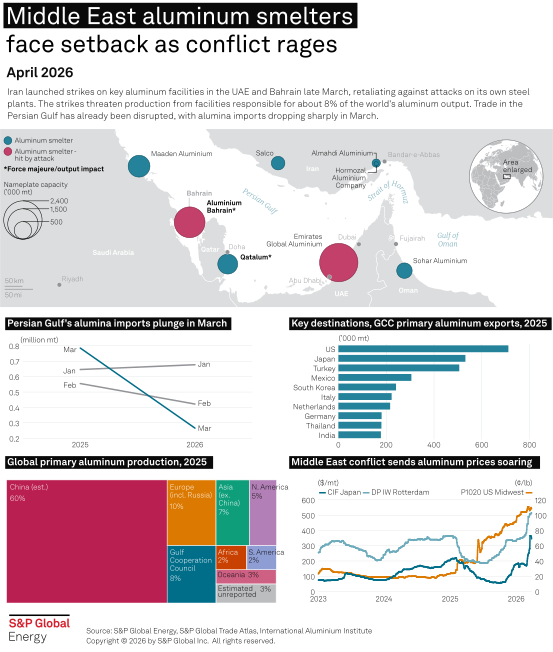
Iranian missile and drone strikes in the Persian Gulf region on March 28 shut down Emirates Global Aluminium's 1.5 million metric tons/year Al Taweelah refinery in Abu Dhabi and Aluminium Bahrain's 1.6 million mt/year facility. The disruptions to the facilities, along with logistical challenges through the Strait of Hormuz, are expected to strain a North American market already dealing with tight supply due to US tariffs.
"It is nearing a supply crisis," Jean Simard, president and CEO of trade group Aluminium Association of Canada, told Platts, part of S&P Global Energy. "Going into the Iran situation, North American aluminum markets already had very low inventories. In the coming weeks, we're heading into a very unhealthy situation where we will see a shortage, and prices will keep going up."
The UAE and Bahrain supplied 23% of US imports of unwrought aluminum in 2025, according to data from S&P Global Market Intelligence's Global Trade Atlas.
EGA estimates that its Al Taweelah refinery could be down for up to 12 months, while Alba has not provided an update on operations.
"Somewhere in that June to July time frame is when we're going to start seeing perhaps the shortage start occurring," Jeff Lehman, president of Norsk Hydro's North American aluminum extrusions business unit, told Platts. "This is when everything that has been in transit is done [coming into North America]. In North America, we haven't felt the pain yet, but it will be coming in the next couple of months."
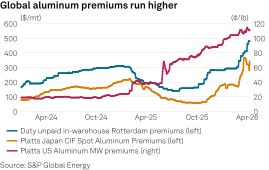
Prior to disruptions in Middle East supply, US aluminum prices had already been sitting at all-time highs. The strikes on smelters in the region have pushed prices even higher.
Platts assessed the spot 99.7% P1020 US Aluminum Transaction Premium at 110.95 cents/pound plus LME cash, delivered Midwest, net 30-day payment terms on April 10.
This assessment, known as the Midwest Premium, has risen 186.5% from year-ago levels.
Middle Eastern supply crucial for global markets
"If you're going to look at the shortage plus the [US] tariffs and Midwest Premium, there's a bit of a mushroom cloud starting to form in the next three to six months," Lehman said.
Middle Eastern supply has become increasingly important to US markets as the US 50% tariffs led to shrinking import volumes from the top supplier, Canada, but it is critical for the health of global markets.
The LME price for primary aluminum rose to $3,686.90/metric ton on April 13, up 17.9% since the US and Israel started bombing Iran on Feb. 28 and a four-year high. The spike underscored the global supply tightness expected amid Middle East disruptions.
"While the Middle East has been an important supplier to the US, you are seeing the impact of the lost supply far greater in Europe than you are in the US, simply based on the moves in regional premiums and LME," Nick Giles, senior research analyst for B. Riley Securities, told Platts. "I think [the Midwest Premium] will continue to move higher, but it will come as a result of higher LME prices and therefore higher tariff costs."
No clear alternative
Experts have stressed that there is no clear way to make up for the supply loss, with some concerned that Western markets will have to turn to geopolitical adversaries like Russia or China.
"I'm watching very closely to see if the [US] administration is going to do anything to lower the sanctions on Russian metal," Joe Quinn, executive director for the DC-based SAFE Center for Strategic Industrial Materials, told Platts.
Meanwhile, others have suggested the situation could pressure the US to lower tariff rates on Canada.
In 2024, before US President Donald Trump imposed a 50% tariff on aluminum imports, Canada supplied 70.9% of US primary aluminum imports, according to Global Trade Atlas data. This number fell to 61.2% in 2025.
"All of this demonstrates the fact that Canada remains by far the most secure supplier for the North American market," Simard said. "It takes Canadian metal between two to seven days to get to the US market versus 45 to 60 days from other parts of the world. We're not nearly as exposed to geopolitical conflicts."
But skepticism remains, as the White House has taken a strong stance on preserving the steep duties on metal imports.
"Tariffs have been locked in at 50% for 10 months," Quinn said. "I hear Jean [Simard], it's a good point, but I just don't see them changing them now."
