Crude Oil, Maritime & Shipping, Wet Freight
April 10, 2026
Strait of Hormuz traffic remains low as calls grow for safe passage

Editor:
HIGHLIGHTS
Nine of 12 transits April 9 exit strait
No non-Iranian barrels loaded in April
Iran demands tolls for strait passage rights
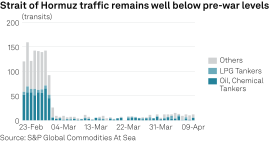
A dozen vessels transited the contested Strait of Hormuz April 9, traveling through Iran's territorial waters, with most of those ships exiting the narrow waterway, according to an April 10 report from S&P Global's Commodities at Sea.
Average daily transits still stand at a fraction of pre-war levels of about 135 per day, as calls to reopen the Strait of Hormuz to global trade mount and crude loadings from ports inside the Strait are at a near standstill.
"An estimated 230 vessels sit loaded with oil and ready to sail," Sultan al-Jaber, CEO of Abu Dhabi National Oil Co., wrote in an April 9 LinkedIn post. "They, and every vessel that follows, must be free to navigate this corridor without condition."
CAS data show that so far in April, there have been no crude loadings at ports inside the Strait of Hormuz in Kuwait, the UAE, Saudi Arabia, or Iraq. An estimated 14.2 million b/d of crude and condensate production has been disrupted by the closure of the Strait of Hormuz since the Feb. 28 start of the war.
In April to date, Iran's crude loadings stand at 1.38 million b/d, CAS data show.
Nine vessels left the Strait of Hormuz on April 9, in the wake of an uncertain ceasefire and as Iran continues to claim its grip on the crucial chokepoint for global trade.
Only three ships entered the waterway. One of those tankers was a ballast crude oil tanker, the Russia-flagged Arhimeda that can be seen on ship tracking data making its way up the strait, hugging Iran's coast. Three of the vessels that went through the Strait of Hormuz are under American sanctions, including one that left the strait carrying 1 million barrels of Iranian crude, CAS data show.
Iran has said that all ships transiting the Strait of Hormuz must pay a toll, coordinate with Iran's navy to guarantee safe passage, and stick to designated lanes to avoid anti-ship mines.
"The weaponization of this vital waterway, in any form, cannot stand. This would set a dangerous precedent for the world – undermining the principle of freedom of navigation that underpins global trade and, ultimately, the stability of the global economy," Jaber wrote.
A total of 22 ships transmitting AIS have exited the Strait of Hormuz since a ceasefire was announced April 7. Only a handful of those have carried crude out of the strait, and most have been loaded with Iranian crude, the data show.
After a Bahrain-led resolution to restore freedom of navigation through the strait presented at the UN Security Council was rejected, the Secretary General of the Gulf Cooperation Council Jasem al-Budaiwi said April 7: "Any attempts to impose a de facto status by force or to exploit the strait as a tool for political pressure constitute behavior that is rejected and condemned both regionally and internationally."
The International Maritime Organization and other groups are working to establish a safe passage framework while Vanguard has advised caution for ships near the waterway and to assess transits on a case-by-case basis.
