Metals & Mining, Non-Ferrous, Ferrous
March 30, 2026
FACTBOX: Attacks in the Middle East hit Gulf aluminum, steel plants amid war

Editor:
HIGHLIGHTS
Middle East alumina imports fall 63% YOY in March: CAS
Global aluminum prices and regional premiums rise
Iran targeted key aluminum facilities in the UAE and Bahrain on March 28, following attacks on its own steel plants as part of the US-Israel military campaign, threatening the output of producers responsible for about 8%-9% of global primary aluminum production and disrupting trade flows in a region that typically imports over one-fifth of the world's alumina.
The damage from the attack on Emirates Global Aluminium and Aluminium Bahrain's, or Alba, facilities is still being assessed, according to the companies.
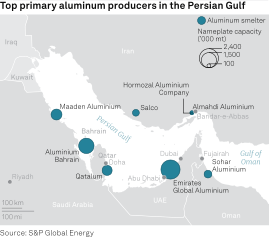
Here are key facts about the current state of metals infrastructure and trade flows in the Middle East:
Infrastructure
- The Gulf region hosts some of the world's largest and most technologically advanced aluminum smelters, including EGA in the UAE, Alba, Ma'aden Aluminium in Saudi Arabia, Qatalum in Qatar, and Sohar Aluminium in Oman.
- According to the International Aluminium Institute, GCC countries produced about 6.16 million metric tons of primary aluminum in 2025, representing about 8% of global output.
- EGA said its Al-Taweelah smelting facility was attacked on March 28. The facility produced 1.6 million mt of cast metal in 2025, accounting for 56% of EGA's total record cast metal sales that year.
- Alba said on March 28 that its facility was also "subject to an Iranian attack." Alba has a production capacity of 1.623 million mt/y.
- In Iran, the Mobarakeh Steel and Khuzestan Steel plants were attacked March 27, and authorities were assessing the damage to the facilities, according to the official news agency IRNA.
- Mobarakeh's annual production capacity exceeded 12 million mt in 2025, accounting for 33% of Iran's total steel output, according to IRNA.
- Khuzestan Steel experienced a 67% rise in exports from March 21, 2025, to Sept. 22, 2025, increasing to 472,462 mt from 282,506 mt during the same period of 2024, according to IRNA.
- Iran's exports of key steel products increased 6% year over year to 7.1 million mt in 2025, according to S&P Global Market Intelligence's Global Trade Analytics Suite.
- Foulath Holding, the parent company of Bahrain Steel and SULB, declared force majeure on certain group operations, citing security and logistical disruptions due to the war, according to the company's March 28 statement.
- Bahrain Steel has an annual production capacity of 13 million mt of iron ore pellets, while SULB produces medium and heavy beams and structural steel sections from plants in Bahrain and Saudi Arabia, according to Foulath's website.
- Earlier in March, Alba issued a force majeure to customers of its smelter in Bahrain, Platts reported March 4, citing a source close to the company.
- Aluminum producer Hydro issued a force majeure to customers of the 636,000 mt/y Qatalum smelter in Qatar, requiring a controlled shutdown due to a halt in gas supply.
Trade flows
- The Middle East is a key alumina importer, accounting for consistently more than 20% of global import share over the past five years, according to S&P Global Commodities at Sea.
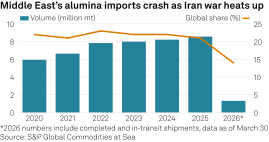
- The Middle East's alumina imports fell 63% year over year to 299,499 mt in March, according to CAS data as of March 30. In 2025, the region recorded its highest alumina imports in March, CAS data show.
- Australia is the largest alumina exporter to the region. The country accounted for 83% of Middle East's alumina inflows in 2025, according to CAS.
- Australia's alumina exports to the Middle East in March dropped 76% year over year to 179,311 mt, CAS data show.
- The Australian Aluminium Council said in March that the Strait of Hormuz remained a critical chokepoint for both alumina imports and aluminum exports.
- All 179,311 mt of volume from Australia to the Middle East was still in transit, according to CAS, indicating that no volume had landed at the ports in March.
- EGA was working out how to deliver metal to export markets from a port in Oman after the traditional route through the Strait of Hormuz was severely disrupted.
- According to EGA, the company had "substantial metal stock on the water when the conflict began, and stock on the ground in some overseas locations."
Prices
- US Midwest aluminum premiums, already the highest in the world, have risen to record highs since the war began. Platts assessed the spot 99.7% P1020 US Aluminum transaction premium at 108.45 cents/lb ($2,349/mt) plus London Metal Exchange cash, delivered Midwest, net 30-day payment terms, on March 27, up from 104 cents/lb on Feb. 27.
- Platts assessed the CIF Japan spot premium for 99.7% P1020/P1020A aluminum ingot at $345/mt plus LME cash on March 27, more than double the level from Feb. 27.
- Platts assessed alumina FOB Australia at $320/mt FOB Western Australia on March 27, up 5% from Feb. 27 levels.
- The LME aluminum 99.7% cash price has risen 7% since the war started, reaching $3,357.23/mt on March 27, the highest in at least three years, according to S&P Global Market Intelligence data.
