Metals & Mining, Non-Ferrous
March 24, 2026
Copper prices drop amid global growth fears, plump stocks

By Kip Keen
Editor:
HIGHLIGHTS
Copper prices have fallen 9.4% since Feb. 27
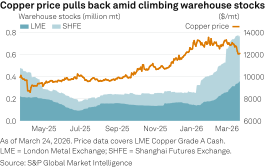
Global inventories surpass 1 million mt for first time since 2003
Iran war disrupts sulfur supply for copper production
Copper prices are getting hammered amid growing fears that higher energy prices -- driven up by the Iran war -- could pummel economic growth and weaken near-term metal demand in a market awash with copper stocks.
The London Metal Exchange price of copper slid 9.4% to $12,081.74/metric ton as of March 23 since the US-Israel war with Iran started on Feb. 28. High energy prices spurred by the Middle East war are triggering fears of weak economic growth, and copper prices often move in conjunction with the global economy. At the same time, warehouse stocks are growing after a period of tightness, meaning copper is more readily available.
The near-term future of copper may be caught in the fog of war: a sulfuric acid bottleneck in the Strait of Hormuz could push down copper output, creating shortages and driving prices back up. But high energy prices could weaken the global economy, shrinking demand and driving down the price.
For now, the price is headed south.
"The sell‑off coincided with a broader risk‑off move, concerns over higher energy prices weighing on global growth and a build-up in exchange inventories," Ewa Manthey, a commodities strategist with ING, told Platts, part of S&P Global Energy.
Taking stock
Copper went on an extended bull run in 2025 and 2026, with the LME price hitting a record high of $13,524.24/mt on Jan. 29. A lucrative arbitrage trade, which was hinged on the potential for US tariffs on refined copper that never landed, drew global supply to the US, lifting prices. Global stocks then began to grow in the first months of 2026.
"The decline is being driven primarily by long liquidation amid a sustained build in exchange-monitored stockpiles, which have now surpassed one million [metric] tons for the first time since 2003," Ole Hansen, head of commodity strategy at Saxo Bank, said in a March 17 report. He added that "the return of speculative and, not least, physical demand and industrial activity will be critical in determining whether the current consolidation phase evolves into renewed strength — or a deeper reset designed to attract fresh buyers."
As energy costs surge -- Dated Brent was $110.05/barrel on March 24, up from $70.94/b on Feb. 27 -- central bank rate-cut expectations have unwound and the dollar has strengthened — adding pressure on prices for some industrial metals.
The conflict "has disrupted what was previously a very constructive macro setup for 2026," BMO Capital Markets analysts said in a March 24 report, downgrading their near-term copper outlook and shifting preference toward aluminum and coal. Copper lacked "shelter against the challenging macro" along with gold, the analysts said.
But the copper will be buffeted by competing forces, as marketsin the coming weeks and months will closely watch copper stocks, US trade policy, mine supply and a resolution of the Iran war.
"The combination of an uncertain trade landscape, ongoing conflicts (e.g. Russia-Ukraine) have been compounded by the development of the Iran War, creating potentially longer-term headwinds for base metal demand," Natalie Scott-Gray, senior metals demand analyst at StoneX, a financial firm, said in a March 20 report.
Supply crunch
Still, while demand for copper could take a hit on higher energy prices, the Iran war could also squeeze supply. The Middle East accounted for almost half of the 2025 sulfur trade, much of it transiting the Strait of Hormuz. Sulfur is used to produce sulfuric acid -- a major input for leaching and solvent extraction/electrowinning (SX/EW) production of copper.
The SX/EW method accounted for about 16% of global copper production in 2019, according to the International Copper Study Group.
"Copper is highly energy‑intensive, and disruptions to associated inputs, including sulfuric acid supply chains, could add cost pressure and create friction in parts of the value chain if disruptions persist," ING's Manthey told Platts.
Industry veterans predicted early in the war that an extended conflict could push some copper production offline.
Should "the disruption last longer than ~3 weeks, copper oxide operations will have to close as they've run out of acid," Robert Friedland, executive co-chairman of copper-producer Ivanhoe Mines, said in a March 4 social media post.
If demand holds on, supply cuts could boost metals like copper. But the support could prove short-lived.
"Should the conflict drag out for months, the loss of transit will lead to price blowouts for aluminum, copper and lithium from the loss of physical supply or constraints on ore processing," S&P Global Energy CERA analysts said in a March 17 report. "These price surges peter out as the energy shock leads to global recession."
