Electric Power, Metals & Mining, Crude Oil, Refined Products, LNG, Natural Gas, Maritime & Shipping, Non-Ferrous, Diesel-Gasoil
March 10, 2026 · Updated March 12, 2026
Global miners brace for cost pressure from Middle East war, higher input prices
By Kip Keen and Liubov Georges
HIGHLIGHTS
Iran war drives oil spike, pressures miners
Fuel costs threaten margins, capex cuts could come
Copper mining costs rise 5%-10% per $50/b oil price jump
The surge in oil prices triggered by the Middle East war is rippling through global mining operations, raising costs for fuel-dependent producers and threatening to drive more punishing inflation in the long term.
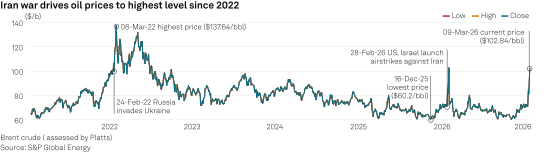
Platts-assessed Dated Brent crude spiked to $102.84/barrel on March 9, the highest level since Russia's 2022 invasion of Ukraine, rising more than $31.90/b or almost 45% since the US and Israel launched airstrikes against Iran. Brent futures have since pared some of those dramatic gains, trading near $90/b after US President Trump suggested the war is "very complete, pretty much."
"Higher oil prices pressure miners' costs," Patricia Barreto, senior principal analyst for zinc and copper market research at S&P Global Energy CERA. Significant margin erosion starts at sustained prices over $90-$100/b for fuel-dependent miners, she said.
"Concern grows beyond six months, triggering capex cuts," Barreto said.
Trump has offered conflicting messages to different audiences as to when the US attacks might end. Iran has effectively closed the Strait of Hormuz, the artery through which roughly 20% of global oil supply normally flows — pushing fuel costs higher for miners.
Mining squeeze
For an industry where diesel can power everything from haul trucks to pumps and generators, the timing is bruising. Total cash costs for treated copper ore climbed a cumulative 27.8% between 2021 and 2024, driven in large part by a 24.2% jump in energy costs from a 2021-22 inflationary episode, S&P Global Market Intelligence data showed. The war shock risks replicating this dynamic.
"Inflation is coming hard to the miners," David Harquail, chair of royalty and streaming giant Franco-Nevada, told Platts. "The oil price hike is just accelerating it."
Platts is part of S&P Global Energy.
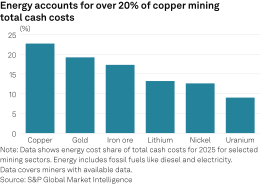
Energy costs as a share of total 2025 cash costs at mining operations for selected metals ranged from 9.0% in the uranium sector to 22.7% for copper, according to S&P Global Market Intelligence data. Gold came after copper at a 19.2% share, with energy costs including inputs such as diesel and electricity.
For copper miners, a $50/b rise in oil prices typically leads to 5-10% higher costs overall, said Nick Pickens, research director at Project Blue, a metals-focused consultancy.
"The Middle East tensions are already increasing costs for Europe's nonferrous metals sector through higher electricity prices, LNG supply disruptions and rising transportation/shipping costs," James Watson, director general of European Metals, an industry association, told Platts. "Our industry is extremely electricity-intensive, so even moderate spikes in power prices quickly undermine competitiveness."
Metals and mining companies in Europe risk a repeat of the 2022 energy crisis when prices spiked, hampering operations, Watson said. The Middle East war has yet to have the same impact "but the situation could deteriorate rapidly if disruptions persist."
European Metals, formerly known as Eurometaux, is calling for quicker and more flexible policies to be able to react to energy costs and help prevent more EU metals companies from shuttering.
Longer duration sharpens the pain
A prolonged run of higher oil prices could set up miners for a double whammy on margins. Not only could extraction costs soar, but pricey energy could dampen consumer spending and, in turn, metal demand, lowering prices.
"Demand risks arise after [oil is] sustained at a higher level for longer, via inflation, policy tightening and possible GDP drag — slashing demand," Barreto said.
Some miners who depend on sulfuric acid for leaching at mining operations, meanwhile, face compounding cost exposure: higher diesel, higher gas-generated electricity and higher sulfuric acid prices.
Sulfuric acid, a byproduct of oil refining, is a critical processing reagent. In 2025, the Middle East accounted for 47% of the sulfur trade, a precursor used to make sulfuric acid, according to Yuya Pan, a senior principal analyst at CERA. Much of seaborne sulfur ships through the Strait of Hormuz. That could be rough on Indonesian nickel processing as well as African copper refining.
"From a geographical perspective, the [Democratic Republic of Congo] is probably most exposed, with many marginal producers relying on diesel generators for power and sulfur for acid leaching, etc.," said Pickens as regards copper mining, adding that miners could face mounting shipping risks over logistics and cost.
Mining equities take a hit
Mining stocks enjoyed a prolonged boom as metals prices rose in 2025 and 2026. The combined market cap of 2,420 publicly traded mining companies rose 125.6% in February compared to a year earlier, according to Market Intelligence.
But markets appear to have started pricing in the impact of the conflict on mining equities.
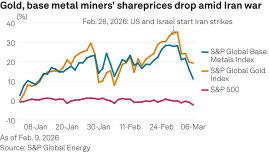
The S&P/TSX Global Base Metals Index, comprising base metals miners, fell 13.1% to 316.34 on March 6 from Feb. 27, the day before the war started. The S&P/TSX Global Gold Index was down 11.6% over the same period, while the S&P 500 was only down 2%.
The National Mining Association, which represents US producers, said it was monitoring the situation closely.
"This is a pretty dynamic situation and we're still in listening-and-information-gathering mode with our members," said Conor Bernstein, an NMA spokesperson.
In Canada, a key miner of products from uranium to fossil fuels, including oil-sands derived oil, industry leaders are parsing a complicated picture.
"There are many variables here, not least of which is the durability of the price hikes," said Pierre Gratton, president and CEO of the Mining Association of Canada. "For most Canadian mines, the primary impact will be on mobile equipment — if grid-connected, higher oil prices won't affect mills, for example."
A sustained increase in oil prices would likely accelerate the electrification of mine fleets, a shift that major producers have been pursuing for years as battery technology improves, Gratton said.
Currency shifts could emerge as another wrinkle for miners.
"Higher oil prices are likely to raise the Canadian dollar, which can reduce input costs -- but also reduce revenues as commodity prices are in US dollars," Gratton said. "In short, it's complicated."
More broadly, Pickens said the Iran conflict could dent market bullishness in the copper sector.
"Events in Iran could provide the catalyst to unwind this positioning," putting the focus on fundamentals, Pickens said. "Physical demand in China is soft, there are high global visible inventories, and we now have a strengthening US dollar -- all bearish for price."
Editor:

Editor: