Metals & Mining Theme, Non-Ferrous
January 30, 2026
US ALUMINUM: A380 market enters 2026 with high input costs, growing discounts

By Tina Allagh
HIGHLIGHTS
Tight spreads keep alloy market under pressure
Many discounts for 2026 nearly double
Automotive demand to hold over long term
This report is part of a series on impactful trends in the US aluminum market based on S&P Global Energy pricing, news, and analytics.
The US A380 aluminum market has entered 2026 under mounting pressure, driven less by demand fundamentals and more by aggressive competition and expanding capacity.
Sellers have reported intensifying pressure to increase discounts well beyond historical norms, even though many believe current market conditions do not justify such concessions.
Producers point to rising volumes as a primary driver of growth. One producer indicated that contract volumes will increase this year after securing new customers, with total shipments expected to rise year over year. This growth, however, has come alongside increased pricing pressure, as new and restarted capacity competes aggressively for market share.
Pure Aluminum's Saranac, Michigan, facility, which began operations in 2025, and Allied Metal's January 2025 furnace launch in Chattanooga, Tennessee, were cited as key sources of competitive pressure.
At full capacity, Allied Metal's Chattanooga plant is slated to produce 100 million pounds/year of alloys, according to a company official.
According to news reports, Phase 1 at Pure Aluminum will include an 88,000 lb capacity rotary furnace and a 180,000 lb capacity reverb furnace, with a combined output of 20 million lb/month. Phase 2 will include a second 180,000 lb reverb, adding another 10 million lb/month of capacity. Pure Aluminum will process 35 million lb/month at full capacity.
A Pure Aluminum official was unavailable for comment.
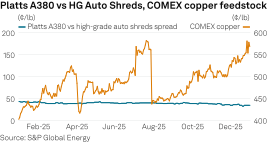
Oversupply weighed heavily on spot prices, and the surge in A380 production has further depressed the market, even as scrap prices have moved higher. Under normal market conditions, producers expect A380 prices to follow the zorba scrap market, but A380 pricing has remained flat, creating what many see as a disconnect between raw material costs and finished alloy prices.
Discounts off the Platts A380 price have widened significantly. A second producer described discounts moving from an average of 3-5 cents a year ago to discussions of 10-13 cents or more for 2026 contracts. The producer said their business has shifted from roughly 90% formula-based pricing to less than 50% for this year.
But some producers have been reluctant to get on the discount bandwagon, with a third producer noting that "the economics of it don't make sense." He added that, with rising input costs for zorba, copper, and silicon, as well as higher transportation rates, operating on double-digit discounts "is not financially sound.
"It takes one person to strike a deal [on discounts] for the whole market to feel the pressure," the producer said. "How is it possible [to have these kinds of discounts] and still make money?"
He added that his 2026 contracts were flat. "We are seeing a lot of aggressive numbers."
The producer also noted that, although there is overcapacity in the market, available supply is tight, and his competitors "are calling, looking for metal."
Automotive production figures hold
As for demand, the producer expects 2026 volumes to be flat to slightly higher compared with 2025. "Flat does not mean weakness," he said. "We are expecting steady demand, which is good."
A fourth producer said that, while his orders are healthy, "we are in the zone of, 'it can't be profitable at all'" because the Platts A380 price has not risen in tandem with scrap and the other inputs. "It's just ridiculous right now. A380 should be closer to the $1.40[/lb] range."
The Platts A380 price was assessed at $1.37-$1.38/lb as of Jan. 22 and rose to $1.40-$1.43/lb as of Jan. 29.
"People can only do this so long until they go out of business, or they say, 'I can't do this and numbers pop,'" the producer said.
A fifth producer emphasized that "the keyword is input costs — copper at $6/lb, zorba is up because of overseas demand, twitch [auto shreds] is up, and the mills are competing for our scrap. All input costs are up." He noted no dip in his demand and said, "I am expecting steady demand in [the first quarter]. The electrical sector is good, and we're seeing more internal combustion demand."
According to S&P Global Mobility, North America's 2026 light vehicle production forecast has been slightly revised downward, but overall production is expected to remain around 15 million units.
"In North America, production is trending downward, with inventory aligned to demand in most cases across the industry," Mobility said. "There will be little support from consumers as model year 2026 and 2027 vehicles arrive on the market, with higher-than-average price increases stemming from the tariffs."
The automotive sector makes up 60% of the A380 market.
But others in the market were shying away from securing contract business and preferred relying on the spot market.
"We are struggling to get orders covered," said a sixth producer, noting he did not go after more contract business for this year. He said he expected the A380 price to hit $1.40/lb in Q1 and remain elevated. He added that 15 million-16 million automotive sales "is enough to sustain the market." He also said electronics are strong, but described the RV market as saturated.
"Double-digits is the highest discounts ever seen on the books," said a seventh producer. "Some of these guys forgot they need to make money." He said overcapacity is not the problem. "The problem is these new guys are taking huge sales, and are enticing buyers with huge discounts."
A diecaster said he was "not lucky enough" to be offered any double-digit discounts on his contracts and said his highest discount for this year was 6.50 cents.
"Why would anybody take 13 cents under the Platts average? It blows my mind," said an eighth producer. "They can lose all the money they want. We are not chasing any of that. It is going to be a long year for them."
Another seller agreed, "We are preparing people for a higher market. I anticipate [A380 prices] hitting $1.50 this spring."

Editor: