Metals & Mining Theme, Agriculture, Ferrous, Biofuel, Food
January 27, 2026
EU‑India seal 'largest-ever' trade pact; automobile tariffs cut, protein duties retained
HIGHLIGHTS
FTA excludes beef, chicken, ethanol, steel
Tariffs on EU auto parts to be eliminated within 5-10 years
EU expects exports to India to double by 2032
The EU and India have sealed the "largest" trade agreement ever, under which India will reduce tariffs on automobile imports from the bloc -- from 110 % to as low as 10 % -- while the EU will cut duties on agricultural imports but retain tariffs on key protein products such as beef and chicken.
"This agreement has brought huge opportunities for 1.4 billion people of India and millions of people of European countries. This agreement represents about 25% of the global gross domestic product and about one-third of global trade. This will strengthen trade and the global supply chain," India's Prime Minister Narendra Modi said during an address at India Energy Week on Jan. 27.
European Commission President Ursula von der Leyen said the agreement creates a "free‑trade zone for 2 billion people" and presented it as a deepening of ties among "the world's biggest democracies."
The EC described it as the "largest free‑trade agreement that both the EU and India have ever concluded," framing the deal as a signal of continued commitment to "economic openness and rules‑based trade" amid geopolitical and economic uncertainty, according to a Jan. 27 statement.
Under the agreement, India will eliminate or reduce tariffs on goods that account for 96.6 % of EU exports to India by value. The EC expects this to double EU exports to India by 2032 and to lower duties on European products by roughly Eur4 billion ($4.75 billion) each year, the statement said.
The EC identified automobiles and industrial inputs as two of the most significant areas of tariff adjustment, according to the statement.
The reduction in automobile tariffs will be accompanied by an annual quota of 250,000 vehicles, the statement said.
The EC said India will eliminate tariffs on imports of European automobile parts within 5-10 years.
Agri boost
The deal eliminates or reduces the usually prohibitive tariffs -- averaging over 36 % -- on EU agri‑food exports, opening a huge market to European farmers, according to the EC.
However, the EU will continue to restrict imports of products such as beef, chicken meat, rice, soft wheat and sugar, subjecting them to stringent health and food‑safety regulations, the statement said.
"The EU will open calibrated quotas for imports of sheep and goat meat, sweetcorn, grapes, cucumbers, dried onions, rum made of molasses and starches," the EC said.
"Sensitive European agricultural sectors will be fully protected, as products such as beef, chicken meat, rice and sugar are excluded from liberalization in the agreement. All Indian imports will continue to have to respect the EU's strict health and food-safety rules."
The EU will retain its tariff on ethanol imports from India, according to the statement.
Tariffs ranging up to 44% on machinery, 22% on chemicals, and 11% on pharmaceuticals will also be mostly eliminated, the EC said, adding that the EU and India already trade more than Eur180 billion of goods and services annually.
India-EU trade
Between January and November 2025, India exported 194,328 metric tons of seafood to the EU‑27, valued at $1.1 billion -- a 33.8% year-over-year increase, according to the Ministry of Commerce.
Crustaceans contributed 60% of this value, led almost entirely by frozen shrimps and prawns, which together accounted for 99% of the segment, totaling 100,577 mt worth $659.47 million.
Between January and November 2025, India exported 664,224 mt of frozen shrimp globally, according to the ministry. The EU-27 was the third-largest destination with 100,577 mt, up 39.4% year over year.
The surge came after the EU approved an additional 102 Indian fishery units for export.
Indian suppliers boosted shipments to non‑US markets, including the EU, as they diversified away from the US market due to trade tariffs.
The EU is also the largest destination for India's steel exports, which currently face headwinds from the Carbon Border Adjustment Mechanism.
The blast furnace–basic oxygen furnace route, which is highly carbon‑intensive, accounts for 70 %-80 % of India's steel production, according to S.S. Mohanty, former director of Steel Authority of India Ltd.
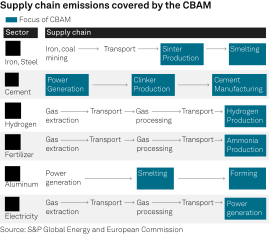
The CBAM imposes a carbon charge based on carbon emissions from steel entering the EU, and came into effect in January 2026.
The commerce ministry said Jan. 27 that no exemptions were extended to India under the CBAM as part of the free trade pact. However, the EU has assured that if any future flexibilities are granted to most-favored nations, India's steel exports will be taken into account for potential exemptions.
"Through CBAM provisions, commitments have been secured, including a forward-looking most-favored nation assurance extending flexibilities if any granted to third countries under the regulation, enhanced technical cooperation on recognition of carbon prices, recognition of verifiers, as well as financial assistance and targeted support to reduce greenhouse gas emissions and comply with emerging carbon requirements," the ministry said in a statement.
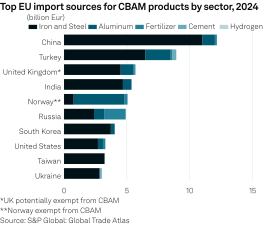
In 2024, India shipped about 3.71 million mt of steel products to EU markets, according to the ministry.
EU‑India FTA negotiations began in 2007, were suspended in 2013 and relaunched in 2022, with the most recent negotiating round held in October 2025.
Platts, part of S&P Global Energy, assessed the spot cut-to-length price of IS2062, 2.5-10 mm thick hot-rolled coil, excluding 18% goods and services tax, at Rupees 52,500/mt ($573/mt) ex-works Mumbai on Jan. 26, stable from Jan. 23.
Platts assessed ethanol CIF Philippines at $571/coalbed methane on Jan. 26, up $2.67/CBM day over day.
Platts assessed peeled, deveined tail-on shrimp FCA India at $7,400/mt on Jan. 23, unchanged day over day.

Editor: