Metals & Mining Theme, Energy Transition, Electric Power, Carbon
January 22, 2026
India’s NITI Aayog unveils cement decarbonization road map as demand rises

HIGHLIGHTS
Cement production projected at 660 mil mt by 2030, 2.1 bil mt by 2070
Compliance framework transitioning to Carbon Credit Trading Scheme
Road map covers blending mandates, standards, CCUS
India's cement industry is poised for sustained expansion under a decarbonization road map that prioritizes alternative fuels, clinker substitution and carbon capture, amid a sevenfold increase in production expected by 2070 from 391 million metric tons in 2023, NITI Aayog said in a report Jan. 22.
India's cement production was projected at 660 million mt by 2030, 1.75 billion mt by 2047, and 2.1 billion mt by 2070, compared to current annual production around 430 million mt and installed capacity exceeding 620 million mt, the report titled "Roadmap for Cement Sector Decarbonisation" said.
Installed capacity was seen rising to 2.56 billion mt by 2050, then flattening at 2.8 billion mt by 2060–2070, implying around 5% annual growth to 2040 and about 1% thereafter, according to the report.
Per capita consumption, at roughly 260 kg versus a global average of 540 kg, and rapid urbanization, pointed to demand doubling by 2030 before growth moderated into a plateau near 2.1 billion mt by 2070, according to NITI Aayog.
Carbon credit trading
The cement sector contributed about 6%–7% of India's GHG emissions, with average emission intensity near 0.63 mtCO2e/mt of cement, according to the report.
Emissions stood around 246 MtCO2e in 2023 and could reach 1,323 MtCO2e by 2070 under a business-as-usual trajectory.
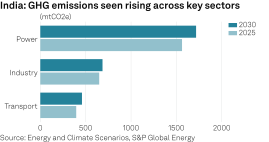
India's compliance framework was transitioning from the Perform, Achieve and Trade mechanism to a Carbon Credit Trading Scheme focused on facility-level GHG intensity, expanding carbon pricing and offsets in industry decisions, NITI Aayog said.
India's low clinker-to-cement ratio of 67.5% provided headroom to expand the use of substitutes, such as calcined clay and multi-component blends.
The road map called for transitioning from prescriptive, input-based standards to performance-based BIS standards to enable wider adoption of low-carbon cements without compromising performance.
Measures included blending mandates, defining standards for alternatives such as calcium sulpho-aluminate cement, mapping new deposits such as calcined clay, and lifting blended cement's share toward 80% by 2030 and 85% by 2050.
Clinker substitution was projected to cut emissions by 7%–15% by 2070, according to the report.
CCUS and decarbonized power
Carbon capture, utilization and storage was positioned to tackle hard-to-abate process emissions, with potential to mitigate up to 50% of process emissions over time.
The report emphasized pilots in the 2030s to de-risk technology and costs, with significant reductions expected from 2040 onwards.
A global snapshot of cement-related CCUS/CCU pilots and a benchmark of government CCUS funding placed India at $24 billion, according to the report.
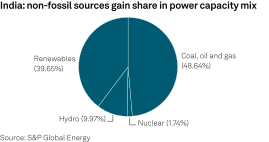
Decarbonization of electricity was projected to reduce 80–133 mtCO2e by 2050, stabilizing thereafter as renewables dominate post-2050.
Impact on supply chains
The decarbonization pathway was set to influence domestic supply chains more than cross-border trade, given the emphasis on internal fuel sourcing (RDF), standards and policy mechanisms, according to the report.
Energy-efficiency measures remained material but contributed about 5%–10% of emissions reductions; the heavy lifting was expected from RDF scaling, clinker substitution and CCUS.
Sector emission intensity was projected to decline steadily, with strategies reducing net emissions from a BAU projection of 1,323 mtCO2e to around 198–252 mtCO2e by 2070, corresponding to an intensity of 0.09–0.13 mtCO2e/mt, according to the report.
With demand rising into 2050 before stabilizing near 2.1 billion mt by 2070, achieving a 20% TSR via RDF, lifting blended cement share, and launching CCUS pilots would be pivotal in aligning supply with India's net zero ambition while supporting infrastructure growth, according to the report.
Platts, part of S&P Global Energy, assessed Cement Clinker FOB Turkey at $44.75/mt Jan. 15, down 25 cents/mt week over week.

Editor: