Metals & Mining Theme, Non-Ferrous, Ferrous
January 21, 2026
Extreme climate limits extractive projects in Greenland to a handful
HIGHLIGHTS
Greenland's potential attracts explorers
Melting ice improves access but slowly
In-situ midstream processing not implied
Greenland, the world's biggest island, coveted by the US President Donald Trump, is believed to be rich in resources, but two-thirds of it lie above the Arctic Circle with harsh conditions, sparse population and very little infrastructure limiting extractive projects to a handful, and the Geological Survey of Denmark and Greenland does not expect any significant changes in the country's mineral potential until the polar icecaps pull back.
"This is about critical minerals. This is about natural resources," US Congressman Mike Waltz said in January 2025, commenting on President-elect Donald Trump reiterating interest in the US assuming control of Greenland.
Last frontier for exploration
Recent assessments show that a wide range of internationally defined critical raw materials are present in Greenland, including 24 of the 34 on the EU's list, according to the Geological Survey of Denmark and Greenland, or GEUS.
The US now has almost twice as many minerals on its critical list, and according to the 2025 US Geological Survey report, the country is more than 50% net import reliant for 40 of the mineral commodities it deems critical, including 80% to 100% net import-reliance on rare earth elements.
This is while Greenland's Kvanefjeld and Tanbreez deposits of the Ilimaussaq complex, itself part of the Gardar Province, collectively host an estimated 1.5% of global rare-earth-element resources, Greenland-focused Toronto-headquartered mining company Amaroq says on its website.
By May 2026, a pilot plant will become operational at the Tanbreez project, with the launch of the first commercial production of up to 85,000 mt/year of rare earth oxides to follow in 2028, the project owner, US-listed Critical Metals Corp., said earlier in January.
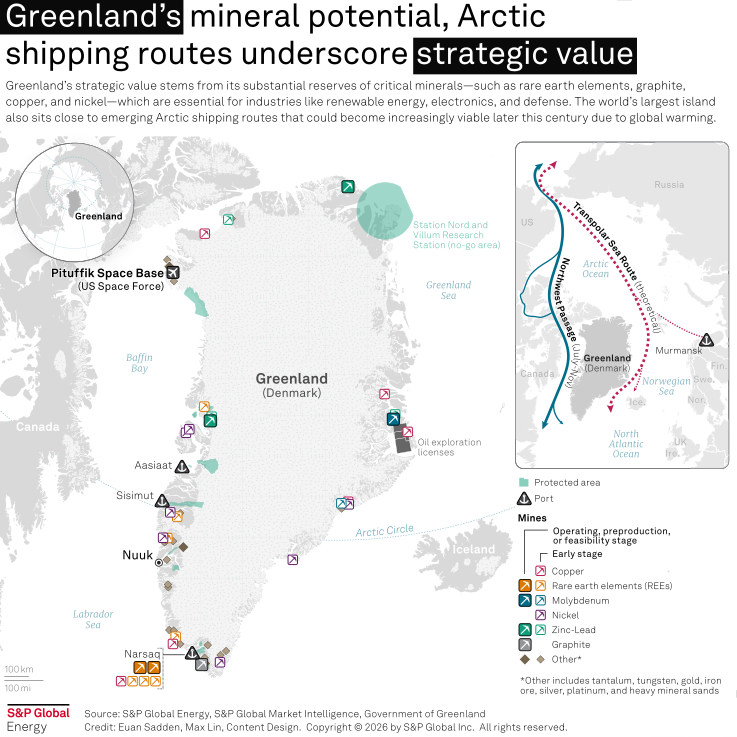
Two active mines
At present, there are only two active mines in Greenland: the Nalunaq gold mine in the south of the island that is developed by Amaroq, and an anorthosite mine in the fjord of Kangerlussuaq in the west.
Although Greenland represents one of the last frontiers for mineral exploration, the ice sheet that covers 80% of it makes it difficult to study the underlying geology in detail and prevents access to potential resources. As a result, the island's minerals have been thoroughly quantified in only a few cases, with just a handful of them classified as actual deposits.
Global warming is causing the retreat of the ice sheet, improving transport access to mineral deposits, but the rate of melting is not as fast as to expose significant new areas of land for mineral exploration in the near future, says GEUS.
However, exploration work, including by private and foreign companies, is ongoing. One example is London-headquartered 80 Mile, a junior explorer advancing several projects, including the Disko-Nuussuaq nickel-copper-platinum-cobalt project on the southwest coast of Greenland, and the Dundas Titanium on the northwest coast.
80 Mile believes that Disko hosts mineralisation similar to the world's largest Ni-Cu sulfide Talnakh mine [owned by Nornickel] in Siberia, while Dundas is recognized as the highest-grade [6.1%] ilmenite project globally, with a Mineral Resource Estimate in accordance with the JORC Code of 117 million mt.
The British company, however, has recently reduced its presence in Greenland with Amaroq taking over its Kangerluarsuk zinc-lead-silver project, following the signing of a definitive divestment agreement in June 2025, according to 80 Miles.
In December 2025, another mineral explorer and developer announced its exit from Greenland: Skylark Minerals lodged a formal relinquishment notice for its license to the fully impaired Citronen Project, an undeveloped zinc and lead mine in northern Greenland.
Small number
There are only a handful of companies committed to Greenland, with Greenland Resources Inc. among them. The Canadian company's Malmbjerg molybdenum deposit in east-central Greenland is classified as a priority project under the European Commission's RESourceEU Action Plan, because after its mining operations begin in 2028, Malmbjerg could supply 25% of the EU's molybdenum demand and 100% of the bloc's defense sector needs in the metal.
Also, Amaroq is anticipating final government approval for the acquisition of the disused Black Angel lead-zinc mine in Maarmorilik, West Greenland, which the company intends to revive to extract the recently discovered commercial concentrations of germanium, gallium and cadmium, alongside remaining zinc and lead reserves.
There would be a few bottlenecks for actual mining and shipping, though: these include depopulation and frozen terrain in areas where operations will be established, a lack of deep-water berths and other infrastructure at scale, and narrow weather windows when haulage is not stalled by too much ice or icebergs.
Pangaea Logistics Solutions, one of the biggest freight forwarding groups working in the Arctic, which shipped the Dundas's trial ilmenite tonnage to Quebec in 2019, using ice-class vessels, a temporary causeway and a specially fitted 400-foot barge for loading, said back then that shipping ilmenite in bulk would require a permanent port in Moriusaqdue, but it has not been built to date.
This also explains why midstream processing of Greenlandic raw materials is often not planned in situ. Greenland Resources will convert the Malmbjerg molybdenite concentrate into ferromolybdenum in Belgium, and Tanbreez rare-earth oxides will be further refined in the US, Saudi Arabia, and Romania.

Editor: