Coal, Energy Transition, Metals & Mining Theme, Metallurgical Coal, Renewables, Ferrous, Carbon
January 14, 2026
COMMODITIES 2026: Brazilian merchant export pig iron suppliers seek to maintain diversification, strengthen CBAM
HIGHLIGHTS
Brazilian pig iron exports hit a record 4.05 million mt in 2025
US Supreme Court ruling on pig iron tariffs expected
EU CBAM may open a pathway for climate-compliant suppliers
This is part of the COMMODITIES 2026 series, where our reporters bring to you key themes that will drive commodities markets in 2026.
Following intense negotiations between Brazil and the US over export merchant pig iron prices for 2025, the final months of the year brought to the Brazilian market the long-awaited prospect of reducing its dependence on US purchases of the raw material in 2026.
Total Brazilian exports of pig iron reached a record high of 4.05 million metric tons in 2025, up nearly 8% from 3.7 million mt in 2024, underscoring the growing concentration of flows to the US market.
The dependence that ensured predictable sales left Brazil's producers exposed to US tariff shocks, as seen with US Section 232 national security tariffs in 2018 and, more recently, the 10% pig iron tariff implemented in 2025.
Driven by expectations surrounding the European Carbon Border Adjustment Mechanism and sanctions on Russia due to the Ukraine war, deals with EU buyers -- especially Italian buyers -- have brought relief and renewed hopes for a firm diversification of destinations for the sector.
In the last five years, the US has quintupled the volume of pig iron purchased from Brazil, closing 2025 at around 3.36 million mt compared to 655,979 mt imported in 2020. In the same period, the US was the main buyer of Brazilian raw material, only losing leadership in 2020 to China, which purchased 2.11 million mt of Brazilian material.
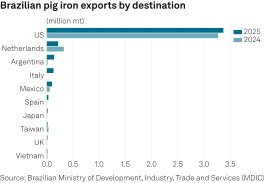
In the view of Brazilian independent producers, despite all domestic and international turbulence, pig iron production is expected to have closed 2025 with a drop of 3.5%-4%, a number considered low by sources. For 2026, the market expects a recovery in production, with potential growth.
"Demand and price should improve with a stronger US market, due to the consolidation of US Steel under the direction of Nippon Steel, the first reflections of the recovery of the US industry as a consequence of President Donald Trump's nationalization policy, in addition to the official start of CBAM in Europe," said a producer.
US Supreme Court ruling on pig iron tariffs expected in early 2026
The US Supreme Court is expected to issue its ruling in early 2026 on the Trump administration's use of a 1977 law pertaining to national emergencies as justification for the tariffs imposed on global trading partners, which currently includes a 10% tariff on US pig iron imports from Brazil and Ukraine, and even higher tariffs on Asian suppliers.
If the tariffs are repealed, US steelmaker demand for pig iron is likely to increase along with the lower cost of import cargoes, while independent traders will be more willing to participate in the market with lower risk of trade policy changes, a US-based trader said.
"Steel mills get the prices they want when they don't have to compete with independent traders. When trading pig iron, you need to have some potential buyers set up, but it becomes too much of a gamble when there is so much risk of policy change," the trader said.
CBAM as Brazil's gateway to the EU
As carbon gains value globally and the EU CBAM begins to reshape industrial trade flows, Brazilian pig iron could emerge as an outlier, with the potential to convert planted forests into a tangible competitive edge.
Faced with tighter spreads following the Ukraine war and a looming shift in European import regulation, Brazilian producers have accelerated the deployment of environmental product declarations, inventory control systems, and a climate governance road map.
The goal is to turn the charcoal-based production route into an economic asset and position Brazil as a preferred supplier in a market that increasingly demands verifiable environmental traceability.
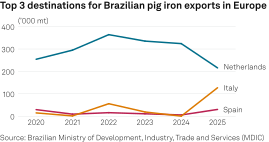
The Netherlands has been the dominant EU destination for Brazilian pig iron, accounting 1.7 million mt within the 2020-25 period, far outpacing Italy (219,156 mt) and Spain (102,082 mt).
Italy saw a sharp rebound in 2025, with volumes jumping to around 127,000 mt after near-zero volumes in 2024, marking its strongest intake of Brazilian pig iron in the period.
"Europe has already bought significant volumes from Brazil and Ukraine to cover the gap in supply. This trend will continue, giving more leverage to suppliers, as before, there were really not many marginal alternatives after the US market. It is obvious that there will be some deficit of pig iron volumes in Europe, with the current configuration of supply," a Ukrainian pig iron producer said.
Russian pressure, compressed margins
The merchant pig iron market is expected to improve with the end of Russian quotas in Europe, alongside a firm demand for Brazilian metal cargo in the US market, according to a producer.
"Americans won't be the only buyers and, therefore, the new year should see our prices rise, but not very significantly. But if the Ukraine war ends, everything changes, and the market can move quickly," he said.
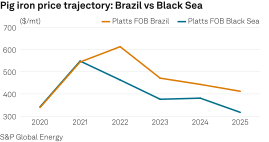
Since the imposition of sanctions on Russia because of the war with Ukraine, Black Sea-origin pig iron has entered the market at steep discounts, with FOB prices averaging $317/mt in 2025, nearly $95/mt below Brazilian material. These aggressive spreads continue to weigh on negotiations across Atlantic and Mediterranean markets.

Editor: