LNG, Natural Gas, Maritime & Shipping
December 17, 2025
ASIA LNG MOC: Activity slows on weak fundamentals; JKM hits multiyear winter low

By Cindy Yeo
HIGHLIGHTS
About 975,000 mt of LNG cargoes traded in Asia physical MOC
Jan JKM assessment last lower in 2020
Arbitrage opportunities sparse amid tighter interbasin spread
LNG activity in the Asian Platts Market on Close assessment process slowed for January as the JKM fell to its weakest winter level since 2020, amid strong Atlantic supply and muted Northeast Asian demand, an analysis of data from Platts, part of S&P Global Energy, showed.
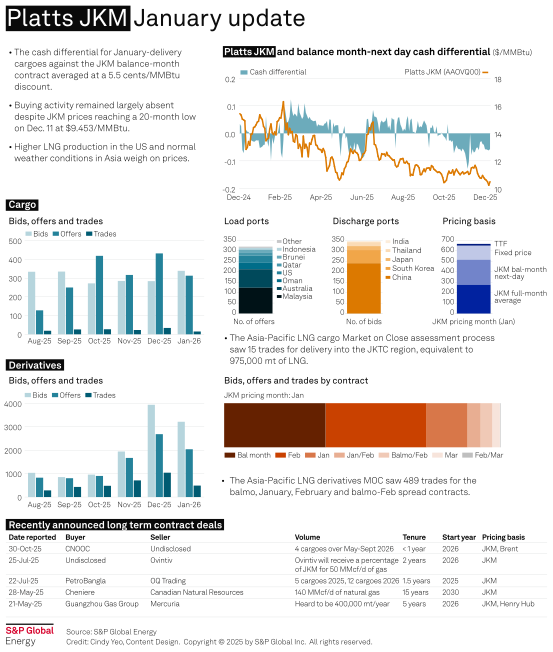
The total number of bids, offers and trades reported during the physical MOC reached 667, down 11.1% from the December pricing period but up 81.7% year over year.
Twelve entities reported 15 trades for end-December and January deliveries into the Japan-Korea-Taiwan-China region, equivalent to around 975,000 mt of LNG.
Fourteen of these trades were priced against the JKM index, with cash differentials averaging a 5-cent/MMBtu discount to the JKM February contract and one trade at a 1.5-cent/MMBtu discount to the JKM balance-month next-day contract.
Elsewhere, 19 bids for January delivery from ADNOC Trading and BP, and one second-half January offer from ADNOC Trading were reported for delivery to Thailand, Platts data showed.
Meanwhile, SEFE reported five bids for early January, while Vitol posted one offer for second-half January delivery into India, the data showed.
Additionally, 489 trades were reported via the APAC LNG Derivatives MOC, down 53% month over month but up 449% year over year.
On the Intercontinental Exchange, JKM monthly futures recorded 139,492 lots and balance-month contracts 11,210 lots, bringing the total traded volume to 150,702 lots, according to exchange data. This is equivalent to about 28.9 million mt of LNG or 457 cargoes.
Weak Asian fundamentals
The January JKM pricing period saw the marker assessed by Platts at $9.453/MMBtu on Dec. 11, its weakest level during the peak winter window since 2020, when the January JKM averaged $8.173/MMBtu.
Several traders attributed the decline to strong LNG production and weak Asian demand, with price-sensitive importers remaining sidelined as alternative fuels stayed more competitive. Indian buyers cited limited appetite for January deliveries, pointing to expectations of sizable contractual volumes for 2026.
The market weakness was reflected in JKM balance-month cash differentials, which averaged a 5.5-cent/MMBtu discount for January 2026 delivery compared with a 0.8-cent/MMBtu premium for January 2025 deliveries.
Nearly 77.4% of LNG bids, offers and trades in the latest assessment cycle were linked to the Platts JKM benchmark, while 19.9% were on a fixed-price basis and 2.7% against the Dutch TTF index.
JKM-linked pricing reduces exposure to outright price risk compared with fixed-price or non-LNG pricing, avoiding potential losses with adequate hedging if prices move unfavorably against positions.
Interbasin spreads narrow, arbitrage shut
Interbasin spreads narrowed as participants were heard cutting their net-long exposure in response to a more bearish-than-expected market.
The JKM-Northwest Europe spread during the January pricing period fell to 53.5 cents/MMBtu on Dec. 12, its weakest level since Oct. 21, when it was last lower at 49.6 cents/MMBtu, Platts data showed.
The tighter spreads signalled reduced arbitrage opportunities for Atlantic cargoes into Asia. "I still see the arbitrage closed. Shipping (rates) is on its way down, but will need to come off a bit more for bringing cargoes into Asia to start making sense," an Atlantic-based trader said.
The Platts-assessed East-West LNG arbitrage for US-sourced cargoes via the Cape of Good Hope was pegged at minus $1.312/MMBtu on Dec. 16, reinforcing a shut arbitrage into Asia.

Editor: