LNG, Maritime & Shipping
December 08, 2025
Panama Canal LNG transits dip in November as Europe lures US cargoes

HIGHLIGHTS
Only 3 laden LNG carriers, one unladen transit canal in November
No LNG crossings through the canal in first 3 weeks of November
The number of laden LNG tanker transits through the Panama Canal in November fell from October, as Europe was attracting most of the cargoes due to closed arbitrage opportunities to Asia, data from S&P Global Energy CERA and S&P Global Commodities at Sea showed Dec. 8.
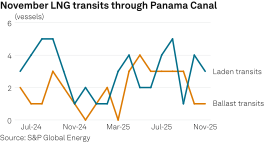
Three laden LNG carriers transited the canal in November, down from four in October but up from only one in September.
November laden transits were higher than in November 2024, when only one laden carrier transited the canal.
Two of the laden transits were destined for Asia-Pacific destinations, while the third was delivered to Mexico's West Coast, the first transit through the Panama Canal headed to a Latin American destination since August.
The first three weeks of November saw zero LNG crossings through the canal.
The first laden transit through the Panama Canal in November was completed by the Celsius Galway Nov. 23. The carrier loaded from the Sabine Pass terminal in Louisiana in mid-November and was sailing through the Pacific Ocean as of Dec. 8, showing its destination as "to be nominated."
The second transit was completed Nov. 24 by the Marvel Swan, chartered by Mitsui. The carrier, which loaded from the Cameron LNG facility in Louisiana, was also sailing through the Pacific as of Dec. 8, showing an estimated arrival date to Chita, Japan, of Dec. 17, CAS data showed.
The last laden transit of the month was completed by the New Fortress Energy-chartered GasLog Singapore Nov. 29. The carrier had loaded volumes at New Fortress' Altamira FLNG facility on Mexico's Gulf Coast, which were delivered to the La Paz import terminal the same company operates on the West Coast of Mexico, on Dec. 6. The carrier has already departed La Paz and is voyaging south toward the Panama Canal, showing Balboa, Panama, as its destination as of Dec. 8.
In comparison, 18 of the 20 US LNG cargoes exported to Asia-Pacific destinations in November opted for the longer route around the Cape of Good Hope.
Meanwhile, only one ballast carrier transited the canal in November, the same number as in October. The number of ballast transits had been three each month from June to September. The Minerva Amorgos returned unladen to the Corpus Christi terminal from Japan.
Meanwhile, the first auction under the next generation of the Long-Term Slot Allocation program, or LoTSA 2.0, which allows vessels to book a transit slot in advance, closed Oct. 28, the Panama Canal Authority previously said.
The ACP had not disclosed the name of the auction's winner on its website as of Dec. 8.
LNG traffic at the Panama Canal typically picks up when the arbitrage between the US and Northeast Asia widens or when the shipping market becomes tight.
Platts, part of S&P Global Energy, assessed the LNG arbitrage to North Asia via Panama Canal versus Atlantic at 22.5 cents/MMBtu on Dec. 5.
Platts assessed the cost of shipping a cargo destined for JKM through the Panama Canal at $2.21/MMBtu on Dec. 5, and the cost of shipping it to the same destinations via the Cape of Good Hope at $3.21/MMBtu, also on Dec. 5.
The FOB Gulf Coast Marker for US cargoes loading 30-60 days was assessed at $7.64/MMBtu on Dec. 5, up 3 cents day over day.

Editor: