Natural Gas, LNG, Maritime & Shipping, Crude Oil, Electric Power
November 13, 2026
EU's Russia LNG ban from January to impact Asian supply; demand holds key
Editor:
HIGHLIGHTS
JKM-TTF spread widens, shuts arbitrage
Winter demand determines post-January flows
Security of supply in the EU remains stable: EC spokesperson
Asia is poised to enter Nov. 16 the January trading cycle for the spot LNG market, as the EU's ban on Russian LNG from 2027 is expected to impact supply dynamics, though regional demand is anticipated to ultimately determine trade flows, market sources told Platts, part of S&P Global Energy, Nov. 13.
The EU said it remains fully committed to implementing its planned ban on Russian natural gas and LNG imports to fully phase in over 2027.
The EU is set to ban all imports of Russian LNG from Jan. 1, 2027, under legislation approved at the start of this year. Some European companies with long-term Russian LNG contracts can continue to divert shipments outside the EU until at least late July 2027 under a carve-out in the EU's latest sanctions package against Moscow, approved in July.
"It would be a strategic mistake to go back to an unreliable supplier that is waging an illegal war against Ukraine," a European Commission spokesperson told Platts.
"The RepowerEU gas regulation is in force and being implemented by the Member States. Pipeline gas and LNG imports [from Russia] are down from 45% in 2022 to just above 10% now. The deadline for last pipeline gas imports [from Russia] under long-term contracts is September 2027," the EC spokesperson said.
The realignment of Russian LNG flows is a long-pending outcome of the war in Europe that market mechanisms have been preparing for, Eric Yep, senior principal analyst for First Take Gas at S&P Global Energy CERA, said.
"It will test many things, including current sanctions frameworks, the logistical ingenuity of Yamal LNG's fleet, the risk appetite of Asian buyers and Russia's political leverage to export its hydrocarbon," Yep said.
The EU's ban on imports of Russian LNG is one of the key factors affecting the Asian LNG market after the January trading cycle, Asian market sources said.
"If Europe increases its purchases of non-Russian LNG to replace Russian LNG, competition between Europe and Asia for flexible cargoes is likely to intensify. This could place upward pressure on spot supply-demand conditions and prices in Asia," an Asian market source said.
The JKM-TTF spread widened to 51.1 cents/MMBtu Nov. 12 after first narrowing to 39 cents/MMBtu Nov. 10, according to Platts data. However, the move was still insufficient to attract marginal LNG cargoes to Asia, with traders citing limited demand in the Japan-South Korea-Taiwan-China hub and stronger demand from Europe.
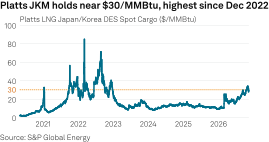
"The arbitrage to send cargoes to Asia from West Africa and the US is shut at the moment. Europe will need to keep pulling marginal cargoes this winter," a Singapore-based source said.
Platts assessed the arbitrage to send cargoes to north Asia from West Africa and the US Gulf Coast via the Cape of Good Hope as closed at minus 0.2 cent/MMBtu and minus 88.2 cents/MMBtu, respectively, Nov. 12, after accounting for two-stroke vessel freight costs and carbon charges, favoring delivery to the Atlantic basin.
However, the JKM-TTF spread could widen as the JKM pricing period rolls into January, potentially allowing marginal cargoes to flow to Asia amid uncertainty over weather and the potential for cold spells in Northeast Asia, an Atlantic-based source said.
"The December-January structure could change. January is the peak peak," the same source added.
If Russian LNG that had been destined for the EU is redirected to third-country markets such as China, this could ease demand for non-Russian cargoes in Asia to some extent, the Asian market source said.
"However, particularly for shipments from the Russian Arctic to Asia, there are constraints related to vessel availability and shipping routes," the source said, adding that it would be difficult for all of the volumes previously destined for Europe to be redirected to Asia in the short term.
Yamal LNG
The impact of the EU's ban is primarily centered around Russia's Yamal LNG flows for winter, as Yamal exports to Europe have been strong due to trade flow restrictions in the Strait of Hormuz and the Red Sea, CERA's Yep said.
"However, this trade flow is expected to see a fundamental shift as the majority of Yamal LNG volumes that average around 20 million mt/year of LNG are redirected to Asia after Jan. 1," Yep said.
"This substantial volume needs to find alternative markets and will trigger a major shift in trade flows — Europe will need to attract a higher share of flexible supply and Yamal LNG will have to find a home in markets like China," he said.
A Singapore-based trader said Russian LNG cargoes will flow to Asia after January, but the supply may decline as Yamal LNG cargoes cannot be transported via the Northern Sea Route during winter.
"Yamal volumes are entering China. Several Chinese companies have already secured Yamal cargoes on a spot basis and are marketing these volumes downstream for delivery early next year. We are still discussing a long-term contract with them," said a source with a China-based company.
Demand key
Despite the EU ban on Russian LNG imports, market sources in Asia said winter and actual demand situations determine actual trading flows after January.
"Assessing the actual impact will require a comprehensive examination of factors including temperatures in Europe and Northeast Asia, European gas storage levels, supply conditions from the Middle East and North America, and the extent to which Russian LNG is redirected to third-country markets," said the Asian market source.
EU-wide gas storage was 71.25% full as of Nov. 12, according to the latest data from Gas Infrastructure Europe.
Asked about the impact of its Russian LNG import ban on European gas and LNG requirements for this winter, the EC spokesperson said, "Security of supply in the EU remains stable. Our main concern is the currently very high prices due to geopolitical events."
"We keep monitoring the situation very closely, but we are confident that we are well placed."
"There is less gas demand and more import flexibility than 5 years ago. And our infrastructure is resilient enough to increase LNG imports and meet winter demand," the spokesperson said.
"To ensure we are better prepared for future challenges, we are revising the EU energy security framework covering oil, gas and electricity based on lessons learned from the current and past crisis. These proposals are foreseen to be adopted in December," the spokesperson added.
The El Niño weather pattern is expected to reach its peak by the first half of winter and continue through spring 2027 with a 100% probability, the Japan Meteorological Agency said Nov. 10 in its latest monitoring and outlook.
The El Niño has been watched as among the market-moving factors for this winter, as it typically results in warmer-than-usual weather in Japan and other parts of Asia.
