Natural Gas, LNG
November 10, 2026
Germany risks gas supply gap if winter proves extremely cold: INES
By Matt Hoisch
Editor:
HIGHLIGHTS
Warns of monthly shortfall as high as 6.6 TWh
Says supply secure under normal conditions
Urges further incentives, mandates to spur stocking
Germany risks natural gas supply shortfalls this winter if temperatures prove extremely cold due to lagging gas storage levels, industry group INES said Nov. 10, while also arguing for additional measures to spur gas storage.
"Low gas storage levels pose a significant risk to security of supply," INES Managing Director Sebastian Heinermann said in a statement on the release of the group's latest bimonthly gas scenarios report update. "Germany needs a reliable long-term framework that makes it economically viable to maintain sufficient gas volumes for the winter and ensures that these volumes are secured through binding measures."
The group's modeling shows very cold weather could leave some gas demand unmet across the first three months of 2027, INES said in the Nov. 10 statement. Shortfalls could reach up to 6.6 terawatt-hours (624 million cubic meters) in one month, and as much as 1.7 TWh on individual days in January, the group explained.
"On particularly cold days, gas demand significantly exceeds the volumes that can be supplied through ongoing pipeline imports and LNG terminals alone," INES said. "Gas storage facilities are therefore indispensable for meeting short-term peaks in demand."
The group also stressed that there must be adequate storage throughout the winter to ensure sufficient withdrawal capacity.
"If storage levels fall too far or too quickly, the available withdrawal capacity may no longer be sufficient to meet peak demand, particularly toward the end of winter," it said.
Under normal winter conditions, German gas supply is secure, INES modeling showed.
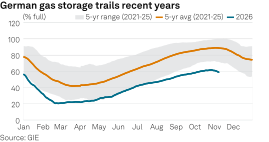
The warning comes with German gas storage just 59% full as of Nov. 8, according to the latest data from Gas Infrastructure Europe. At the same time last year, stores were filled to 74.9%, per GIE.
Europe's largest economy, which also boasts the EU's largest gas storage capacity, missed a domestic target this year to fill storage sites to 70% on average by Nov. 1.
Further measures
INES urged Germany to develop further measures to spur gas storage filling amid the shortfall in gas storage.
The group highlighted two approaches: a scheme to compensate players for the difference between market prices and gas storage costs, and a requirement for market participants to use storage sites.
Germany has already pledged to develop a 24 TWh strategic gas reserve to safeguard supply security during acute disruptions. But it does not expect to start stocking those volumes until summer 2027.
The country has struggled to fill storage this year amid persistent backwardation that has sapped the financial incentive for market players to store gas in warmer months to sell for a profit in colder ones.
"The low storage levels demonstrate that existing market mechanisms do not reliably ensure adequate winter preparedness," INES stressed Nov. 10.
Platts, part of S&P Global Energy, assessed the month-ahead German THE gas price at €83.23/megawatt-hour on Nov. 9, a premium of €1.43/MWh against the Q1 2027 assessment.
German gas market area manager Trading Hub Europe, or THE, recently sought to mitigate some supply risk via long-term options to source gas across the first quarter of 2027. It covered almost all the demand it tendered for.
The government has also taken other measures to bolster gas supplies. In September, Berlin ordered state-owned energy player SEFE to stock a further 8 TWh of gas by the middle of December.
