Natural Gas, LNG
October 19, 2026
INFOGRAPHIC: JKM stays anchored to LNG fundamentals amid 2026 supply shocks
By Ying Ting Lew, Gwen Teo, and Shuocheng Ni
Editor:
HIGHLIGHTS
JKM movements reflect Asia LNG disruptions
Oil and gas hub prices diverge from LNG
Forward JKM volatility remains below TTF
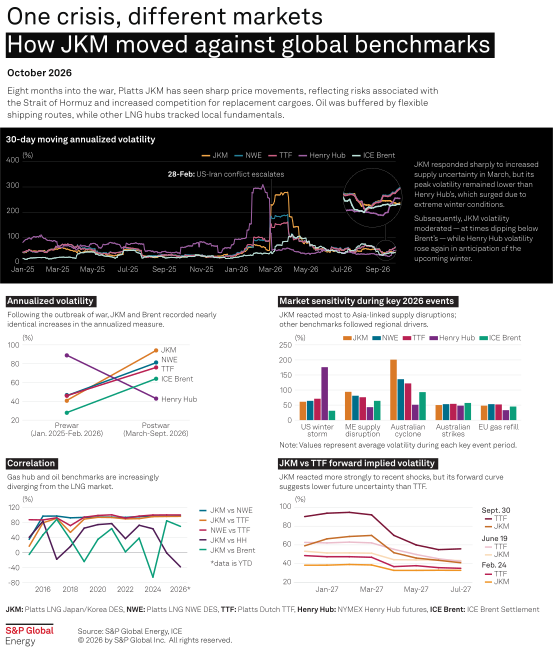
JKM's reaction to 2026 market disruptions underscores its role as a benchmark closely tied to physical LNG market fundamentals. Volatility was strongest during events that directly affected LNG supply and trade flows into Asia. During Middle East supply disruptions over March-September 2026, JKM volatility averaged 94%, compared with 81% for NWE, 76% for TTF, 64% for Brent and 43% for Henry Hub.
JKM's annualized volatility rose from 41% over January 2025-February 2026, while Brent's increased from 28% during the same period.
However, JKM's forward curve suggests a faster normalization of market expectations.
As of Sept. 30, implied volatility for JKM winter 2026-27 contracts stood at 59%-70%, compared with 90%-95% for TTF. The gap suggests participants see less uncertainty in longer-dated Asian LNG pricing than in Europe, despite heightened prompt-market risks.