LNG, Natural Gas
September 05, 2025
Europe LNG trades with Platts NWE vs TTF floating price mechanism gain traction
HIGHLIGHTS
Traders using Platts NWE vs Dutch TTF futures for spot trades, strip deals
Formula protects against risk of fixed discounts vs TTF using Platts NWE
Market anticipates financial liquidity for NWE to pick up
European LNG traders are moving toward linking contracts to the floating price difference between LNG cargoes and pipeline gas to better manage market risks associated with fixed price discounts, multiple market sources told Platts, part of S&P Global Energy.
Companies are employing the Platts Northwest Europe Marker in LNG term sheets and strip contracts -- referencing the floating price published by Platts for a half month against its differential to the Dutch TTF futures, sources said.
Effectively, this formula keeps the discount to TTF floating while negotiating an LNG deal for cargoes delivered to Northwest Europe.
Traders said that the risk posed by a moving LNG discount value to the European gas hub price can be effectively managed by using an LNG benchmark that reflects market dynamics such as the Northwest European marker published by Platts.
As a result, market participants started using the half-month and full-month prices of the Northwest Europe Marker, assessed by Platts against the Dutch TTF values for reference in negotiating a deal.
Further, with growing confidence in the successful usage of Platts NWE in such deals, the mechanism is now also used successfully in signing strip contracts, with one such trade having occurred this quarter, traders said.
"Nobody can manage the [LNG-TTF] differential even if you have a flood of cargoes, so having an NWE benchmark is key," an LNG trader said.
"You have, [let's] say, a discount to Gate, but then cargoes flood the market and the LNG-TTF fluctuates so much so [that] you may have to divert. and you don't know where it will go. So having your NWE-TTF will add a key floating component," the trader added.
Risk with fixed discounts
Given the robust liquidity of the Dutch TTF futures in the European market, market participants typically trade the LNG being delivered to Europe at a discount to the Dutch TTF futures.
However, the value of these discounts is influenced by the regasification capacity available, the variable costs at these different European terminals and the spread between the different gas hubs within Europe that trade either at a flat price or as a spread to the Dutch TTF futures. Furthermore, the discounts are in a big way influenced by the competition for cargoes between Europe and Asia.
Traders take stock of whether the cargoes loaded in the Pacific basin should be directed to Europe or Asia by referring to and trading the JKM/TTF spread.
While the JKM-TTF spread is used as an indicator of possible arbitrage between Atlantic and Pacific markets, the two benchmarks are far from identical. The price gap captures multiple dimensions at once: delivery periods, product specifications and volumes, and geography -- with TTF tied to Europe's pipeline gas and JKM reflecting LNG cargoes into Asia.
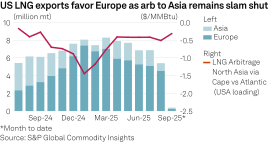
As Europe's LNG market matures, focus is shifting toward the Platts NWE-JKM spread. Unlike JKM-TTF, this comparison looks exclusively at LNG in both Northwest Europe and Asia. By stripping out timing and product mismatches, it isolates the pure locational difference that traders are most interested in managing.
"JKM/TTF does not reflect the waterborne cargo market; you're looking at European gas versus Asian LNG in this case," an Atlantic-based source said. "With how quickly the arbitrage can open and close, sometimes even on a daily basis, JKM/NWE is what the market should be looking at."
Even when traders lock in the JKM/TTF spreads, European traders are exposed to the moving discount to the gas hub prices.
For instance, if a trader was considering locking in an October trade on Aug. 1 for cargo delivered to NWE in the first half of October, the spread between October Dutch TTF Futures and the LNG price was near 49.5 cents/MMBtu, as per the Platts assessment.
However, on Sept 2, due to changing sentiment, the discount for October H1 against October TTF was assessed at 65 cents/MMBtu. For a buyer, that is a mark-to-market loss of around $542,500.
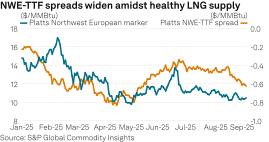
In a strip contract with a fixed discount against TTF, the value of the cargo changes with changing dynamics of the JKM/TTF spread and the inter-European gas hub spreads.
So, by pegging the discount of TTF to Platts Northwest Europe Marker, the seller protects the risk of tightening discounts to TTF if NWE rises against TTF and vice versa for the buyers who protect their risk of widening discount to TTF futures.
"Platts NWE is the key to help achieve a floating component as it is that spread to TTF that is unhedgeable," another trader said.
Hedging strategy
Companies could hedge the discount to TTF by taking a cross-market exposure against Dutch TTF futures and the Platts NWE by selling one of the futures and buying the other depending on whether the risk is of the spread narrowing or widening and the overall risk management strategy of each company.
So, for example, if a buyer was worried that the TTF versus NWE spread could widen, the company could essentially purchase the futures of one of the futures while simultaneously selling the futures of another, thereby locking the spread.
Market participants acknowledge that the inertia involved in moving away from the highly liquid TTF derivatives and improving the liquidity on NWE derivatives might be challenging. The derivatives have not traded on an exchange since the 785 lots traded by Vitol and TotalEnergies in 2023 and cleared on the Chicago Mercantile Exchange.
Further, the different costs and gas hub prices associated with each terminal in Europe add another layer of complexity to the hedging strategy, weighing on the decision to hedge the Dutch TTF versus NWE spread.
"The thing is that if you lock TTF versus NWE then also it may not be perfect because each terminal has different breakeven considerations," another trader said.
The Platts NWE marker is increasingly being used in pre-deal negotiations and is gaining adoption in short- to mid-term deals in Europe. Market participants, including downstream buyers and trading houses, are showing more interest in using the marker alongside Dutch TTF futures. Traders note that as more companies reference NWE in their term sheets, participation could increase, improving liquidity and reinforcing its role in the market.
Platts assessed the DES Northwest Europe Marker for October at $10.475/MMBtu, discount of 62.5 cents/MMBtu to October Dutch TTF futures on Sept. 4.
