Natural Gas
August 26, 2025
EU gas storage passes baseline 75% filling threshold
By Matt Hoisch and Nikita Pravilshchikov
HIGHLIGHTS
Level marks theoretical minimum under revised EU regulation
Market participants more concerned with hitting higher targets
Storage levels down on year but recent injection rates remain elevated
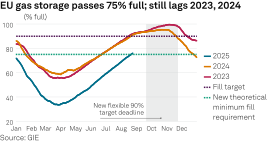
EU gas storage has surpassed 75% full, bringing stocks past the theoretical minimum for filling requirements outlined in the Union's revised storage regulation, according to data from Gas Infrastructure Europe.
Storage was at 863.6 TWh (81.6 Bcm), or about 76% full, as of Aug. 24, GIE data showed. The Union passed the 75% threshold on Aug. 21.
However, market participants see the benchmark more as a symbolic milestone than a firm accomplishment.
"What people are looking at is the end of October level," one analyst told Platts. "I wouldn't read too much into this 75% because I think it's more or less factored in."
A second analyst likewise does not see the recent marker as a noteworthy level. "75% is quite vulnerable," he said.
On Aug. 7, analysts from S&P Global Energy projected that EU storage levels will reach 86% capacity by Nov. 1, a 2% downward revision from their earlier forecast of 88%.
Revised storage regulation
Under the new regulation—which received a final necessary affirmative vote from the EU Council in July—storage targets are more flexible. Member states still have to hit a 90% filling target, but the new rules allow for a broader deadline of Oct. 1 to Dec. 1, rather than the previous hard Nov. 1 deadline.
However, there is also leeway with the potential to allow for filling as low as 75%.
The amended regulation permits member states to deviate by up to 10 percentage points from the 90% filling target in the event of "difficult" market conditions; on top of that, the European Commission can further increase the deviation by another five percentage points under a delegated act for one filling season if these market conditions persist.
While the adjusted storage regulation has been approved by both the EU Council and Parliament, it will only enter into force the day after its publication in the EU's Official Journal. A council spokesperson told Platts on July 15 that the publication in the journal was expected in September.
'We don't have enough margin here'
Market participants have shown limited concern around recent EU storage efforts, despite levels sitting at their lowest point relative to the same time in recent years.
This time last year, storage had reached 91.29% full. In 2023, the figure was 91.82%.
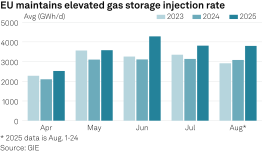
Injection rates, however, have continued to exceed past years' levels. Since the start of August, EU storage injections have averaged just under 3,800 GWh/ day, GIE data show. That is over 23% higher than the average of some 3,084 GWh/day in August 2024 and over 30% more than the roughly 2,916 GWh/ day injected on average in August 2023.
Still, it is uncertain whether the elevated rate can continue. A wave of planned maintenance on the Norwegian Continental Shelf's gas infrastructure is set to ramp up over the coming days, tempering flows from the EU's primary supplier of piped gas.
While the turnarounds have been widely anticipated and are understood to be priced in, market participants will monitor whether they end on time.
Maintenance overshooting by three to seven days could be a "really critical" setback for the EU's storage efforts, according to a third analyst. "We don't have enough margin here," he said.
In Germany, the recent failed allocation of Rehden storage by SEFE has also added uncertainty to the feasibility of hitting the higher targets, according to a European gas broker.
The 44.7 TWh Rehden site was filled to just 22.22% as of Aug. 24, GIE data show.
"I feel that they [Germany's gas market manager Trading Hub Europe] will just be satisfied with the filling level that will be achieved for now, which should be decent in the presence of continual LNG imports," a European gas trader said.
Beyond the regulatory targets, demand is another unknown. "We don't know if the winter will be colder or milder than last winter," the third analyst said. "Going with lower gas [levels] than last year in the gas storage is also a risk that maybe the market is not really talking about too much."
Platts, part of S&P Global Energy, assessed the TTF front-month gas price at Eur33.365/MWh on Aug. 22, up 0.7% on the day.
The monthly average of the spot price is down about 10% year on year. In the month to Aug. 22, the front-month price averaged Eur32.894/MWh, compared with an average of about Eur36.523/MWh over the same period last year.