LNG, Natural Gas
August 19, 2025
ASIA LNG MOC: Sept JKM activity hits new heights as traders optimize positions

By Cindy Yeo
HIGHLIGHTS
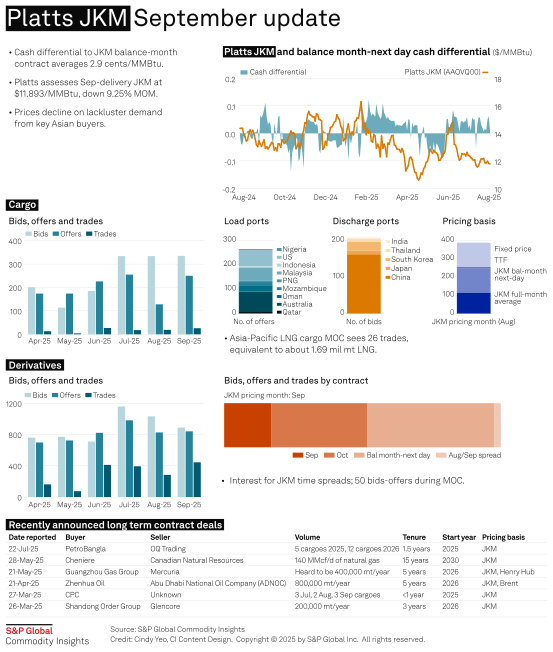
Some 1.69 million mt of LNG cargo traded in cargo MOC
Derivatives MOC reported 445 trades of 25 lots each
Sept JKM down 9.3% on weak buying from key importers
The Platts Market on Close assessment process for Asia's LNG physical market saw record-high activity during the September JKM pricing period as traders sought to optimize their positions in response to rising prompt demand.
A total of 611 market entries -- comprising 335 bids, 250 offers, and 26 trades -- were recorded for deliveries across H2 August, September and October, involving 25 participating entities.
This represented a 27% increase month on month and a 241% surge year on year, surpassing the previous record of 607 entries in July.
The majority of market activity centered around deliveries into the Japan-Korea-Taiwan-China (JKTC) region. Beyond this, 14 bids for deliveries into South Korea, two bids for Japan, three bids for Thailand, and six bids for deliveries into India were reported.
Among the 26 trades, which totaled approximately 1.69 million mt of LNG, Vitol emerged as the most active buyer, securing 13 cargoes. PetroChina followed with five, while BP and Shell each acquired two cargoes. CNOOC, Glencore, Trafigura, and QatarEnergy Trading each purchased one cargo.
On the sell side, Shell led with 13 cargoes, followed by PetroChina with three, and CNOOC and Glencore with two each. RWE, Six One Commodities, Tokyo Gas and Unipec each sold one cargo.
Of the trades concluded, 20 were fixed-price transactions, with first-half September deliveries averaging $11.866/MMBtu and second-half September averaging $11.49/MMBtu. The remaining six were linked to JKM BalMo-ND, September, and October contracts.
Overall, 65% of market activity was indexed to floating prices, mainly JKM full-month or BalMo, with 12 orders tied to Dutch TTF. JKM-linked bids and offers averaged parity against the JKM BalMo-ND contract and a 1.8 cents/MMBtu discount to October JKM.
In the derivatives MOC, activity remained robust with 2,177 bids, offers, and trades from 23 participants -- up 1.5% month on month and nearly 40% year on year. A total of 445 trades, equivalent to about 2.14 million mt of LNG, were reported across September, October, and BalMo-ND contracts.
JKM futures traded volume between July 16 and Aug. 15 totaled 101,292 lots (about 19.48 million mt, or 307 cargoes), with the MOC process accounting for nearly 11% of volumes.
Subdued buying interest from key Asian buyers weigh on prices
Platts assessed the September JKM at $11.893/MMBtu, marking a 9.3% drop month-on-month and 6.9% year-on-year. This drop was primarily attributed to subdued demand from key Northeast Asian importers, as alternative fuels became more economically viable.
Asian spot LNG prices fell despite supply-side risks following the magnitude 8.8 earthquake that struck off Russia's Kamchatka Peninsula July 29, leading to tsunami advisories and port closures across Northeast Asia, although traders reported minimal disruption to LNG flows, including from Russia's Sakhalin terminal.
Fundamentally, South Korean and Chinese importers remained largely on the sidelines, favoring alternative fuels such as coal and domestically trucked LNG, which offered more affordable options for power generation.
On the other hand, Japan drove spot demand as companies front-loaded inventories to prepare for weather-driven demand, actively balancing prompt purchases with forward sales. Gas utilities also engaged in optimization trades leveraging storage capacity and capitalizing on inter-month structures.
One trader noted that the prompt purchases done by Japanese companies were encouraging traders to optimize September positions, which contributed to the strong activity observed on the MOC.
"People have been optimizing... those with more shipping length can offer into H1 September and buy back H2 September," the trader said.
Meanwhile, the arbitrage for US cargoes coming to Asia was largely shut, with the Platts assessed East-West arbitrage for US-sourced cargoes averaging at minus 46 cents/MMBtu. Despite the arbitrage being closed on paper, around a quarter of the offers reported in the physical MOC had a US load port.
"The closed arb should not be too big of an issue for Asia. Previously some US cargoes were still coming in but now it is more obvious to go to Europe," another trader said.